


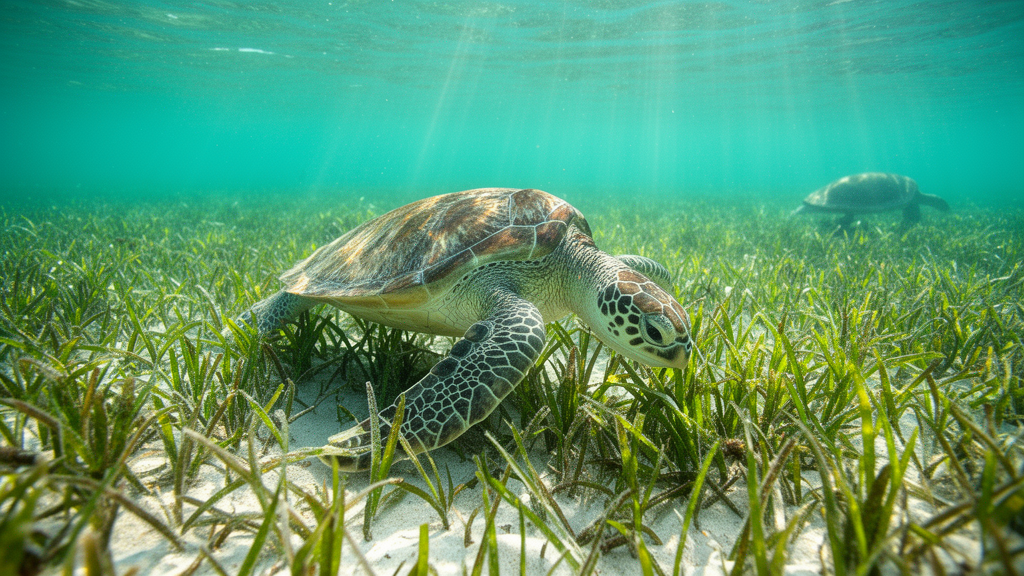
On a remote coral reef atoll in the Indian Ocean, roughly 2,100 kilometres northwest of mainland Australia, one of the world’s densest green turtle foraging populations is holding an entire seagrass ecosystem in a chokehold. New research from the Cocos (Keeling) Islands reveals that intensive turtle grazing has suppressed the meadows’ structural complexity and ecological functions to a fraction of their potential—yet when researchers gave the seagrass a reprieve from grazing for just over two years, the plants staged a dramatic comeback that offers both hope and a warning for conservationists worldwide.
The findings, published in a peer-reviewed study conducted at Edith Cowan University in collaboration with the local Cocos Malay community, demonstrate that the dominant seagrass species Thalassia hemprichii retains a remarkable capacity to rebuild its biomass, nutrient stores, and sediment-trapping functions once the relentless pressure of turtle herbivory is lifted. But the study also makes clear that under current grazing regimes, the seagrass meadows at Cocos (Keeling) are operating in a chronically resource-depleted state—one that could tip toward ecological collapse if additional stressors such as ocean warming, turbidity, or nutrient loading compound the existing herbivory pressure.
Green turtles (Chelonia mydas) have endured a turbulent history. Across the twentieth century, populations crashed due to overharvesting, habitat loss, and climate change. Following decades of dedicated conservation effort, the species is now generally increasing or stable across its global range—a rare and celebrated conservation success story. But that success carries consequences. As turtle numbers rebound, their role as ecosystem engineers reasserts itself, and the cascading effects on the seagrass meadows that sustain them are becoming increasingly apparent. Reports of intensive grazing impacts on tropical seagrass ecosystems have now emerged from Indonesia, India, Bermuda, the Caribbean, the United States, and Australia, presenting a new challenge for the simultaneous conservation of both turtles and their foraging habitat.
At the Cocos (Keeling) Islands, the situation is particularly striking. Unlike most green turtle populations, which suffered severe commercial exploitation, the CKI population was subject only to subsistence harvest from the time of settlement in the 1820s until the mid-1980s, after which harvesting declined to negligible levels. The population subsequently recovered to what long-term monitoring since 1999 has characterised as one of the highest densities of green turtle foraging aggregations recorded globally. Meanwhile, the seagrass meadows—known locally as ‘lumut’ in the Cocos Malay language—have suffered devastating losses. Researchers estimate that approximately 80 percent of seagrass was lost between 2006 and 2018, likely due to a combination of ocean warming, turbidity from coastal development, and persistent grazing pressure on the remaining meadows. Community members on the islands became increasingly concerned that intensive turtle grazing was preventing seagrass recovery, even though the plants remained persistent across the historical extent of the meadows in the lagoon, albeit at extremely low cover of just 1 to 5 percent compared to 10 to 75 percent in the 1990s.
To investigate whether the seagrass could recover its structure and functions if given relief from grazing, researchers deployed exclusion cages at two sites near Home Island (Pulu Kampong) in November 2021. The cages, constructed from galvanised steel mesh with 110 by 110 millimetre apertures, were designed to prevent access by green turtles and large fish whilst allowing smaller mesograzers to pass through. Four caged plots and four naturally grazed plots of equal size were established at each site, spaced at least three metres apart to ensure physiological independence. The rhizomes around the edges of each plot were severed with a shovel to prevent belowground connections between treatments. The cages were cleaned of biofouling every two to three months, and remained effective at excluding turtles and large fish for two years and three months—far longer than most previous herbivore exclusion studies, which rarely extended beyond a single year.
When the researchers harvested the seagrass in February 2024, the differences between caged and grazed plots were stark. Plants inside the cages had more than double the leaf area per shoot compared to those exposed to grazing, despite having a similar number of leaves per shoot at approximately three. At the meadow scale, the contrast was even more dramatic: caged plots held almost four times more shoots than grazed plots, with a leaf area index nine times higher. Aboveground biomass was approximately seven-fold greater in caged treatments, and belowground biomass was similarly seven-fold higher. Perhaps most tellingly, the ratio between aboveground and belowground biomass remained consistent between treatments, indicating that grazed plants were not strategically reallocating resources but were instead proportional miniatures of their protected counterparts—structurally similar but drastically scaled down.
The functional implications of these structural differences proved substantial. While the photosynthetic rate per standard leaf area did not differ between treatments, when scaled to the total leaf area per plot, caged seagrass achieved net photosynthetic rates more than twelve times higher than grazed plots. This finding suggests that the productivity of the meadow as a whole is severely compromised by grazing, even though individual leaves maintain their physiological capacity. Nutrient storage told a similar story: caged seagrass stored six-fold more nitrogen, seven-fold more carbon, and six-fold more phosphorus in leaf material compared to grazed plots. In rhizome tissues, the pattern was even more pronounced, with eight times more nitrogen and nine times more phosphorus stored in caged plants. These reductions represent a significant loss of the seagrass meadow’s capacity to act as a nutrient sink in the lagoon environment—a function that becomes increasingly critical as planned infrastructure development, including airport runway upgrades, threatens to elevate nutrient inputs to the already vulnerable ecosystem.
Sediment processes revealed more nuanced, site-specific responses. At one site, caged plots trapped significantly more fine silt-clay particles and very fine sand than grazed plots, likely driven by the greater seagrass abundance and biomass enhancing the capacity to attenuate water flow. At the more exposed second site, located closer to the inter-island channel, the grazed treatment had significantly lower organic matter content in surface sediments than caged plots, suggesting that seagrass plays a particularly important role in retaining organic material in locations subject to greater water movement. The researchers note that belowground biomass appears especially important for sediment stability, independent of the canopy above, and that its retention is essential for maintaining this ecological function.
Several plant-scale attributes appeared remarkably resilient to grazing pressure. Shoot growth rates, photosynthetic performance per unit leaf area, and the number of leaves per shoot showed no significant difference between caged and grazed treatments. This suggests that grazed plants retain the physiological machinery to continue growing even under chronic herbivory—a mechanism that may support rapid recovery once grazing pressure is reduced. However, the growth rates recorded in this study were substantially lower than those reported for Thalassia hemprichii elsewhere in the Indo-Pacific, raising questions about whether the comparatively low growth reflects a local characteristic of this remote population or a symptom of the broader resource-depleted state of the meadows.
The researchers caution that the caged and grazed treatments likely represent two points along a gradient of herbivory intensity rather than a binary contrast. Small or juvenile green turtles, with head widths of 61 to 139 millimetres, were likely capable of accessing seagrass around the inner perimeter of the cages—a behaviour confirmed through video footage in subsequent experiments. Evidence of cropped leaves was still observed within caged plots, though at roughly half the rate seen in grazed treatments. This means the caged condition represents a state in which seagrass can accumulate structural complexity and functional capacity with reduced, but not eliminated, grazing pressure. The broader ecosystem remains under substantial herbivory pressure, and the researchers emphasise that the condition of these meadows reflects the combined influence of turtle grazing alongside other co-occurring stressors including turbidity, thermal stress, and coastal development.
The study’s authors argue that these findings highlight the need for nuanced management strategies that can accommodate the inherently dynamic nature of turtle-seagrass interactions. Rather than viewing the relationship as simply good or bad, they frame tropical seagrass meadows as spatially and temporally dynamic systems existing along a continuum of seagrass abundance and grazing pressure. Effective management, they suggest, requires regular monitoring of seagrass condition, targeted interventions such as partial exclusion measures, minimisation of concurrent anthropogenic stressors on water quality, and the establishment of a carrying capacity for green turtles that accounts for the growth dynamics of Thalassia hemprichii in the local context. Without such approaches, the researchers warn that the system risks transitioning to a state where seagrass meadows—and the critical ecological, socioeconomic, and cultural services they provide to the Cocos Malay community—collapse entirely. The recovery of green turtle populations stands as one of marine conservation’s greatest triumphs, but this research makes clear that the next chapter of that story must be written with equal attention to the habitats that sustain both turtles and the human communities who share these waters.
Subject of Research: Green turtle herbivory effects on seagrass structure and ecosystem function at a remote coral reef atoll
Article Title: Turtle Herbivory Suppresses Seagrass Function but Reveals Recovery Potential in a Remote Coral Reef Atoll
Article References: O'Dea, C., McMahon, K., Macrae, O., Keegan, S., & Bell, S. (2026). Turtle Herbivory Suppresses Seagrass Function but Reveals Recovery Potential in a Remote Coral Reef Atoll. Ecology and Evolution, 16(10), Article e74466. https://doi.org/10.1002/ece3.74466
Image Credits: AI Generated
DOI: 10.1002/ece3.74466
Keywords: green turtles, seagrass, herbivory, Cocos Keeling Islands, Thalassia hemprichii, ecosystem function, conservation, nutrient storage, sediment trapping, exclusion experiment, tropical lagoon, marine ecology
Cite Scienmag News
Violet Maxwell. (October 26, 2026). Turtle Grazing Strips Seagrass Meadows to the Brink—but Two Years of Relief Reveals Startling Recovery. Scienmag. https://scienmag.com/turtle-grazing-strips-seagrass-meadows-to-the-brink-but-two-years-of-relief-reveals-startling-recovery/
Violet Maxwell. "Turtle Grazing Strips Seagrass Meadows to the Brink—but Two Years of Relief Reveals Startling Recovery." Scienmag, 26 October 2026, https://scienmag.com/turtle-grazing-strips-seagrass-meadows-to-the-brink-but-two-years-of-relief-reveals-startling-recovery/. Accessed 26 October 2026.
Violet Maxwell. "Turtle Grazing Strips Seagrass Meadows to the Brink—but Two Years of Relief Reveals Startling Recovery." Scienmag. October 26, 2026. https://scienmag.com/turtle-grazing-strips-seagrass-meadows-to-the-brink-but-two-years-of-relief-reveals-startling-recovery/


