


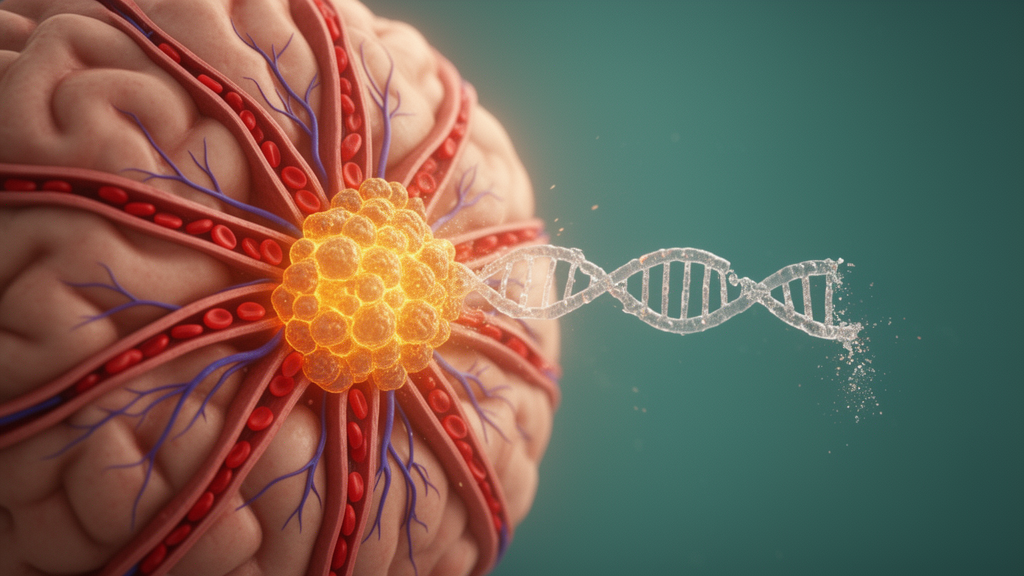
Loss of the CDKN2A and CDKN2B tumor suppressor genes appears to switch on a c-MET–dependent program that promotes blood vessel formation in IDH-mutant astrocytoma, according to a study published in the Journal of Translational Medicine. Diffuse gliomas are the most common primary malignant brain tumors and remain incurable, and standard therapy for high-grade disease has been essentially unchanged for more than two decades. The 2016 and 2021 WHO classifications separate IDH-mutant astrocytoma from IDH-wildtype glioblastoma and designate homozygous deletion of CDKN2A/B as a criterion for grade 4 IDH-mutant astrocytoma regardless of what the tumor looks like under the microscope. That molecular grading rule has sharpened the need for therapeutic strategies tailored to molecularly defined subgroups, and the new findings point to a specific signaling axis that may be druggable in this aggressive subset.
To identify pathways underlying molecular grade 4 behavior, the researchers analyzed IDH-mutant astrocytomas from The Cancer Genome Atlas, stratifying the tumors by CDKN2A/B status for pathway enrichment analysis. Tumors carrying the homozygous deletion showed enrichment of angiogenesis pathways, an association suggesting that the deletion is linked to a pro-vascular tumor environment. The team then turned to an independent cohort of 40 WHO grade 4 IDH-mutant astrocytomas. When these tumors were stratified by CDKN2A/B status and vascular density was quantified on available histopathologic sections, patient tumors harboring the deletion demonstrated increased vascular formation. The clinical association was consistent across both the large genomic dataset and the histology-based cohort, though the study design captures correlation rather than a demonstrated causal effect in patients.
To model the functional consequences of the deletion, the researchers used molecular grade 4 IDH-mutant astrocytoma cell lines engineered for tetracycline-inducible re-expression of the proteins encoded by the deleted region: p14ARF, p15INK4B, and p16INK4A. This inducible system allowed the team to switch the missing gene products back on and observe what changed. RNA sequencing of the engineered cells recapitulated the pathway enrichment pattern seen in patient tumors, and functional assays of angiogenic behavior mirrored the clinical observations. When the CDKN2A/B gene products were re-expressed, the cells secreted less vascular endothelial growth factor (VEGF) and less basic fibroblast growth factor (bFGF), two well-established drivers of new blood vessel growth.
The downstream effects were tested using conditioned media, the culture fluid in which tumor cells had been growing. Conditioned media from re-expression cells impaired endothelial angiogenic signaling, migration, and sprouting in vitro, and reduced vascular recruitment in vivo, compared with conditioned media from cells retaining the CDKN2A/B homozygous deletion. In other words, restoring the deleted gene products made the tumor cells less able to coax endothelial cells, the building blocks of blood vessels, into angiogenic behavior. The in vivo vascular recruitment models provided preclinical evidence that the angiogenic phenotype extends beyond cell culture, although such models cannot establish how the pathway operates in patients without therapeutic intervention.
Searching for the mediator of this phenotype, the team identified elevated c-MET expression and activity in CDKN2A/B-deleted tumors and cell lines. c-MET is a receptor tyrosine kinase, a cell-surface signaling molecule that can activate intracellular pathways when triggered, and its heightened presence in the deletion-harboring tumors marked it as a candidate link between the genetic loss and the angiogenic output. When the researchers inhibited c-MET, either with siRNA or with pharmacological inhibition, VEGF secretion in the IDH-mutant astrocytoma cells declined. The result held across both molecular tools, strengthening the case that c-MET activity contributes to the pro-angiogenic state rather than being a bystander of the deletion.
The most consequential comparison came from combining c-MET blockade with VEGF blockade. Conditioned media from IDH-mutant astrocytoma cells treated with c-MET inhibition, either alone or combined with VEGF inhibition, more effectively suppressed endothelial angiogenic function than conditioned media from cells treated with VEGF inhibition alone. This suggests that targeting c-MET may reach angiogenic signaling that VEGF-directed therapy alone does not fully cover, and that the two approaches could be complementary in this molecularly defined tumor subtype. The authors conclude that these findings identify c-MET as a novel therapeutic target in IDH-mutant astrocytoma with CDKN2A/B homozygous deletion and suggest that c-MET inhibition may exert anti-angiogenic effects in this aggressive form of the disease.
The study’s structure is notable for how it connects molecular classification to a measurable tumor feature. Because the WHO system now defines grade 4 IDH-mutant astrocytoma by the CDKN2A/B deletion itself, a patient’s tumor can be assigned to the most aggressive category on genetic grounds even when its appearance under the microscope is less alarming. The reported increase in vascular density among deletion-harboring tumors provides a histopathologic correlate of that molecular grade, and the enrichment of angiogenesis pathways in the TCGA analysis supplies a genomic correlate. The engineered cell lines then close the loop by showing that re-introducing the deleted gene products reverses the angiogenic phenotype in vitro and in vivo.
Several caveats frame the interpretation. The clinical data establish associations between the deletion, angiogenic pathway enrichment, and vascular density, not a proven causal chain in patients. The functional evidence comes from engineered cell lines, endothelial assays, and in vivo vascular recruitment models, which are preclinical systems. The article was shared as an accepted manuscript to provide faster access to peer-reviewed research; it is citable and carries a permanent DOI, but this version is subject to further edits and will be replaced by the final Version of Record. Whether c-MET inhibition can be translated into a clinical strategy for this subgroup will depend on future studies, but the work supplies a defined target, a defined patient population identified by a routine molecular diagnostic, and preclinical evidence that blocking the c-MET axis suppresses the angiogenic signaling that the deletion appears to unleash.
Subject of Research: CDKN2A/B homozygous deletion activates c-MET–dependent pro-angiogenic signaling in IDH-mutant astrocytoma, identifying c-MET as a potential therapeutic target in this aggressive glioma subtype.
Article Title: CDKN2A/B deletion activates c-MET dependent pro-angiogenic signaling in IDH-mutant astrocytoma
Article References: Grief, D., Stevens, E., Nascari, D., Loftus, J., Teixeira Yokoda, R., Tran, N. L., & Fortin Ensign, S. (2026). CDKN2A/B deletion activates c-MET dependent pro-angiogenic signaling in IDH-mutant astrocytoma. Journal of Translational Medicine. https://doi.org/10.1186/s12967-026-09128-4
Image Credits: AI Generated
DOI: 10.1186/s12967-026-09128-4
Keywords: IDH-mutant astrocytoma, CDKN2A/B deletion, c-MET, angiogenesis, VEGF, diffuse glioma, WHO grade 4, tumor suppressor genes, brain tumors, targeted therapy, CDKN2A, deletion
Cite Scienmag News
Juliet Wilcox. (October 26, 2026). Gene Loss Drives Blood Vessel Growth in Aggressive IDH-Mutant Astrocytoma. Scienmag. https://scienmag.com/gene-loss-drives-blood-vessel-growth-in-aggressive-idh-mutant-astrocytoma/
Juliet Wilcox. "Gene Loss Drives Blood Vessel Growth in Aggressive IDH-Mutant Astrocytoma." Scienmag, 26 October 2026, https://scienmag.com/gene-loss-drives-blood-vessel-growth-in-aggressive-idh-mutant-astrocytoma/. Accessed 26 October 2026.
Juliet Wilcox. "Gene Loss Drives Blood Vessel Growth in Aggressive IDH-Mutant Astrocytoma." Scienmag. October 26, 2026. https://scienmag.com/gene-loss-drives-blood-vessel-growth-in-aggressive-idh-mutant-astrocytoma/


