


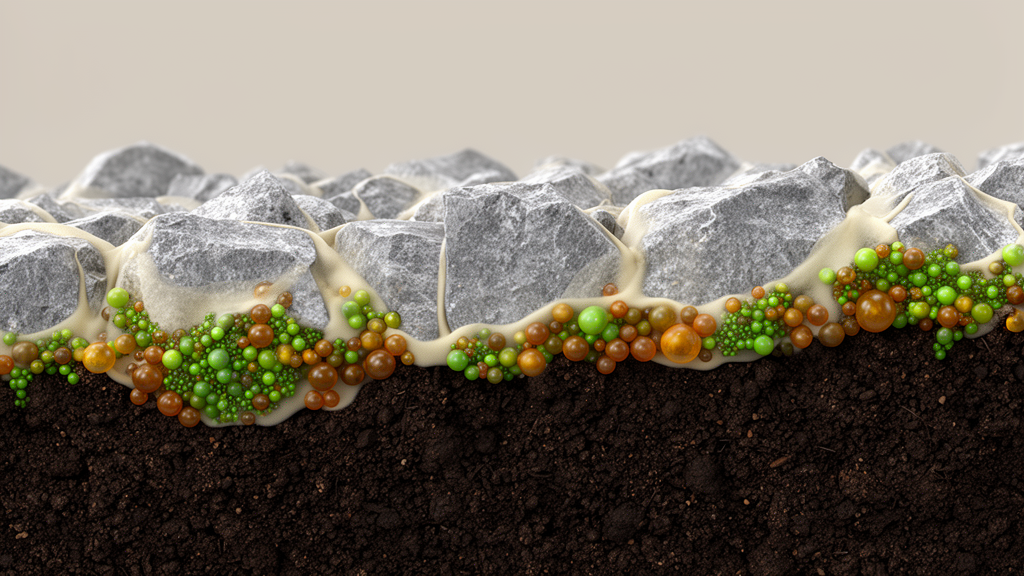
Carbonate rocks such as limestone and dolostone do more than draw down carbon dioxide as they dissolve. A new study published in National Science Review reports that the weathering of these rocks also promotes the accumulation of microbial necromass, the remains of dead microbes that make up a large share of soil organic carbon, and helps protect that necromass from decomposition. Soil organic carbon underpins climate regulation, nutrient cycling, water retention and biodiversity maintenance, and microbes sit at the center of its formation.
Microbes consume plant-derived carbon, grow and multiply, and leave their necromass behind when they die. Whether that necromass accumulates depends on two processes: how efficiently microbes convert carbon into new biomass, and how well their remains are shielded from further decomposition. Both processes are strongly shaped by soil conditions, which are in turn largely governed by the underlying bedrock.
Carbonate rocks underlie roughly 15 percent of Earth's ice-free land and dissolve at least ten times faster than many silicate rocks. Their weathering releases calcium and nutrients and alters soil acidity, influencing microbial activity and the binding of organic matter to minerals. Yet most research on carbonate weathering and carbon cycling has focused on carbon dioxide uptake during rock dissolution, leaving its effects on soil organic carbon less well understood.
To close that gap, the team analyzed 466 observations of forest topsoils worldwide, using amino sugars as biomarkers of microbial necromass. Soils in karst landscapes, which are shaped by the dissolution of carbonate rocks, contained 43.4 percent higher amino sugar concentrations and 57.6 percent higher organic carbon concentrations than non-karst soils. Field surveys across six regions of southwestern China reinforced the global pattern.
Karst soils held 19.3 percent more amino sugars per unit of organic carbon than non-karst soils, and within the karst sites the carbonate rock weathering rate was the strongest measured predictor of microbial necromass accumulation. Faster weathering was also associated with more microbial genes for breaking down complex plant compounds, including lignin, and the soils showed evidence of more extensive lignin degradation. Together, these findings suggest that carbonate rock weathering promotes microbial processing of plant-derived carbon.
The laboratory experiments then tested the mechanism under controlled conditions. The researchers added powdered limestone to soils and compared the results against a quartz control, with separate additions of water, glucose or glycine. Limestone addition raised soil pH and calcium availability and increased the activity of enzymes linked to the breakdown of complex organic matter.
By tracing carbon from glucose and glycine labeled with carbon-13, the team found that limestone addition increased the efficiency of carbon accumulation in microbial necromass by 22 percent to 71 percent, depending on the compound. The study also identified a mechanism for the longer-term protection of that carbon. Karst soils had 57.8 percent higher concentrations of amino sugars bound to minerals than non-karst soils, and the abundance of these mineral-bound necromass markers was closely linked to specific forms of calcium.
Calcium can help organic matter attach to mineral surfaces, making it harder for microbes to access and decompose. This mineral protection offers an explanation for the greater retention of microbial necromass in karst soils and links the geochemistry of rock dissolution to the physical stabilization of organic carbon. Taken together, the findings show that carbonate rock weathering supports both the formation and the protection of microbial-derived carbon, a role that extends beyond its well-documented function in inorganic carbon uptake during rock dissolution.
The authors suggest that including rock type and weathering rates in soil carbon models could improve predictions of where organic carbon accumulates and how long it persists in landscapes. The results also provide a basis for testing whether enhanced carbonate rock weathering could help soils retain more organic carbon. Peilei Hu of the Institute of Subtropical Agriculture is the first author of the paper, with Wei Zhang and Kelin Wang as corresponding authors, and the work was supported by the National Natural Science Foundation of China and the Guangxi Bagui Young Scholars Program.
Because the evidence spans global observational datasets, regional field measurements and controlled incubations, the laboratory treatments simulate weathering effects rather than reproducing full field conditions, and the field associations identify weathering rate as the strongest measured predictor rather than proving causation on their own.
Subject of Research: How carbonate rock weathering promotes the formation and mineral protection of microbial necromass in soils
Article Title: How carbonate rock weathering helps soil hold on to carbon
Article References: How carbonate rock weathering helps soil hold on to carbon. Original publication (Bibliographic details unavailable.)
Image Credits: AI Generated
DOI: Not provided
Keywords: carbonate rock weathering, soil organic carbon, microbial necromass, karst landscapes, calcium, mineral-associated organic matter, amino sugars, lignin degradation, carbon cycling, National Science Review, limestone, carbon sequestration
Cite Scienmag News
Morgan Morrow. (October 26, 2026). Carbonate rock weathering builds and shields microbial carbon in soils. Scienmag. https://scienmag.com/carbonate-rock-weathering-builds-and-shields-microbial-carbon-in-soils/
Morgan Morrow. "Carbonate rock weathering builds and shields microbial carbon in soils." Scienmag, 26 October 2026, https://scienmag.com/carbonate-rock-weathering-builds-and-shields-microbial-carbon-in-soils/. Accessed 26 October 2026.
Morgan Morrow. "Carbonate rock weathering builds and shields microbial carbon in soils." Scienmag. October 26, 2026. https://scienmag.com/carbonate-rock-weathering-builds-and-shields-microbial-carbon-in-soils/


