


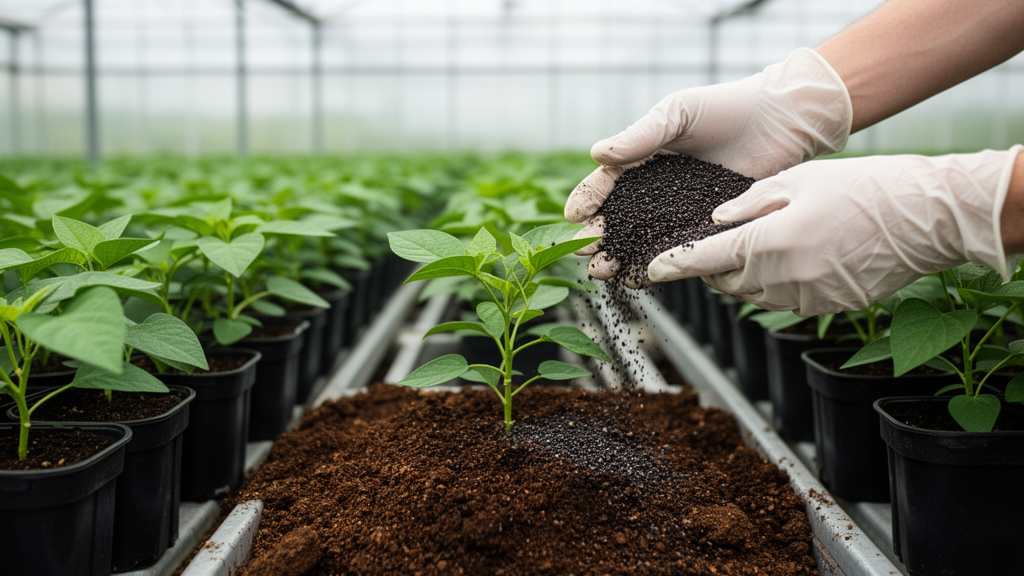
A greenhouse study reports that the rhizospheric fungus Aspergillus terreus substantially reversed the growth and biochemical damage that lead inflicts on red bean plants (Phaseolus vulgaris L.). Researchers isolated the fungus from the root zone, designated it isolate F2, and applied it as a spore suspension to plants grown in soil spiked with lead acetate at two concentrations, 25 and 75 parts per million. The experiment followed a completely randomized block design with three replicates, and the results were published in Environmental Science and Pollution Research on 26 October 2026.
Without the fungus, lead stress took a heavy toll on the plants. At the higher concentration of 75 ppm, shoot length fell by up to 43 percent and dry weight by up to 37 percent, while root length and fresh weight declined by up to 24 percent and 34 percent, respectively. The photosynthetic pigments were also strongly affected: chlorophyll a, chlorophyll b, carotenoids, and xanthophylls dropped by approximately 24 to 58 percent under lead stress, with the greatest reductions recorded for chlorophyll b and carotenoids at the 75 ppm level.
The biochemical profile of the stressed plants changed in parallel. Levels of secondary metabolites, including flavonoids and phenolics, increased as a stress response, while soluble sugars became considerably reduced. Lipid and proline levels were elevated under lead stress, which the study reports as evidence of oxidative damage and osmoregulatory processes. Inoculation with A. terreus considerably reversed these effects: growth parameters, pigment levels, and metabolic balance were restored in the fungus-treated plants compared with lead-stressed plants left uninoculated.
The researchers confirmed that the fungus colonized the root sections using lactophenol cotton blue staining and light microscopy. The isolate itself was identified molecularly through ITS rDNA sequencing and phylogenetic analysis performed with the MEGA-11 software. To quantify how distinctly the treatments differed, the team applied multivariate techniques, including principal component analysis, hierarchical clustering, Pearson correlation, and treatment profile radar charting, across all 15 measured variables. The first two principal components together explained 73.3 percent of the total variance, and chlorophyll a, fresh weight, and soluble sugars emerged as the best distinguishing variables between treatment groups.
The authors conclude that A. terreus is an ideal bioinoculant for reducing lead phytotoxicity and a viable, environmentally friendly approach to the bioremediation of heavy metal-contaminated farm soils. However, they flag a significant limitation: because lead concentrations in plant tissue and soil were not measured in this study, direct evidence of lead immobilization or removal remains to be established in future work. The findings therefore demonstrate that the fungus alleviates the physiological and biochemical symptoms of lead stress in red bean under greenhouse conditions, while the question of whether it immobilizes or removes the metal remains open.
The scope of the evidence is also worth keeping in perspective. This was a greenhouse experiment with a single crop species, two lead doses, and three replicates per treatment, so the results describe controlled conditions rather than field performance. The authors position the study as identifying A. terreus as an effective bioinoculant against lead-induced physiological and biochemical stress in Phaseolus vulgaris L., with direct measurements of lead in plant tissue and soil named as the remaining step for future studies.
Subject of Research: Rhizospheric fungus Aspergillus terreus mitigates lead (Pb) toxicity in red bean (Phaseolus vulgaris L.) by modulating growth, photosynthetic pigments, and biochemical stress markers
Article Title: Rhizospheric fungus Aspergillus terreus mitigates lead (Pb) toxicity in red bean (Phaseolus vulgaris L.) by modulating growth, photosynthetic pigments, and biochemical stress markers
Article References: Jani, A., Dilawar, N., Rahman, A., Bashir, H., Wazir, K., Wahab, H., Khan, R., & Ullah, S. (2026). Rhizospheric fungus Aspergillus terreus mitigates lead (Pb) toxicity in red bean (Phaseolus vulgaris L.) by modulating growth, photosynthetic pigments, and biochemical stress markers. Environmental Science and Pollution Research. https://doi.org/10.1007/s11356-026-38331-5
Image Credits: AI Generated
DOI: 10.1007/s11356-026-38331-5
Keywords: Rhizospheric, fungus, Aspergillus, terreus, mitigates, lead, toxicity, bean, Phaseolus, vulgaris, modulating, growth
Cite Scienmag News
Roger Howard. (October 26, 2026). Soil fungus eases lead stress in greenhouse-grown red bean plants. Scienmag. https://scienmag.com/soil-fungus-eases-lead-stress-in-greenhouse-grown-red-bean-plants/
Roger Howard. "Soil fungus eases lead stress in greenhouse-grown red bean plants." Scienmag, 26 October 2026, https://scienmag.com/soil-fungus-eases-lead-stress-in-greenhouse-grown-red-bean-plants/. Accessed 26 October 2026.
Roger Howard. "Soil fungus eases lead stress in greenhouse-grown red bean plants." Scienmag. October 26, 2026. https://scienmag.com/soil-fungus-eases-lead-stress-in-greenhouse-grown-red-bean-plants/


