


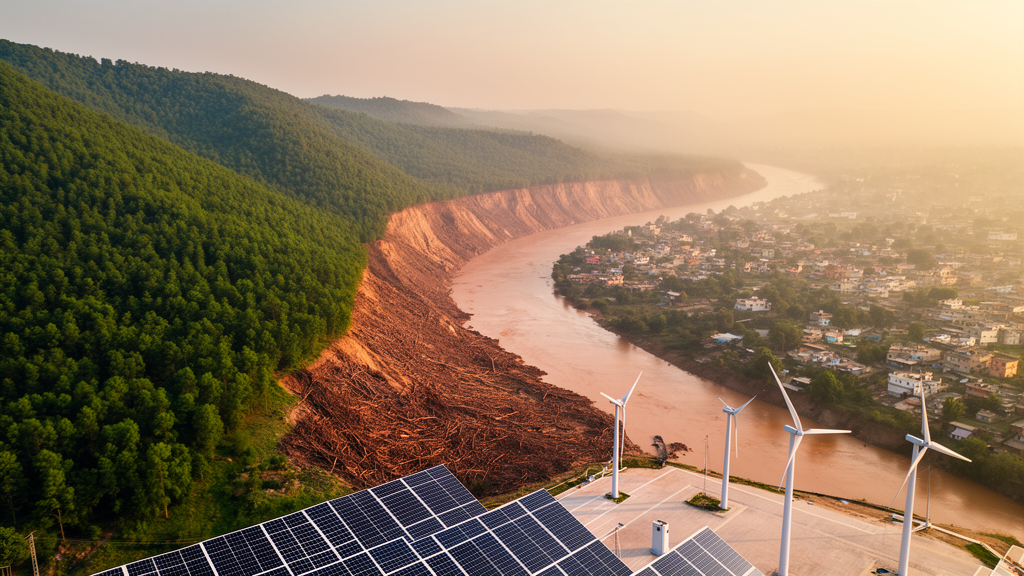
A study published in Theoretical and Applied Climatology reports that the relationships between international clean energy finance, human capital development, deforestation and the frequency of climate-related disasters in Pakistan are nonlinear and asymmetric. Sadia Bano and Anwar Khan analyzed quarterly data spanning 2001 to 2024 using a newly developed Kernel-based Regularized Quantile Regression, or KRQR, to estimate how these drivers relate to disaster frequency across the distribution of outcomes.
The estimated coefficients varied widely across the distribution. For clean energy finance and total natural disasters, coefficients ranged from -0.8 to 0.8, and for deforestation and disasters the range was -0.6 to 0.6. The link between human capital development and disasters was markedly wider, spanning -10 to 5, indicating substantial heterogeneity in how that relationship behaves across quantiles.
The asymmetries extended beyond individual variables. The study found asymmetric effects in the joint impacts of clean energy finance with deforestation on disasters and with human capital development on disasters, as well as in the synergistic effect of the three-way interaction of clean energy finance, deforestation and human capital development on disaster frequency. The authors describe these joint and synergistic effects as indicating substantial impacts on higher frequencies of natural disasters.
To assess stability, the researchers performed robustness checks using KRQR-estimated average marginal effects. These checks revealed a similar pattern for the majority of the linkages, highlighting significant heterogeneities across the selected variables. The study’s scope is the Pakistani context over the 2001 to 2024 period, and its stated aim is to identify drivers that enhance communities’ resilience to natural disasters.
Based on these outcomes, the authors suggest that policymakers in Pakistan should consider the asymmetries in the relationships among the variables, prioritize expanding access to clean energy in areas of urgent need, and educate people about plantation drives that can yield fruitful outcomes to enhance climate resilience across communities.
Subject of Research: Asymmetric effects of clean energy finance, human capital development and deforestation on climate-related disasters in Pakistan
Article Title: Discovering the synergistic impacts of clean energy finance, human capital development, and deforestation on climate-related disasters in Pakistan
Article References: Bano, S., & Khan, A. (2026). Discovering the synergistic impacts of clean energy finance, human capital development, and deforestation on climate-related disasters in Pakistan. Theoretical and Applied Climatology, 157(11), Article 749. https://doi.org/10.1007/s00704-026-06670-5
Image Credits: AI Generated
DOI: 10.1007/s00704-026-06670-5
Keywords: clean energy finance, human capital, deforestation, climate disasters, Pakistan, quantile regression, climate resilience, asymmetric effects, Discovering, synergistic, impacts, clean
Cite Scienmag News
Faith Mcneil. (October 26, 2026). Clean Energy Finance, Deforestation and Disaster Risk Show Asymmetric Links in Pakistan. Scienmag. https://scienmag.com/clean-energy-finance-deforestation-and-disaster-risk-show-asymmetric-links-in-pakistan/
Faith Mcneil. "Clean Energy Finance, Deforestation and Disaster Risk Show Asymmetric Links in Pakistan." Scienmag, 26 October 2026, https://scienmag.com/clean-energy-finance-deforestation-and-disaster-risk-show-asymmetric-links-in-pakistan/. Accessed 26 October 2026.
Faith Mcneil. "Clean Energy Finance, Deforestation and Disaster Risk Show Asymmetric Links in Pakistan." Scienmag. October 26, 2026. https://scienmag.com/clean-energy-finance-deforestation-and-disaster-risk-show-asymmetric-links-in-pakistan/


