


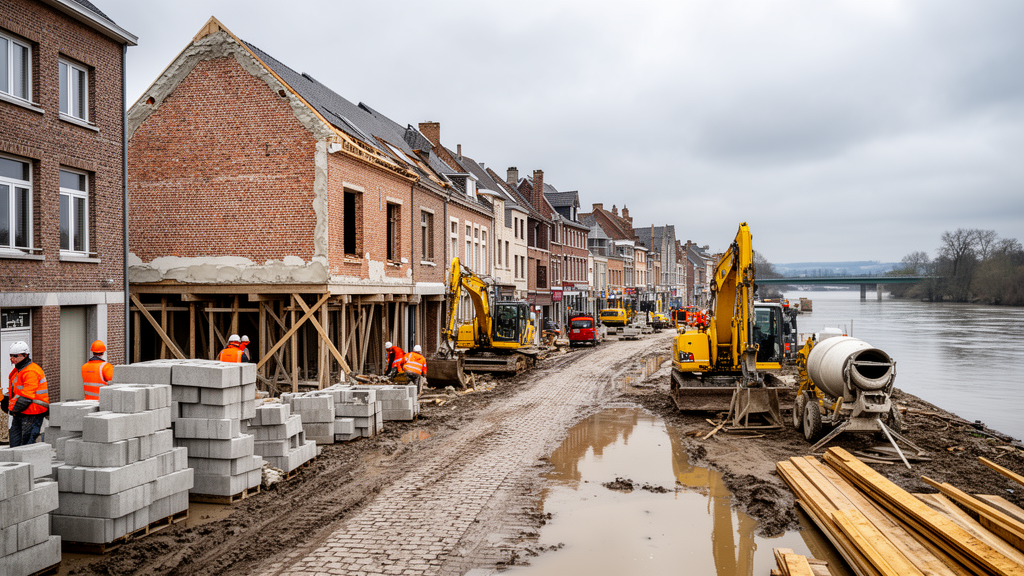
Floods across Europe could force the replacement of roughly 30 million tonnes of building materials every year under current conditions, generating about 9 million tonnes of carbon dioxide equivalent in emissions, according to a study published in Nature Communications. The research is among the first to quantify both the material demand and the greenhouse gas emissions tied to repairing and rebuilding after riverine and coastal flooding across the continent.
The team assessed how these impacts could evolve under climate change and land subsidence. In a scenario where existing flood protection is maintained but not upgraded, and under a moderate emissions pathway, both annual material replacement demand and the associated emissions could rise more than tenfold by 2080.
Coastal flooding, rather than riverine flooding, emerges as the dominant driver of this projected increase in the study’s estimates.
The choice of emissions scenario matters. Under a high emissions scenario, the impacts of flood-driven rebuilding could be about 22 percent higher than under the moderate pathway, indicating that mitigation choices made in the coming decades will shape how much material Europe must replace after floods.
Accumulated over time, the numbers become striking. The researchers estimate that cumulative replacement emissions between 2024 and 2080 under the moderate scenario could reach 4.0 billion tonnes of carbon dioxide equivalent.
That total exceeds ten times Europe’s annual emissions from building material production in 2020, meaning that flood recovery alone could add a substantial carbon burden over the coming half century.
The authors argue that strengthening both mitigation and adaptation efforts is essential to reduce material losses, curb the additional emissions from reconstruction, and lessen human suffering.
The study’s estimates are model-based projections rather than observed outcomes, and they depend on assumptions about flood protection, land subsidence and future emissions, but they indicate that the carbon cost of flood recovery in Europe is larger than previously quantified.
Subject of Research: Material demand and greenhouse gas emissions from rebuilding after riverine and coastal floods in Europe under climate change and land subsidence
Article Title: Building materials and emissions from rebuilding under increasing climate-driven flood hazards
Article References: Zhong, X., Fishman, T., Tiggeloven, T., Peled, Y., Jin, Y., Ward, P. J., & Behrens, P. (2026). Building materials and emissions from rebuilding under increasing climate-driven flood hazards. Nature Communications. https://doi.org/10.1038/s41467-026-79185-2
Image Credits: AI Generated
DOI: 10.1038/s41467-026-79185-2
Keywords: floods, building materials, greenhouse gas emissions, climate change, land subsidence, coastal flooding, riverine flooding, reconstruction, Europe, flood protection, carbon footprint, Nature Communications
Cite Scienmag News
Violet Maxwell. (October 26, 2026). Flood rebuilding in Europe could drive emissions up tenfold by 2080. Scienmag. https://scienmag.com/flood-rebuilding-in-europe-could-drive-emissions-up-tenfold-by-2080/
Violet Maxwell. "Flood rebuilding in Europe could drive emissions up tenfold by 2080." Scienmag, 26 October 2026, https://scienmag.com/flood-rebuilding-in-europe-could-drive-emissions-up-tenfold-by-2080/. Accessed 26 October 2026.
Violet Maxwell. "Flood rebuilding in Europe could drive emissions up tenfold by 2080." Scienmag. October 26, 2026. https://scienmag.com/flood-rebuilding-in-europe-could-drive-emissions-up-tenfold-by-2080/


