


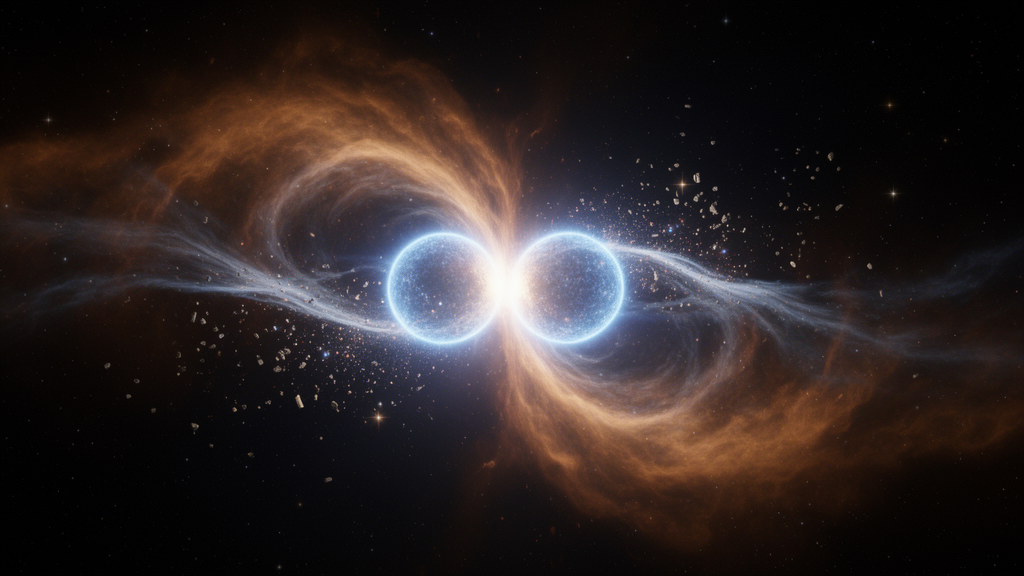
In our solar system’s corner of the galaxy, stars rarely collide. Space is vast, and stars have room to roam, which is why even in most of the present-day universe stellar collisions remain rare events. The James Webb Space Telescope, however, peers deep enough into space to see the universe as it was not long after the Big Bang, and its observations have revealed extraordinarily compact stellar systems. That discovery has raised a striking possibility: collisions between stars may once have been far more common than they are today.
A new study led by UCLA astrophysicists and published in AAS Journals finds that in the early universe, stellar systems were extremely dense, with stars frequently hitting one another. According to the models, these collisions could unfold in two very different ways. At very rapid speeds, the encounters destroyed the stars involved. At slower speeds, the stars merged into one. Repeated mergers could then build a single extraordinarily massive star, which might eventually collapse into a black hole. Some of these gigantic stars did become black holes, and the finding could help explain how the seeds of supermassive black holes formed early enough to grow into the enormous black holes already present in the young universe.
“Perhaps the strangest outcome of our simulations is that stars can merge repeatedly within the cluster until they form one gigantic star with a mass equal to that of an entire cluster,” said UCLA doctoral student and corresponding author Claire Williams. “When a star this huge reaches the end of its life, models suggest that it may have no option but to collapse into itself and form a massive black hole.”
The center of the Milky Way offers a nearby example of the same basic ingredients: a massive black hole embedded within a dense nuclear star cluster. The model suggests that once a black hole is present, its gravity accelerates nearby stars, causing collisions close to the black hole to destroy them rather than merge them, and to release gas into the surrounding region. “One place in the nearby universe where collisions between stars are common is the galactic center,” Williams said. “In our model, once these very massive stars turn into intermediate-mass black holes, the system resembles our own galactic center, which is a black hole surrounded by a dense star cluster.”
The origin of supermassive black holes has long been a mystery. Astronomers expected that they would grow gradually, but the James Webb Space Telescope has found them forming quickly after the Big Bang. The new research is not the first to propose stellar collisions as the mechanism, but the modeling ties together observations, such as the intriguing “little red dots,” and theoretical models to identify clear pathways to collisions for stars within dense clusters and to the formation of supermassive black holes.
Little red dots, or LRDs, are extremely compact objects in the early universe that appear as red dots, and they are believed to contain a rapidly growing black hole at their center. The new simulations suggest that LRDs may be dense star clusters filled with stellar collisions, forming a very large star that may eventually become a black hole. “Little red dots are a hot topic in astronomy,” said UCLA astrophysicist and co-author Smadar Naoz. “You can compare studies of people trying to understand LRDs to the tale of blind people who are trying to describe an elephant by touching it, and each person describes it differently based on what part they’re touching. Our research connects several of those perspectives together and may help us see more of the elephant.”
Intermediate-mass black holes may need a cluster like this in order to exist. These are an elusive type of black hole, larger than those that form when a star dies but smaller than the supermassive black holes that dominate the centers of galaxies, and they are almost never observed. The clusters in the model originate from conditions unique to the early universe, which was very different from what astronomers see today. There were no big spiral galaxies like the Milky Way, only regions with dense clusters of star formation. Within those clusters, stars collided and formed black holes, around which galaxies would eventually form. As the universe expanded, it became less extreme and moved toward the equilibrium state it occupies now.
“Dense star clusters provide a natural birthplace for massive black-hole seeds in our model,” Williams said. “The same environment that forms the black hole can also provide stars and gas that influence its subsequent growth.” By linking the compact objects revealed by JWST to the dense stellar environments of the early universe, the study offers a coherent picture in which repeated stellar mergers, massive star collapse and early black hole growth are connected stages of the same process, bringing astronomers closer to explaining how the universe’s largest black holes arrived so soon after the Big Bang.
Subject of Research: Stellar collisions and black hole seed formation in dense star clusters of the early universe
Article Title: Stellar collisions may have been common when the universe was young
Article References: Stellar collisions may have been common when the universe was young. Original publication (Bibliographic details unavailable.)
Image Credits: AI Generated
DOI: Not provided
Keywords: stellar collisions, early universe, James Webb Space Telescope, supermassive black holes, little red dots, dense star clusters, intermediate-mass black holes, UCLA, astrophysics, galactic center, Stellar, collisions
Cite Scienmag News
Grant Pearson. (October 26, 2026). Stellar collisions may have been common when the universe was young. Scienmag. https://scienmag.com/stellar-collisions-may-have-been-common-when-the-universe-was-young/
Grant Pearson. "Stellar collisions may have been common when the universe was young." Scienmag, 26 October 2026, https://scienmag.com/stellar-collisions-may-have-been-common-when-the-universe-was-young/. Accessed 26 October 2026.
Grant Pearson. "Stellar collisions may have been common when the universe was young." Scienmag. October 26, 2026. https://scienmag.com/stellar-collisions-may-have-been-common-when-the-universe-was-young/


