


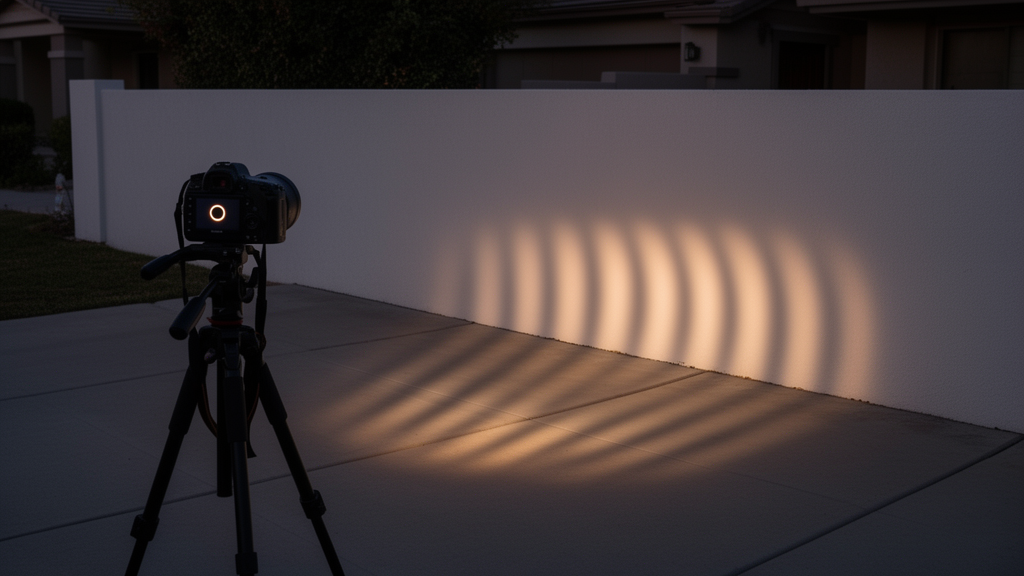
Eclipse shadow bands, the faint rippling patterns of light and dark that can sweep across the ground near solar eclipse totality, can now be measured quantitatively from ordinary video. A study published in Experimental Astronomy by Joseph Conti presents a reusable image-processing framework that turns ground-based video recordings captured with consumer-grade cameras into quantitative characterizations of these transient patterns. The method quantifies band prominence, orientation, separation, velocity, and power spectral density.
Applied to two eclipse datasets, the framework detected statistically significant shadow band activity during eclipse windows consistent with atmospheric scintillation theory. The analysis went beyond simple detection. It identified statistically significant shadow bands persisting for more than 10 minutes after third contact, the moment (C3) when totality ends, under conditions of high partial solar obscuration. It also documented temporal rotation of shadow band orientation over the course of an event.
The analysis further identified simultaneous shadow band modes with distinct orientations and velocities, indicating that multiple band patterns with different geometries and motions can coexist in the same recordings.
The persistence of shadow bands well after C3, under high partial solar obscuration, provides observational evidence supporting the hypothesis that, under favorable atmospheric conditions, shadow bands may also occur outside the path of totality, in regions experiencing only a partial eclipse.
The study is a methods paper, and its claims rest on the two eclipse datasets analyzed rather than a broad survey of events. The abstract does not report the geographic locations, camera configurations, or atmospheric conditions of the recordings, and the statistical significance statements apply to the detected band activity within the analyzed windows.
Nevertheless, the results demonstrate that consumer-grade video recordings can support quantitative characterization of detailed and dynamic shadow band behavior. The author positions the framework as a reusable tool for future observational and atmospheric studies of the phenomenon.
For now, the framework stands as a validated pipeline for extracting band prominence, geometry, motion, and spectral content from video, and as evidence that shadow band activity can be measured systematically with widely available equipment.
Subject of Research: Quantitative image-processing analysis of eclipse shadow bands using consumer-grade video recordings
Article Title: A quantitative image-processing framework for eclipse shadow band analysis
Article References: Conti, J. (2026). A quantitative image-processing framework for eclipse shadow band analysis. Experimental Astronomy, 62(3), Article 25. https://doi.org/10.1007/s10686-026-10086-4
Image Credits: AI Generated
DOI: 10.1007/s10686-026-10086-4
Keywords: eclipse shadow bands, image processing, atmospheric scintillation, solar eclipse, totality, third contact, consumer cameras, power spectral density, partial eclipse, Experimental Astronomy, quantitative, image-processing
Cite Scienmag News
Grant Pearson. (October 26, 2026). Consumer Video Yields Quantitative Framework for Eclipse Shadow Bands. Scienmag. https://scienmag.com/consumer-video-yields-quantitative-framework-for-eclipse-shadow-bands/
Grant Pearson. "Consumer Video Yields Quantitative Framework for Eclipse Shadow Bands." Scienmag, 26 October 2026, https://scienmag.com/consumer-video-yields-quantitative-framework-for-eclipse-shadow-bands/. Accessed 26 October 2026.
Grant Pearson. "Consumer Video Yields Quantitative Framework for Eclipse Shadow Bands." Scienmag. October 26, 2026. https://scienmag.com/consumer-video-yields-quantitative-framework-for-eclipse-shadow-bands/


