


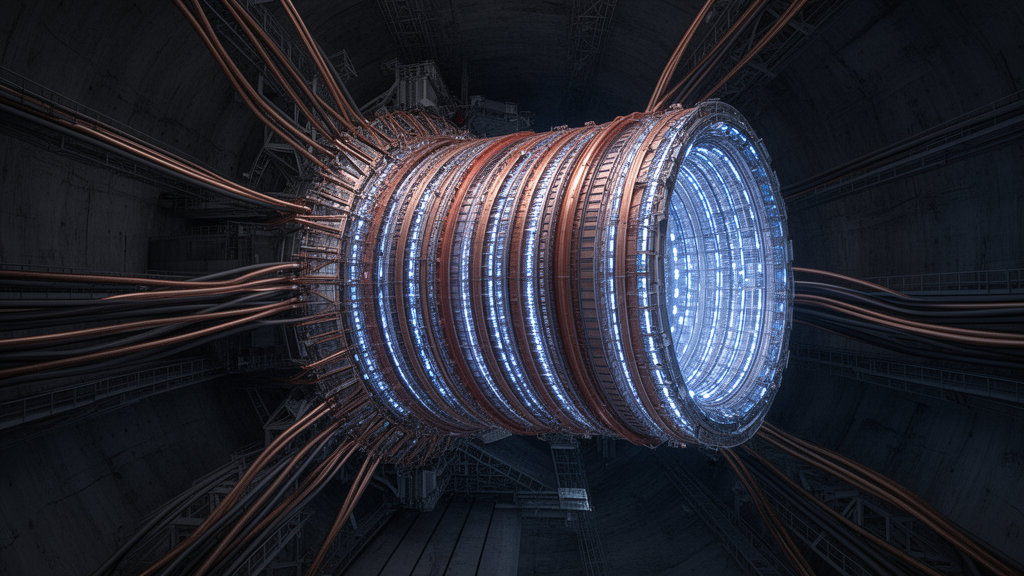
A new phenomenological study published in the European Physical Journal C evaluates the potential of the Future Circular Collider in its hadron-hadron mode, known as FCC-hh, to detect a specific type of new particle predicted by the U(1)_{B-L} gauge symmetry. The research, led by Farinaldo S. Queiroz and colleagues, focuses on the discovery and exclusion reach for a heavy neutral vector boson, denoted as Z’, which naturally emerges when baryon and lepton numbers are promoted to local gauge symmetries. By analyzing the dilepton production channel at a center-of-mass energy of 100 TeV, the authors demonstrate that the FCC-hh could extend the search for this boson far beyond the current limits established by the Large Hadron Collider, potentially probing mass scales up to 50 TeV under specific coupling conditions.
The U(1)_{B-L} model represents a well-motivated extension of the Standard Model, addressing several open questions in particle physics, including the origin of neutrino masses and the matter-antimatter asymmetry. In this framework, the Standard Model gauge group is extended to include a new U(1)_{B-L} symmetry, which is anomaly-free only when three right-handed neutrinos are introduced. These right-handed neutrinos carry a charge of -1 under the new symmetry, allowing for the cancellation of gauge anomalies and naturally accommodating a Type-I Seesaw mechanism for neutrino mass generation. The gauging of the B-L symmetry leads to the existence of the Z’ boson, which couples to all Standard Model fermions proportionally to their B-L quantum numbers, with quarks carrying a charge of 1/3 and leptons a charge of 1.
Current experimental constraints from the LHC have placed mass limits on the Z’ boson in the B-L model, generally excluding scenarios with masses up to approximately 5 to 7.7 TeV, depending on the coupling strength and decay channels. However, these limits leave a significant portion of the parameter space unexplored, particularly for heavier masses or weaker couplings. The FCC-hh, designed to operate at 100 TeV with an integrated luminosity of up to 30 ab^{-1}, offers a transformative increase in energy and precision. The study specifically targets the parameter space not yet excluded by LHC data, aiming to quantify how much further the FCC-hh can push the boundaries of detection for this new gauge boson.
The analysis employs full Monte Carlo simulations to model the production of the Z’ boson via the Drell-Yan mechanism in proton-proton collisions, resulting in a final state of two high-energy leptons, either electrons or muons. The simulations account for various Standard Model background processes, including irreducible Drell-Yan production, diboson production, single top-quark production, and top-quark pair production. By generating signal and background events for different combinations of Z’ mass and B-L gauge coupling, the researchers were able to identify optimal kinematic selection cuts that maximize the signal-to-background ratio. This approach ensures that the projections for exclusion and discovery are both realistic and robust against background fluctuations.
The results indicate that the FCC-hh has a substantial reach in the high-mass regime. For large couplings, where g_{B-L} is approximately 1, the collider is projected to exclude Z’ masses up to roughly 50 TeV at a 95% confidence level. For weaker couplings, where g_{B-L} is approximately 0.1, the exclusion reach extends to about 30 TeV. In terms of discovery potential, defined by a 5-sigma statistical significance, the FCC-hh could observe signals for Z’ masses up to 40 TeV for strong couplings and up to 20 TeV for weak couplings. These findings highlight the collider’s capability to uncover new physics signals in a mass range that is currently inaccessible to existing experiments.
An important aspect of the analysis is the treatment of the Z’ decay width, which scales proportionally to the square of the gauge coupling. For small couplings, the resonance is narrow, and the signal shape is primarily determined by the detector’s energy resolution. However, for larger couplings, the Z’ becomes a broad resonance, causing the signal distribution to spread across the invariant mass spectrum. To account for this, the study utilizes an adaptive invariant-mass window that can expand up to 30% of the nominal resonance value. This strategy ensures that the Breit-Wigner tails are properly captured, allowing for accurate significance calculations across the full range of coupling strengths considered.
The optimization of selection cuts was performed using a random search algorithm that evaluated hundreds of thousands of cut combinations to maximize statistical significance. The algorithm focused on kinematic observables such as the transverse momentum of the leptons and the dilepton invariant mass. The study found that hard cuts on transverse momentum and invariant mass were primarily responsible for suppressing background contributions, while angular variables provided only marginal improvements to the sensitivity. This suggests that the high-energy kinematics of the dilepton final state are the most powerful discriminants for identifying the Z’ boson in the presence of Standard Model backgrounds.
The correlation between the Z’ mass and the statistical significance is strongly negative, driven by the parton distribution functions of the proton. Producing a heavy Z’ boson at 100 TeV requires quarks to carry a large fraction of the proton’s momentum, a process that becomes increasingly rare as the mass increases. Consequently, the production cross-section drops significantly with mass, reducing the number of observable events. In contrast, the correlation between significance and the gauge coupling is relatively small, indicating that the observability of the Z’ boson at the FCC-hh depends predominantly on its mass rather than the specific value of the coupling within the studied range.
The study also compares the projected exclusion regions at different stages of FCC-hh operation. With just three years of operation, corresponding to an integrated luminosity of 3 ab^{-1}, the collider can already exclude Z’ scenarios up to 40 TeV. At full operation with 30 ab^{-1}, the exclusion reach extends to 50 TeV for strong couplings. These projections are compared with existing ATLAS limits, demonstrating a clear and substantial advancement in sensitivity. The research underscores the FCC-hh’s role as an indispensable tool for probing physics beyond the Standard Model, particularly in the context of gauge symmetries that extend the current theoretical framework.
In conclusion, the phenomenological analysis confirms that the FCC-hh has the potential to significantly expand the search for the Z’ boson predicted by the U(1)_{B-L} gauge symmetry. By leveraging its high energy and luminosity, the collider can exclude a large portion of the viable parameter space and potentially achieve discovery-level significance for heavy Z’ bosons. The study provides a detailed roadmap for future searches, identifying optimal kinematic cuts and highlighting the importance of adaptive analysis strategies for broad resonances. As the FCC program progresses, these projections will guide experimental efforts to uncover new fundamental forces and particles that may underpin the unresolved mysteries of the Standard Model.
Subject of Research: Phenomenological projection of FCC-hh sensitivity to U(1)_{B-L} Z' bosons
Article Title: Can the FCC-hh prove the B-L gauge symmetry?
Article References: Queiroz, F. S., Zamora-Saa, J., Silva, R. C., & Oviedo-Torres, Y. M. (2026). Can the FCC-hh prove the B-L gauge symmetry?. The European Physical Journal C, 86(10), Article 1225. https://doi.org/10.1140/epjc/s10052-026-16519-w
Image Credits: AI Generated
DOI: 10.1140/epjc/s10052-026-16519-w
Keywords: FCC-hh, B-L symmetry, Z' boson, particle physics, Standard Model, dilepton channel, Monte Carlo simulation, high-energy physics, prove, gauge, symmetry, scientific research
Cite Scienmag News
Katie Riggs. (October 26, 2026). FCC-hh Projected to Probe B-L Symmetry at 50 TeV. Scienmag. https://scienmag.com/fcc-hh-projected-to-probe-b-l-symmetry-at-50-tev/
Katie Riggs. "FCC-hh Projected to Probe B-L Symmetry at 50 TeV." Scienmag, 26 October 2026, https://scienmag.com/fcc-hh-projected-to-probe-b-l-symmetry-at-50-tev/. Accessed 26 October 2026.
Katie Riggs. "FCC-hh Projected to Probe B-L Symmetry at 50 TeV." Scienmag. October 26, 2026. https://scienmag.com/fcc-hh-projected-to-probe-b-l-symmetry-at-50-tev/


