


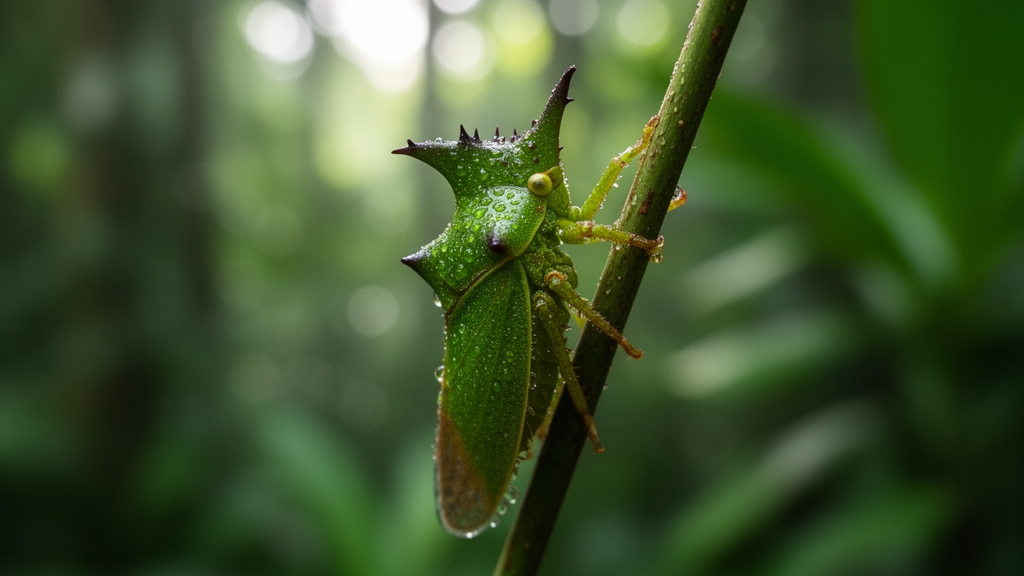
In a city-state better known for skyscrapers than for its insect life, a quiet taxonomic revolution is unfolding among some of nature’s most extravagantly helmeted insects. Treehoppers, the plant-feeding bugs of the family Membracidae, are famed for the ornate pronotal outgrowths that rise above their heads like thorns, helmets, or miniature sculptures. A new study has now compiled the first comprehensive account of Singapore’s treehopper fauna, raising the number of locally recorded species from 36 to 52, spread across 11 tribes and 17 genera. Of these, 16 are new species records for the country, including eight morphospecies whose identities remain unresolved. The work, anchored in the collections of the Lee Kong Chian Natural History Museum, also delivers something Southeast Asia has lacked for over a century: an annotated checklist and an illustrated identification key built for a modern audience of researchers, naturalists, and citizen scientists.
Treehoppers comprise roughly 3,450 species and 428 genera worldwide, and their pronotal forms have been hypothesised to serve functions ranging from crypsis and mimicry to aposematism, pheromone dispersal, and even electroreception. Beyond their architectural pronota, these insects are notable for maternal care and ant attendance, behaviours that have made them favourites of behavioural ecologists. While the New World hosts the family’s best-known representatives, the Oriental zoogeographic region is regarded as a centre of diversity for the subfamily Centrotinae, which contains approximately 1,500 species. In fact, every membracid distributed across Asia is a centrotine, with a single known exception: Stictocephala bisonia, a Nearctic native adventive in Europe and recently discovered in Asia. Understanding Singapore’s centrotines therefore contributes directly to mapping diversity in one of the group’s great evolutionary heartlands.
Singapore’s treehoppers have a distinguished but fragmented history. The first local species were collected by Alfred Russel Wallace and described by Walker in 1857, accounting for three species. The most thorough account to date came from Funkhouser in 1918, who noted new species and inventoried several others, bringing the tally to 24. Scattered contributions from Buckton, Matsumura, Distant, Goding, and Kato added a handful more, but no further work was published after the early twentieth century, leaving the exact state of the current fauna ambiguous. This gap matters because Singapore’s landscape has been transformed since 1965: only approximately 0.28 percent of the original vegetative cover, once lowland dipterocarp forest, mangroves, and freshwater swamp, remains. Vestigial habitats, secondary forest, parks, and planted streetscapes now serve as refuges for local insect diversity, making an updated inventory both timely and urgent.
The study examined 497 specimens digitally, physically, or both, with the majority, 466 specimens, drawn from the museum’s Zoological Reference Collection. These specimens derive from opportunistic collection events rather than targeted surveys, underscoring how much remains to be found. ZRC material was examined under a binocular stereo-microscope, and 31 representative specimens were photographed to anchor the new visual key. Additional type and non-type material was assessed digitally from the Smithsonian National Museum of Natural History, including 16 holotypes, and from the Natural History Museum in London, including two lectotypes. Several specimens could not be confidently assigned to any named species, either falling outside the observed intraspecific variation of well-delineated species or defying assessment against descriptions that lacked sufficient diagnostic information. These are retained as morphospecies pending future resolution.
The annotated checklist consolidates previous combinations, synonyms, type localities, recorded distributions, host plants, and ant attendants for every locally occurring species, drawing on the great catalogues of Funkhouser, Metcalf and Wade, and McKamey, with names standardised against the World Auchenorrhyncha Database. Among the new records for Singapore are Evanchon maculatum, previously known from Indonesia; Gargara luconica, from Indonesia, Malaysia, and the Philippines; Tricentrus acuticornis, from China, Indonesia, and the Philippines; T. banguensis, from India, Indonesia, and Malaysia; T. fulgidus, from China, Indonesia, Malaysia, and Vietnam; T. intermedius, from Sabah; Nilautama minutispina, from Indonesia and Malaysia; and Telingana recurvata, from Indonesia and Sarawak. Many species carry Singapore as their type locality, including Centruchus laticornis, Centrochares ridleyana, Gargara nervosa, G. projecta, G. sordida, G. triangulata, Tricentrus brunneus, T. spinicornis, T. truncaticornis, Micreune formidanda, and Ceraon orientale, several of which were described from specimens collected in 1917.
Host plant data emerged for 37 species, and the patterns are striking. More than a third of species with known hosts, 14 species spread across four tribes, were found on Melastoma malabathricum, a shrub widespread across Singapore’s forest edges and disturbed habitats. The authors suggest this strong concomitance may reflect ecological availability rather than phylogenetic constraint. Other important host taxa include Fabaceae, collectively hosting 11 species, Moraceae with 8, and Myrtaceae with 7. Most species proved polyphagous, with 22 feeding on more than one plant family. The extreme case is Leptocentrus taurus, an exceptionally polyphagous species with 72 recorded host plants across 23 families, from cashew and mango to hibiscus and tomato. The authors caution that these patterns rest on opportunistic records covering only the species for which host data exist, and that expanded surveys across a fuller representation of each tribe will be needed to contextualise them.
Ant attendance was documented for only 11 species, most notably involving the green weaver ant Oecophylla smaragdina, which tends treehoppers for the honeydew they excrete. The ecological stakes are considerable: ant attendance is known to decrease predation and, in some instances, may even be required for nymphal survival. Notably, almost all Indian treehopper species were recorded as ant attended in earlier monographic work, and if similar patterns apply throughout the Old World, ant attendance in Singapore’s fauna is likely heavily undersampled. First host plant and ant attendant records were contributed for Evanchon maculatum, Gargara luconica, and Nilautama minutispina, baseline ecological data that remain absent for many Southeast Asian species. The authors interpret all such records as preliminary, awaiting confirmation through targeted field observations, since museum labels rarely distinguish true hosts, on which nymphs develop or oviposition occurs, from incidental plant associations.
The illustrated identification key is a technical achievement in its own right. Whereas early taxonomic studies of membracids relied primarily on pronotal characters, later works recognised the diagnostic value of frontoclypeal lobes, forewing venation, and leg chaetotaxy, particularly the presence of ab- and adlateral cucullate setae on the mesothoracic femur. The new key incorporates this updated methodology and was designed with a fan-shaped structure, minimising the number of steps required for identification. It accounts for sexual dimorphism, ensuring delineations apply to both sexes, with separate steps for species such as Tricentrus acuticornis, whose males lack the suprahumerals present in females. Images of two non-Singaporean species were incorporated to visualise diagnostic genus-level characters for locally occurring species whose specimens could not be sourced. Only 40 of the 52 species are included, however, as 12 were excluded because their diagnostic characters could not be confidently assessed from available literature, making the key preliminary pending future redescriptions anchored upon type material.
Those exclusions expose a deeper crisis in Oriental treehopper taxonomy. Species identification proved challenging without access to types, because descriptions from the late 1800s to early 1900s seldom provide useful diagnostic information. The problem is most acute in the hyper-diverse genera Gargara, with 174 species, Tricentrus, with 238, and Leptocentrus, with 90, which are the largest yet most poorly studied taxa in the family. Goding’s early twentieth-century keys to the Old World Membracidae, published over 20 years, are limited by unclear terminology and were likely not based on types. Even the better-established Indian and Chinese monographs conflict: independent treatments of the same species occasionally differ, as seen in Tricentrus albomaculatus and T. gibbosulus, where workers examining type material reported contrasting features. The authors conclude that species redescriptions based on type material are sorely needed to resolve current ambiguities.
Morphology-based species counts may also be inflated, since treehoppers display intraspecific variation driven by sexual dimorphism, host-plant specificity, or geographic isolation. Yet underestimates can arise too: the classic Enchenopa binotata complex from the Neotropics, once defined as a single species by morphology, is now recognised as up to 15 species differentiated by substrate-borne mating signals and host specificity, and Oriental cryptic complexes have been disentangled through integrative approaches as well. The foremost local candidate for such investigation is Leptocentrus taurus, whose unusually wide distribution, exceptional polyphagy, pronotal variation, and contrasting sets of synonyms leave it in taxonomic limbo. Nymphal morphology offers a promising alternative, as nymphs of highly polymorphic species can be remarkably monomorphic and diagnostic, but nymphs are rarely present in collections and comparative Oriental data are non-existent for most taxa.
With only 0.28 percent of Singapore’s original vegetative cover intact, it is possible that some species recorded during the 1800s and 1900s have become locally extinct, and future targeted surveys, particularly within primary forest habitats, will help ascertain the continued presence of previously recorded taxa. The uncovering of new records suggests treehopper diversity is undersampled in adjacent Southeast Asian states as well, where broad re-examinations have not occurred since original descriptions decades ago. For now, Singapore’s 52 helmeted inhabitants, from the forked pronota of Micreune formidanda to the weaver-ant-tended colonies of Centrochares ridleyana, stand as a reminder that even in one of the world’s most urbanised nations, evolutionary artistry persists in the margins, awaiting the observers patient enough to look.
Subject of Research: The treehoppers (Hemiptera, Membracidae) of Singapore: An annotated checklist, new records, and an illustrated identification key
Article Title: The treehoppers ( Hemiptera , Membracidae ) of Singapore: An annotated checklist, new records, and an illustrated identification key
Article References: Tan, V., & Hwang, W. S. (2026). The treehoppers (Hemiptera, Membracidae) of Singapore: An annotated checklist, new records, and an illustrated identification key. ZooKeys, 1295, 161-225. https://doi.org/10.3897/zookeys.1295.204613
Image Credits: AI Generated
DOI: 10.3897/zookeys.1295.204613
Keywords: treehoppers, Hemiptera, Membracidae, Singapore, annotated, checklist, records, illustrated, identification, scientific research
Cite Scienmag News
Gavin Prescott. (October 26, 2026). Singapore’s Helmeted Treehoppers Reveal 52 Species in First Complete Checklist. Scienmag. https://scienmag.com/singapores-helmeted-treehoppers-reveal-52-species-in-first-complete-checklist/
Gavin Prescott. "Singapore’s Helmeted Treehoppers Reveal 52 Species in First Complete Checklist." Scienmag, 26 October 2026, https://scienmag.com/singapores-helmeted-treehoppers-reveal-52-species-in-first-complete-checklist/. Accessed 26 October 2026.
Gavin Prescott. "Singapore’s Helmeted Treehoppers Reveal 52 Species in First Complete Checklist." Scienmag. October 26, 2026. https://scienmag.com/singapores-helmeted-treehoppers-reveal-52-species-in-first-complete-checklist/


