


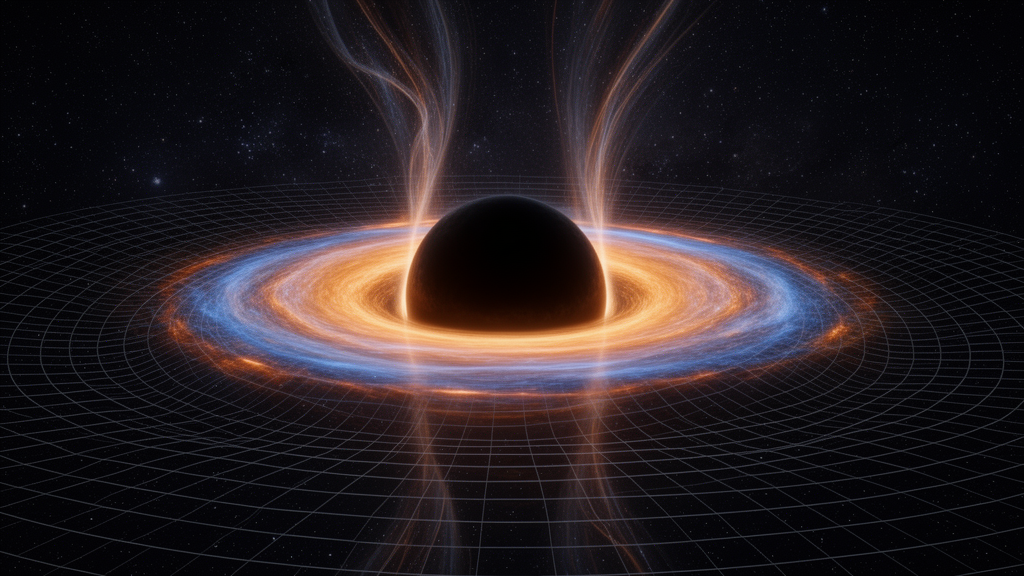
A theoretical study published in The European Physical Journal C on 22 October 2026 has mapped how the original Penrose process and the four laws of black hole thermodynamics behave inside conformal Weyl gravity, a higher-derivative alternative to Einstein’s general relativity. Dilmurod Ortiqboev, Farruh Atamurotov, Ahmadjon Abdujabbarov, Chen Zhou and G. Mustafa analysed a Kerr-like rotating black hole solution characterized by two dimensionful constants: γ, which encodes the asymptotic rotational curvature of galactic rotation curves in an otherwise asymptotically flat spacetime, and κ, which is associated with the cosmological background constant Λ. The team determined the locations of the event horizon and the extreme configurations of these rotating black holes, provided both perturbative and exact expressions for the horizon radius, and restricted the geodesic equations and all energy extraction analysis to the equatorial plane. Their principal results concern the feasibility and efficiency of the Penrose process, black hole deceleration mechanisms, and the validity of the four laws of black hole thermodynamics.
Conformal Weyl gravity, originally proposed by Hermann Weyl, is one of the most extensively studied higher-order alternatives to general relativity. Unlike Einstein’s theory, it is invariant under local conformal transformations of the metric, in which the metric tensor is rescaled by a position-dependent factor Ω²(x) that specifies the local scaling of the line element. The requirement of local conformal invariance uniquely leads, at the level of fourth-order derivative theories, to a gravitational action constructed from the square of the Weyl tensor, the completely traceless part of the Riemann curvature tensor. Variation of this action yields fourth-order field equations governed by the traceless Bach tensor. One remarkable feature of the theory is that it modifies the gravitational potential at galactic and cosmological scales without introducing dark matter, explaining flat galactic rotation curves through additional linear and quadratic terms in the metric function. On galactic scales γ is of order 10⁻²⁶ per metre, while κ, which reduces to Λ/3 when γ vanishes, is of order 10⁻⁵² per square metre cosmologically.
The static, spherically symmetric vacuum solution of the theory, obtained by Mannheim and Kazanas, serves as the conformal gravity analogue of the Schwarzschild metric. Its lapse function contains the Newtonian term, a linear γ r term and a quadratic κ r² term, together with an effective mass defined as (2−3γM)M/2. Building on this, the authors employed a known procedure to derive the rotating Kerr black hole solution in Weyl gravity, in which the horizon-generating function acquires a fourth-order correction proportional to the combination k of γ and κ. Requiring the event horizon to be a null hypersurface forces this function to vanish, a fourth-degree algebraic equation that generically yields four roots: the outer event horizon, the inner horizon, a distant de-Sitter horizon and a non-physical negative root. Because the energetic processes studied occur near the event horizon, where cosmological effects are small, the de-Sitter horizon can be ignored and the event horizon treated as a first-order correction in the dimensionless quantity kM².
The perturbative expressions show that the conformal Weyl correction shifts both the outer and inner horizons only slightly, with the displacement governed by kM², which is expected to be extremely small for astrophysical black holes. The Kerr horizon structure is therefore preserved, and in the limit γ, κ → 0 the standard Kerr horizons are recovered exactly. The extreme configurations reveal a sharper contrast between the two conformal parameters. The parameter κ increases both the event horizon radius and the maximal allowed spin, indicating that the conformal correction permits slightly faster rotating black holes than in the Kerr geometry when κ is positive. In contrast, a positive γ shifts both quantities in the opposite direction, reducing the horizon radius and lowering the extreme spin. Consequently, γ and κ compete with each other in determining the extremality condition. In the extreme case, the spin can reach 3M(2−3Mγ)/(4√2), the horizon takes its smallest value 3M(2−3Mγ)/4, and the boundary condition kM² = 2/27 emerges.
The team also analysed the radial motion of massive test particles in the equatorial plane, where the conserved energy and angular momentum follow from the time-like and space-like Killing vectors of the axially symmetric spacetime. The radial effective potential, obtained from the normalization of the four-momentum, determines turning points, circular orbits and the innermost stable circular orbit. In the extremal Weyl rotating black hole, the conformal parameters reshape this potential: γ primarily affects the depth of the potential well and the location of the innermost stable circular orbit, while the positive κ parameter effectively introduces a de-Sitter-like repulsion, a background cosmological force, that modifies the radial potential well and shifts the turning points in a way absent in standard Kerr geometry. These shifts represent genuine signatures of Weyl conformal gravity, in which the cosmological background directly influences particle dynamics near the black hole.
At the centre of the energy extraction analysis sits the original Penrose process, proposed by Roger Penrose in 1969 as a classical mechanism for extracting rotational energy from a spinning black hole. Inside the ergoregion, the region between the event horizon and the static limit where dragging of inertial frames allows negative-energy states, an incoming particle on a direct orbit splits into two fragments: one falls into the black hole on a retrograde orbit with negative energy, while the other escapes carrying more energy than the incoming particle. The extractable energy follows from the Christodoulou-Ruffini-Hawking irreducible mass, the energy locked inside the event horizon, subtracted from the Komar mass, which the authors evaluate as the effective mass. For an extremal Kerr black hole the largest extractable energy is approximately 0.293 of the total black hole energy; in conformal Weyl gravity this maximum is reduced by additional terms proportional to γ and κ. The Penrose efficiency itself is reduced only through k, by an amount of order κ or γ², and if k < 0 dominates the efficiency can be partially increased. For the boundary condition kM² = 2/27 the efficiency equals (√6−2)/4, approximately 0.112.
The spin-down analysis tracks how repeated Penrose processes slow the black hole’s rotation. Each process delivers the infalling particle’s negative energy and angular momentum to the black hole, which does work on the exterior and decelerates. In Kerr geometry the slowdown law is a = M₀√(2−M₀²/M²), where M₀ is the extremal mass, and the black hole stops rotating when its mass decreases to M₀/√2. In Weyl gravity the corresponding law is modified by the conformal parameter k: for positive k the Weyl black hole can lose less energy before stopping, otherwise it can lose more. The total mass of massive particles required to bring the rotation to a halt contains a term proportional to −log k in the approximation, meaning that, as in the Kerr model, an infinite number of particles are required for the Penrose process to stop the black hole completely.
The thermodynamic analysis confirms that all four laws of black hole mechanics hold in conformal Weyl gravity. The zeroth law requires the surface gravity to be constant over the event horizon; the authors computed the surface gravity from the Killing vector that is null on the horizon and showed it is indeed constant, vanishing in the extreme configurations. The corrections depend sensitively on the sign of κ: for positive κM², increasing γ decreases the surface gravity at fixed spin, whereas for negative κM² the same increase enhances it, a nontrivial interplay between the two conformal parameters. Because the Wald entropy in conformal Weyl gravity is conformal invariant, the Bekenstein-Hawking area formula cannot be applied directly; instead the authors used the Wald Noether-charge formalism to derive the Weyl entropy contribution, proportional to α_g times the effective mass times the horizon radius divided by the sum of the squared horizon radius and the spin squared. The Hawking temperature is tied to the surface gravity through T = κ_g/(2π), and the first law of black hole thermodynamics holds by construction of the Wald formalism, with the total conserved energy, angular momentum and entropy returning to their usual Kerr values in the appropriate limit.
The second law and the phase structure follow from the split entropy into Einstein-sector and Weyl contributions. Testing the entropy changes separately by perturbation, the authors found that the Einstein-sector contribution dominates for small k and yields a positive derivative with respect to mass, so the total entropy increases with total mass and the second law is satisfied in the full Einstein-Weyl theory, even though the pure Weyl entropy alone can decrease under certain perturbations. The heat capacity, defined as the sum of the Einstein and Weyl contributions, changes sign at a phase transition point. For the Kerr black hole this point lies at a spin of approximately 0.681M, where the heat capacity has a second-order discontinuity. In conformal Weyl gravity the critical spin shifts by a term proportional to kM³: the linear correction in γ pushes the transition toward smaller spins, whereas the κ-dependent contribution pushes it toward larger values, with quadratic and mixed terms providing subleading corrections. The location of the heat-capacity singularity is therefore not universal but depends explicitly on the deformation of the underlying geometry.
The third law finds confirmation in the Penrose process itself. Since an infinite number of massive particles would be needed to stop the black hole from spinning while retaining some of its mass, the extremal configuration, where the surface gravity and temperature vanish, cannot be reached by any finite physical process. At extremality the entropy approaches a finite value modified by both conformal parameters, but this does not violate the third law because the heat capacity vanishes as the temperature approaches zero, scaling as the temperature squared near extremality. The authors conclude that conformal Weyl gravity introduces small but physically meaningful modifications to Kerr black hole thermodynamics and energy extraction efficiency, controlled by the dimensionless combinations γM and κM². These are extremely small for astrophysical black holes, but become relevant in regimes where conformal gravity is expected to play a role, such as the early universe or near galactic centres. The explicit separation of the effects of γ and κ, the team notes, highlights the predictive power of conformal gravity and provides a clear target for observational tests of modified gravity theories.
Subject of Research: Energy extraction processes and black hole thermodynamics in rotating conformal Weyl gravity black holes
Article Title: Energy extraction processes and thermodynamics in rotating Weyl conformal black holes
Article References: Ortiqboev, D., Atamurotov, F., Abdujabbarov, A., Zhou, C., & Mustafa, G. (2026). Energy extraction processes and thermodynamics in rotating Weyl conformal black holes. The European Physical Journal C, 86(10), Article 1214. https://doi.org/10.1140/epjc/s10052-026-16333-4
Image Credits: AI Generated
DOI: 10.1140/epjc/s10052-026-16333-4
Keywords: conformal Weyl gravity, Penrose process, black hole thermodynamics, Kerr black hole, Wald entropy, surface gravity, ergosphere, event horizon, phase transition, energy extraction, spin-down, modified gravity
Cite Scienmag News
Kelsey Dorsey. (October 25, 2026). Energy extraction processes and thermodynamics in rotating Weyl conformal black holes. Scienmag. https://scienmag.com/energy-extraction-processes-and-thermodynamics-in-rotating-weyl-conformal-black-holes/
Kelsey Dorsey. "Energy extraction processes and thermodynamics in rotating Weyl conformal black holes." Scienmag, 25 October 2026, https://scienmag.com/energy-extraction-processes-and-thermodynamics-in-rotating-weyl-conformal-black-holes/. Accessed 25 October 2026.
Kelsey Dorsey. "Energy extraction processes and thermodynamics in rotating Weyl conformal black holes." Scienmag. October 25, 2026. https://scienmag.com/energy-extraction-processes-and-thermodynamics-in-rotating-weyl-conformal-black-holes/


