


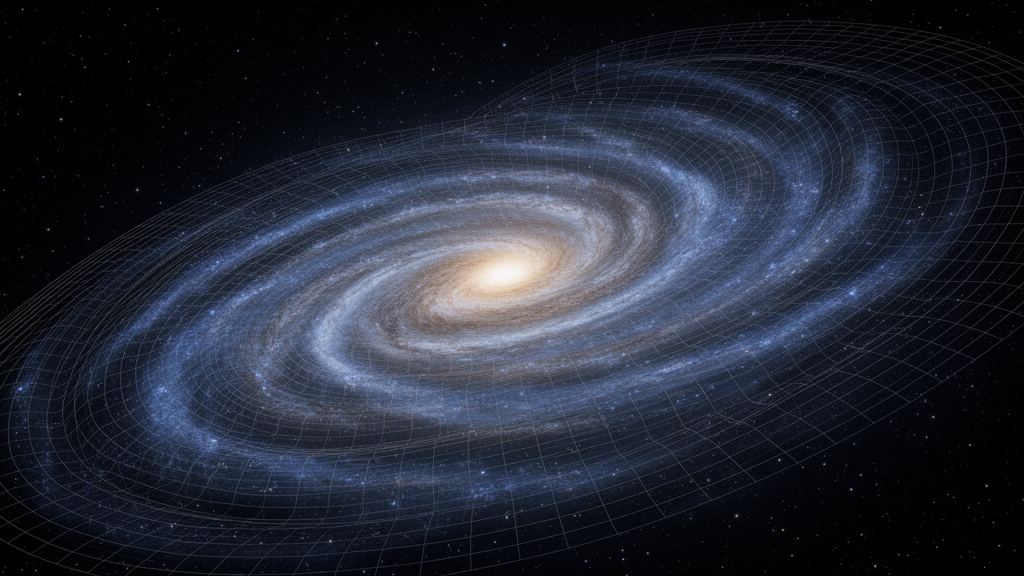
A theoretical physicist has proposed a new answer to one of the longest-standing puzzles in astrophysics: why the strange dynamics of galaxies seem governed by a single, universal acceleration constant. In a paper published in The European Physical Journal C, Manuel Uruena Palomo argues that modified Newtonian dynamics, or MOND, could emerge from the gravitational drag exerted by the expanding universe on local inertial frames — a Machian effect in which the cosmos itself sets the stage for galactic motion.
MOND was introduced by Mordehai Milgrom in 1983 as an alternative to dark matter. In galaxies, stars orbit faster than Newtonian gravity from visible matter alone allows, producing the famous flat rotation curves. MOND captures this with a modification of Newton’s second law below a critical acceleration, roughly 1.2 × 10⁻¹⁰ m/s², called a₀. Above this threshold Newton’s laws apply; below it, in the so-called deep-MOND regime, the orbital velocity becomes independent of distance and satisfies v⁴ = GMa₀, reproducing the baryonic Tully–Fisher relation. The smooth transition between regimes is controlled by an interpolating function μ(a/a₀), but neither this function nor the constant a₀ has ever been derived from deeper principles — they are simply inserted by hand.
The new work tackles precisely that gap. Building on Dennis Sciama’s 1953 model of the origin of inertia, later refined by Hans-Jürgen Treder, the study treats inertia as a gravitational induction effect: when a body accelerates relative to the mass of the universe, a gravitoelectric-like field produces the familiar inertial force. In these Machian frameworks, complete dragging of inertial frames by cosmic matter would fix the gravitational constant and make inertia relative, not absolute. The author considers an idealized homogeneous universe undergoing constant Hubble expansion and asks how the receding cosmic matter influences the inertia of an accelerating object.
The first result concerns the origin of a₀. In such a universe, most of the observable mass lies near the cosmic horizon at radius R_u, receding at nearly the speed of light with a relative acceleration of order H₀²R_u, which equals c²/R_u — numerically close to the MOND acceleration scale. Because the Machian inertial force weights each mass element by 1/r, the characteristic acceleration entering the inertial law is slightly reduced, to about two-thirds of that value. If this picture is right, a₀ would not be a new fundamental constant at all, but a derived quantity set by the size and expansion rate of the observable universe. It would also mean MOND would vanish in a static universe: as H₀ goes to zero, so does the modification.
The harder question is why this cosmic scale only manifests below the same acceleration it defines. The paper’s answer relies on horizon geometry. An accelerating observer possesses a Rindler horizon at distance c²/a, beyond which signals can never reach them. When this horizon is much smaller than the cosmic Hubble horizon — that is, when a is much larger than a₀ — the universe appears to accelerate rigidly past the observer, and ordinary Newtonian inertia is recovered. But when a falls to the order of H₀²R_u, the two horizons become comparable and the relative acceleration field of cosmic matter becomes anisotropic, breaking the uniformity that yields standard inertia.
The causal consequences are subtle. Even a tiny acceleration biases which already-propagating signals from distant matter reach the observer: acceleration in one direction brings new regions of the universe into causal contact ahead, while the Rindler horizon removes regions behind. Crucially, the author notes, this does not require faster-than-light information transfer — the change in causal access merely alters which existing null rays intersect the observer’s worldline. In an eternally homogeneous universe, the newly accessible matter has been radiating long enough for its influence to arrive along the observer’s altered path.
To quantify the effect, the paper models the acceleration-deformed causal boundary, guided by the exact geometry of de Sitter space, as a sphere shifted in the direction of acceleration. This simple shifted-sphere Ansatz satisfies the required limits: it collapses to the cosmic horizon in the inertial limit and to the Rindler horizon at large accelerations. Integrating the Machian inertial drag over this deformed volume and the anisotropic acceleration field produces a force that, at low accelerations, falls below the Newtonian value — a reduction in inertial mass, in the language of modified inertia. The physics is that the region gained ahead contributes less inertial drag than the region lost behind.
The resulting expression for the inertial force contains a dimensionless coefficient K, which the toy model fixes only to order-unity accuracy. Setting K to unity — a deliberate normalization rather than a derivation — yields a correction factor of the form x/(1 + x), which is exactly the simple interpolating function of MOND, with a₀ = c²/R_u. In other words, neither the interpolating function nor the acceleration constant is inserted by hand; both emerge from the interplay of cosmic expansion and the observer’s causal horizon. The mechanism also naturally suggests the external field effect, since the relevant acceleration is the total one relative to the cosmological frame, so a system’s internal dynamics cannot in general shed an ambient external acceleration.
The implications stretch beyond rotation curves. Because linear frame-dragging modifies the propagation of light, such a Machian inertial effect could in principle also contribute to gravitational lensing, where galaxies already show an excess bending usually attributed to dark matter. And because the result concerns phenomenology rather than a complete relativistic theory, the author flags open problems: the constant-Hubble toy model simplifies the true expansion history, the small mismatch in the coefficient K may trace to that simplification, and an exact treatment would require integrating sources over the past light cone in an expanding FLRW spacetime, including pressure terms.
The paper is explicit that this is a proof of concept, not a finished fundamental theory. It rests on a simplified cosmology, requires an order-unity normalization, and leaves the extension to a time-varying Hubble parameter and to fully relativistic Machian formulations — where surface-integral terms encode what lies beyond the horizon — to future work. But if the idea survives those tests, it would transform a four-decade-old empirical law into a consequence of General Relativity’s large-scale structure: galaxies obeying modified dynamics not because gravity is wrong, but because the expanding universe drags their inertia.
Subject of Research: A theoretical proposal deriving MOND's acceleration constant and interpolating function from Machian cosmic frame-dragging in an expanding universe
Article Title: Is MOND an effect of cosmic frame-dragging à la Mach?
Article References: Uruena Palomo, M. (2026). Is MOND an effect of cosmic frame-dragging à la Mach?. The European Physical Journal C, 86(10), Article 1215. https://doi.org/10.1140/epjc/s10052-026-16501-6
Image Credits: AI Generated
DOI: 10.1140/epjc/s10052-026-16501-6
Keywords: MOND, dark matter, Mach's principle, frame-dragging, gravitoelectromagnetism, cosmic expansion, inertia, Sciama model, galaxy rotation curves, Rindler horizon, Hubble constant, theoretical physics
Cite Scienmag News
Grant Pearson. (October 25, 2026). Cosmic frame-dragging may explain MOND’s mysterious acceleration constant. Scienmag. https://scienmag.com/cosmic-frame-dragging-may-explain-monds-mysterious-acceleration-constant/
Grant Pearson. "Cosmic frame-dragging may explain MOND’s mysterious acceleration constant." Scienmag, 25 October 2026, https://scienmag.com/cosmic-frame-dragging-may-explain-monds-mysterious-acceleration-constant/. Accessed 25 October 2026.
Grant Pearson. "Cosmic frame-dragging may explain MOND’s mysterious acceleration constant." Scienmag. October 25, 2026. https://scienmag.com/cosmic-frame-dragging-may-explain-monds-mysterious-acceleration-constant/


