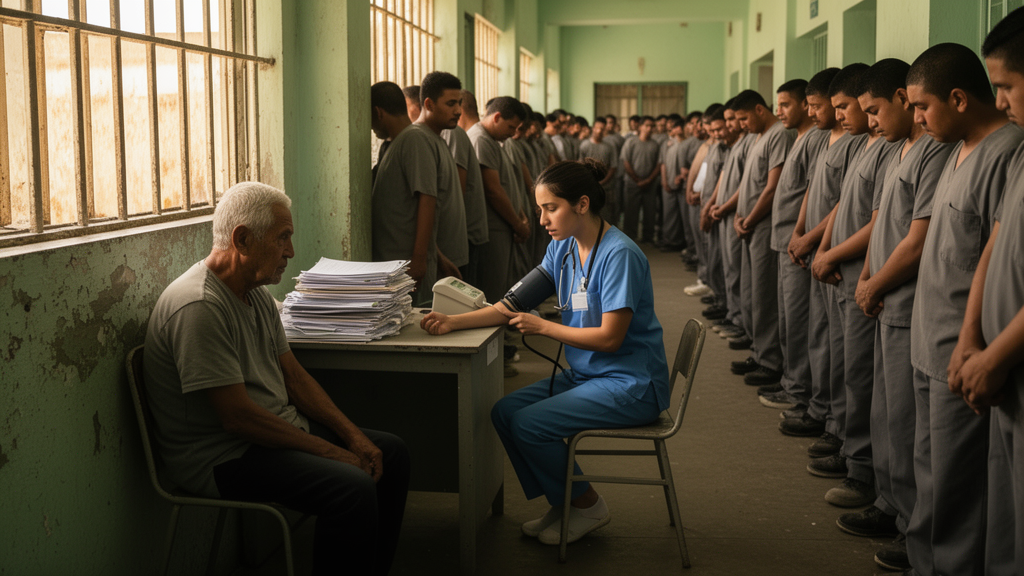
More than one in five chronic-care episodes among people in Mexican prisons went entirely untreated, and a substantial share of the rest was paid for out of prisoners’ own pockets or by their families, according to a secondary analysis of national public data published in BMC Health Services Research. Among 10,280 chronic-care episodes recorded in the 2021 National Survey of the Prison Population (ENPOL), 53.9% (95% CI 52.9–55.0) were provided by the prison health center, 20.8% (19.9–21.7) were self- or family-financed, and 23.1% (22.1–24.0) went untreated. For untreated episodes of non-communicable disease in state prisons, the most frequent reason for absent treatment was that the prison center itself did not provide the service.
The research team, working from public observational sources rather than new fieldwork, went beyond simple prevalence counts. They used ENPOL 2021 microdata to classify chronic-care episodes by provider and financing, and drew on independent samples from the 2021 National Health and Nutrition Survey (ENSANUT) to build age- and sex-standardized treatment benchmarks for the general population, including comparators restricted to lower socioeconomic strata. To examine what is associated with unattended care, they specified a mixed model guided by a directed acyclic graph, relating state-level prison occupancy to unattended care with a documented barrier, while adjusting for marginalization, system size, the share of pretrial detainees, legal status and incarceration duration. Administrative series — the CNSIPEE prison system statistics for 2021–2025 and monthly prison-system reports from 2015 to 2026 — were analyzed ecologically, not as individual follow-up.
The occupancy and staffing results were consistent across specifications. In a sample of 6,301 people across all 32 states, higher state prison occupancy was associated with unattended care, with an adjusted odds ratio of 1.37 per state standard deviation (95% CI 1.12–1.66), essentially unchanged in the survey-weighted model (1.37, 95% CI 1.12–1.67). Greater prison medical staffing moved in the opposite direction: an adjusted odds ratio of 0.75 (95% CI 0.63–0.89) for unattended care. In contrast, the analysis found no clear evidence of an association with medical capacity in the general health system; the authors did not draw a conclusion from this null result about which level of the system matters most.
Comparisons with the general population revealed a stark diabetes gap. Untreated diabetes in prisons exceeded ENSANUT 2021 estimates by 11.55 percentage points (95% CI 7.46–15.65), and this difference persisted even when the comparator was restricted to lower-socioeconomic strata — meaning the gap is not simply an artifact of prisoners coming from poorer backgrounds. The picture for hypertension was more cautious: the initial difference of 13.60 percentage points was not clearly demonstrated when the comparison was restricted to the lowest-wellbeing tercile, so that contrast was not treated as established. Within states, Indigenous identification was associated with 3.6 percentage points (95% CI 1.2–6.0) more unattended care.
Other indicators underscored thin preventive infrastructure. Periodic medical review was reported by only 41.8% of respondents. Contrasts in service availability proved inconclusive, and the administrative mortality series — despite spanning more than a decade of monthly reports — did not support time-ordered inference, meaning the data could not establish whether changes in prison conditions preceded changes in mortality. The authors are explicit that these administrative indicators should be read as monitoring signals rather than as evidence of causal effects, and that the mortality figures in particular cannot be used to draw conclusions about trends over time.
The study’s design carries important limitations that shape how the findings should be interpreted. As a secondary analysis of cross-sectional survey data, it captures associations at a single point in time; the occupancy and staffing associations, however consistent, cannot establish that crowding or understaffing cause unattended care. The ecological treatment of the administrative series means those data describe aggregate patterns, not individual trajectories. The authors call for prospective center-level data with stable identifiers — a data infrastructure that would allow prisons to be tracked over time and evaluated individually — as the necessary next step for accountability.
What the analysis does establish is a structural pattern: ongoing chronic care in Mexican prisons relied substantially on family financing or remained untreated, and higher occupancy and lower prison medical staffing were consistently associated with unattended care across models. The convergence of the diabetes gap with general-population benchmarks, the within-state Indigenous disparity, and the low rate of periodic medical review together sketch a system in which the burden of continuity of care falls on prisoners and their relatives when institutional provision falls short. For prisoners managing conditions such as diabetes and hypertension, the distinction between center-provided, family-financed and absent treatment determines whether care happens at all.
The authors frame their contribution as a national assessment that integrates chronic-care pathways with prison resources, supervision and administrative indicators — domains Mexico had not previously brought together in a single evaluation. They position the administrative monitoring apparatus, which they found inadequate for causal inference, as a candidate for upgrade into the prospective, individually linked data system they propose. Such a system would allow future assessments of Mexico’s prison health services to move from documenting cross-sectional associations toward evaluating changes over time and, ultimately, the effects of interventions.
Subject of Research: Access to chronic disease care and health system performance in Mexican prisons
Article Title: Assessing Mexico’s prison health system: access, care processes, resources, accountability and administrative mortality indicators
Article References: Planter-Pérez, K. A., Gutierrez-Perez, S., De Arcos-Jiménez, J. C., Vargas-Becerra, P. N., Hübbe-Contreras, T. E., Navarro-Ruiz, N. E., Damián-Negrete, R. M., Fernández-Diaz, O. F., Romero-Güémez, M. A., Bugarin-González, E., & Briseno-Ramirez, J. (2026). Assessing Mexico’s prison health system: access, care processes, resources, accountability and administrative mortality indicators. BMC Health Services Research. https://doi.org/10.1186/s12913-026-15894-0
Image Credits: AI Generated
DOI: 10.1186/s12913-026-15894-0
Keywords: Mexico, prison health, chronic disease, health services research, prison overcrowding, medical staffing, diabetes, hypertension, health equity, Indigenous populations, ENPOL 2021, administrative data
Cite Scienmag News
Phoebe Ingram. (October 25, 2026). Crowded prisons and thin medical staffing linked to untreated chronic care in Mexico. Scienmag. https://scienmag.com/crowded-prisons-and-thin-medical-staffing-linked-to-untreated-chronic-care-in-mexico/
Phoebe Ingram. "Crowded prisons and thin medical staffing linked to untreated chronic care in Mexico." Scienmag, 25 October 2026, https://scienmag.com/crowded-prisons-and-thin-medical-staffing-linked-to-untreated-chronic-care-in-mexico/. Accessed 25 October 2026.
Phoebe Ingram. "Crowded prisons and thin medical staffing linked to untreated chronic care in Mexico." Scienmag. October 25, 2026. https://scienmag.com/crowded-prisons-and-thin-medical-staffing-linked-to-untreated-chronic-care-in-mexico/