


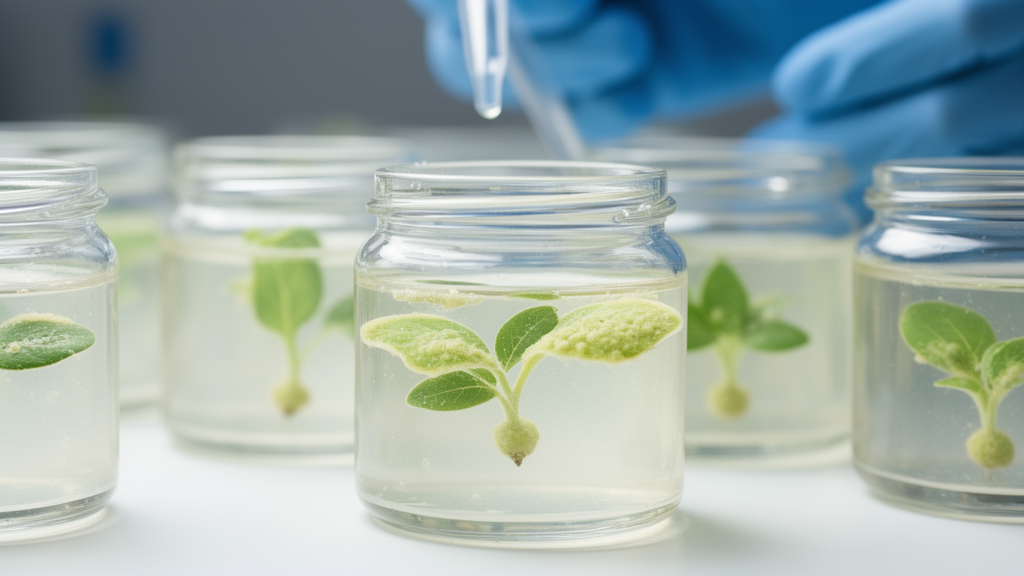
Papaya is one of the tropics’ most valuable fruit crops, yet multiplying elite varieties quickly and reliably has long frustrated growers and breeders. A new study from the Plant Biotechnology Laboratory at Universiti Teknologi MARA in Malaysia reports that the answer lies in getting the hormonal balance exactly right, and that the choice of starting tissue matters just as much. Working with the commercially popular Sekaki cultivar, researchers Abdullahi Mohammed and Nor Azma Yusuf systematically tested combinations of two plant growth regulators, the cytokinin 6-benzylaminopurine (BAP) and the auxin alpha-naphthaleneacetic acid (NAA), to find the formulations that drive callus, the mass of undifferentiated cells that serves as the raw material for plant regeneration, to proliferate fastest and healthiest.
The team excised stem and petiole explants from 45-day-old Sekaki seedlings, surface-sterilized them, and cultured them on Murashige and Skoog basal medium supplemented with BAP at concentrations from 0 to 2.0 milligrams per liter and NAA from 0 to 4.0 milligrams per liter, producing 25 treatment combinations. After an initial induction screen, the four best treatments for each explant type were carried forward into a randomized complete block design with five replicates each, where callus fresh weight, dry weight, length, morphology, and growth rate were measured over a six-week proliferation period.
The results were strikingly explant-specific. For stem-derived callus, the optimal combination proved to be 2.0 milligrams per liter BAP paired with 2.0 milligrams per liter NAA, which produced the highest fresh weight of 8.13 plus or minus 3.64 grams, a dry weight of 0.33 plus or minus 0.08 grams, the longest callus at 3.88 plus or minus 0.61 centimeters, and the fastest growth rate of 1.27 plus or minus 0.57 grams per week. This treatment yielded light yellow, soft, intact tissues, the visual hallmarks of vigorous, regenerable callus.
Petiole explants told a different story. Their best performance came with a slightly richer auxin supply, 2.0 milligrams per liter BAP combined with 3.0 milligrams per liter NAA, delivering 10.56 plus or minus 2.07 grams of fresh weight, 0.37 plus or minus 0.05 grams of dry weight, a callus length of 4.12 plus or minus 0.19 centimeters, and a growth rate of 1.68 plus or minus 0.33 grams per week, all while maintaining a light yellow, compact structure. At their respective optima, petiole explants outperformed stem explants on every measure, with a proliferation velocity roughly 32 percent higher.
The importance of auxin dosage emerged clearly from the comparisons. Holding BAP constant at 2.0 milligrams per liter, dropping NAA to 1.0 milligram per liter slashed stem callus fresh weight to just 1.60 plus or minus 0.61 grams and slowed growth to 0.18 plus or minus 0.07 grams per week, while also producing friable, browned tissue. Pushing NAA up to 4.0 milligrams per liter was also counterproductive, yielding intermediate biomass of 6.17 plus or minus 4.43 grams but with high variability and loosely formed, easily fragmented callus. The lesson is that callus proliferation depends on a balanced cytokinin-to-auxin ratio rather than simply more hormone.
One of the study’s more novel contributions is its use of callus growth rate, calculated as the weekly increase in fresh weight from a standardized 0.5-gram inoculum, rather than relying solely on endpoint biomass measurements. Correlation analysis showed that growth rate tracked final fresh weight almost perfectly, with r-squared values of 0.98 for stem-derived and 0.99 for petiole-derived callus, and it also correlated strongly with dry weight (r-squared of 0.95 and 0.98) and callus length (r-squared of 0.72 and 0.89). This validates growth rate as a reliable, and potentially early, indicator of proliferation efficiency that could speed up protocol optimization in future tissue culture work.
Morphology proved to be more than cosmetic. The light yellow, soft, intact calli produced under the optimal treatments are consistent with high viability and mitotic activity, whereas the browning and green patches seen in stem-derived callus under suboptimal regimes, such as 1.0 milligram per liter BAP with 1.0 milligram per liter NAA, reflect phenolic accumulation and partial differentiation that typically compromise regenerative capacity. Petiole tissues tolerated a wider range of hormonal combinations while retaining good color and texture, whereas stem callus lost coherence and browned outside a narrow hormonal window.
The authors attribute the petiole’s superior performance to differences in endogenous hormone content, cellular organization, and physiological responsiveness to externally supplied regulators, though they note that endogenous hormone levels were not directly measured in this study. Consistency is another practical advantage: the optimized petiole treatment showed lower variability among replicates (plus or minus 0.33 grams per week) than the best-performing high-auxin stem treatment (plus or minus 0.68 grams per week), a quality highly desirable in commercial tissue culture, where uniform proliferation eases production planning, quality control, and cost management.
The study does have limitations the researchers themselves acknowledge. No histological characterization was performed, so the regenerative competence of the different callus types could not be confirmed at the cellular level. Growth rate was assessed over a single six-week period with standardized subcultures, and more frequent sampling would be needed to build detailed growth curves. Only the Sekaki cultivar was tested, so whether these exact hormone recipes transfer to other commercial papaya varieties remains to be determined, and factors such as explant physiological age, genotype, and environment may also influence outcomes.
Even with those caveats, the work delivers a reproducible starting protocol for papaya biotechnology: Murashige and Skoog medium with 2.0 milligrams per liter BAP plus 2.0 milligrams per liter NAA for stem explants, and 2.0 milligrams per liter BAP plus 3.0 milligrams per liter NAA for petiole explants. Because papaya propagates sexually by seed, producing genetically heterogeneous progenies with limited seed viability, clonal systems like this one are essential for maintaining true-to-type planting material. The optimized combinations provide a foundation for micropropagation, somatic embryogenesis, genetic transformation, and in vitro production of bioactive compounds, and they suggest that petiole tissue, long overshadowed by leaves and hypocotyls, deserves a central place in future papaya improvement programs.
Subject of Research: Optimization of BAP and NAA hormone combinations for callus proliferation from stem and petiole explants of papaya cv. Sekaki
Article Title: Effect of BAP and NAA on callus proliferation and characteristics of papaya (Carica papaya L.) cv. Sekaki explants
Article References: Mohammed, A., & Yusuf, N. A. (2026). Effect of BAP and NAA on callus proliferation and characteristics of papaya (Carica papaya L.) cv. Sekaki explants. Discover Plants, 3(1), Article 493. https://doi.org/10.1007/s44372-026-00811-w
Image Credits: AI Generated
DOI: 10.1007/s44372-026-00811-w
Keywords: papaya, tissue culture, callus proliferation, BAP, NAA, plant growth regulators, micropropagation, petiole explants, Sekaki cultivar, growth rate, plant biotechnology, Carica papaya
Cite Scienmag News
Alan Morgan. (October 25, 2026). Hormone Recipe Unlocks Rapid Callus Growth in Papaya Tissue Culture. Scienmag. https://scienmag.com/hormone-recipe-unlocks-rapid-callus-growth-in-papaya-tissue-culture/
Alan Morgan. "Hormone Recipe Unlocks Rapid Callus Growth in Papaya Tissue Culture." Scienmag, 25 October 2026, https://scienmag.com/hormone-recipe-unlocks-rapid-callus-growth-in-papaya-tissue-culture/. Accessed 25 October 2026.
Alan Morgan. "Hormone Recipe Unlocks Rapid Callus Growth in Papaya Tissue Culture." Scienmag. October 25, 2026. https://scienmag.com/hormone-recipe-unlocks-rapid-callus-growth-in-papaya-tissue-culture/


