


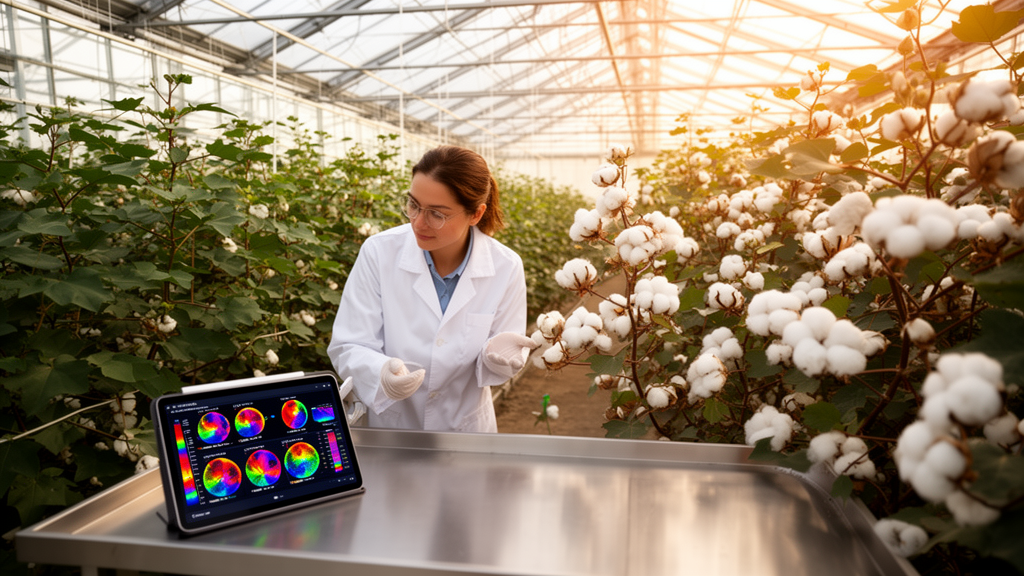
Machine learning models that explicitly account for how genes respond to their environment have been used to improve genomic prediction across four crop species and to propose, entirely through simulation, redesigned genomes for elite cotton lines. The study, published in Theoretical and Applied Genetics, integrated genome-wide markers associated with environmental responsiveness and phenotypic plasticity into core marker sets, then coupled them with environmental covariates in genomic selection models. Evaluations spanning 13 phenotypic traits in four crops identified LightGBM and random forest regression as the top-performing algorithms, with LightGBM showing the most consistent superiority across scenarios, particularly when predicting performance in untested environments.
Its known weakness is genotype-environment interaction, the phenomenon by which a variety that excels in one location or season may falter in another, compromising yield stability and climate adaptation. By folding these adaptive markers into prediction models together with environmental covariates, the models achieved improved cross-environment predictive accuracy, meaning they could estimate how a given genotype would perform not just where it was measured, but across the range of conditions represented in the training data. The most striking application came in an in-silico genome-design analysis of cotton, where the team used SHAP-based interpretation within the fitted predictive model to propose candidate marker configurations for real breeding lines.
In six elite fiber lines, modification of 23 to 36 markers associated with BLUP-adjusted traits was predicted to improve boll weight by 2.2 to 6.3 percent and lint percentage by 0.2 to 3.9 percent in target environments. When the analysis additionally optimized markers linked to plasticity and environmental responsiveness, the predicted gains rose further, to 3.5 to 7.2 percent for boll weight and 2.3 to 3.5 percent for lint percentage. In 11 high-yield lines, modification of BLUP-associated markers was predicted to improve fiber length by 0 to 2.4 percent and fiber strength by 0.4 to 3.9 percent, with environment-interaction markers predicted to enhance these traits by a further 0.8 to 3.7 percent.
These figures are model outputs describing what the fitted algorithms predict would happen if the proposed marker configurations were realized in a breeding program. One of the study's most suggestive observations concerns the adaptive markers themselves. Between 78 and 85 percent of environment-specific markers exhibited high SHAP values, a measure of each marker's contribution to the model's predictions, even though these loci only partially overlapped with the markers associated with BLUP-adjusted traits.
The authors suggest this partial overlap indicates that environment-specific markers capture genetic effects that conventional trait-associated marker sets miss, making them potentially relevant to adaptive breeding aimed at climate adaptability rather than yield alone. The researchers are explicit that these improvements derive from in-silico model simulations and should be interpreted as candidate breeding targets rather than validated genetic gains. No redesigned cotton line has yet been created or field-tested; the numbers describe what the fitted models predict would happen if the proposed marker configurations were realized.
By demonstrating consistent performance across 13 traits and four crops, and by showing particular strength in untested environments, the study positions LightGBM-style machine learning as a pivotal tool for genotype-environment-driven breeding strategies. The ability to optimize yield, fiber quality, and environmental adaptability within a single predictive framework addresses what the authors describe as multi-objective breeding, the simultaneous improvement of several traits at once. Whether the predicted gains survive contact with real fields remains to be established by future validation work.
For now, the study's contribution is a predictive framework rather than a finished variety. It shows that machine learning can identify environment-responsive loci genome-wide, fold them into genomic selection models with improved cross-environment accuracy, and translate SHAP-based interpretation into concrete candidate marker configurations for elite cotton lines.
Subject of Research: Machine learning-based genomic selection incorporating genotype-environment interactions for multi-trait crop improvement and in-silico cotton genome design
Article Title: A predictive approach to genome design for multi-trait improvement and environmental adaptability via machine learning
Article References: Han, X., Yan, H., Liu, K., Gong, J., Gong, W., Dai, P., Harrison, M. T., Wang, B., Li, Y., Pan, J., Gao, X., Shi, Y., Yuan, Y., & Shang, H. (2026). A predictive approach to genome design for multi-trait improvement and environmental adaptability via machine learning. Theoretical and Applied Genetics, 139(11), Article 315. https://doi.org/10.1007/s00122-026-05416-1
Image Credits: AI Generated
DOI: 10.1007/s00122-026-05416-1
Keywords: genomic selection, machine learning, genotype-environment interaction, cotton breeding, LightGBM, SHAP, phenotypic plasticity, climate adaptability, in-silico genome design, crop improvement, multi-trait breeding, fiber quality
Cite Scienmag News
Alan Morgan. (October 25, 2026). Machine learning predicts genome designs for multi-trait cotton and crop breeding. Scienmag. https://scienmag.com/machine-learning-predicts-genome-designs-for-multi-trait-cotton-and-crop-breeding/
Alan Morgan. "Machine learning predicts genome designs for multi-trait cotton and crop breeding." Scienmag, 25 October 2026, https://scienmag.com/machine-learning-predicts-genome-designs-for-multi-trait-cotton-and-crop-breeding/. Accessed 25 October 2026.
Alan Morgan. "Machine learning predicts genome designs for multi-trait cotton and crop breeding." Scienmag. October 25, 2026. https://scienmag.com/machine-learning-predicts-genome-designs-for-multi-trait-cotton-and-crop-breeding/


