


Neuropathic pain, the burning, electric-shock-like pain caused by damage to the somatosensory nervous system itself, affects roughly 7 to 10 percent of the world’s population. A growing body of evidence now suggests that many of these patients face a second, quieter burden: cognitive impairment. Epidemiological data reviewed in a new narrative analysis indicate that cognitive impairment occurs in 11.4 to 31.7 percent of people with neuropathic pain, far above rates in the general population, touching information processing speed, executive function and overall cognition. Patients describe it as brain fog, and imaging studies have even documented hippocampal atrophy that in some cases reverses once pain is relieved after surgery.
The review, which synthesized literature from PubMed and Web of Science published through December 2025, argues that pain and cognitive decline are not separate problems that merely coexist. They share a tangled web of pathological mechanisms that feed one another through positive feedback loops. At the molecular level, peripheral nerve injury releases adenosine triphosphate, chemokines and damage-associated molecular patterns in the spinal dorsal horn. Microglia, the brain’s resident immune cells, detect these signals through purinergic receptors such as P2X4R and P2X7R and Toll-like receptor 4, polarizing into a pro-inflammatory state. Activated astrocytes then pour out inflammatory mediators including IL-6, CCL2 and CXCL1, weaken the blood-brain barrier, and downregulate the glutamate transporter GLT-1, allowing the excitatory neurotransmitter to accumulate to toxic levels in the synaptic cleft.
The consequences ripple outward. Inflammatory factors suppress brain-derived neurotrophic factor while reactive oxygen species and nitric oxide accumulate, accelerating neuronal apoptosis and aberrant circuit remodeling. Meanwhile, chronic pain depletes the monoaminergic neurotransmitters norepinephrine and serotonin, weakening descending pain inhibitory pathways, while excessive glutamatergic excitation through NMDA receptors amplifies pain signals. Overactive pain signaling also drives the hypothalamic-pituitary-adrenal axis into sustained overdrive, flooding the hippocampus and prefrontal cortex with neurotoxic levels of glucocorticoids that impair learning, memory and executive function, completing a vicious cycle of pain, neurotransmitter dysregulation and cognitive decline.
At the level of whole brain networks, the review describes how sustained pain hyperactivates the salience network, the brain’s switching hub that normally directs attention between the internally focused default mode network and the externally oriented central executive network. With its gating function impaired, cognitive resources remain locked onto pain processing, starving attention, working memory and executive control. Neuroimaging confirms structural correlates: reduced gray matter volume and cortical thinning in the hippocampus, prefrontal cortex and anterior cingulate cortex, changes significantly correlated with memory decline and pain progression. Upstream, genetic susceptibility adds further risk, with the apolipoprotein E ε4 allele and the BDNF Val66Met polymorphism each weakening synaptic plasticity and pain inhibition, while disrupted sleep, physical inactivity and chronic stress accelerate the decline.
A fifth mechanism runs through the gut-brain axis. Chronic stress disrupts gut motility and barrier integrity, allowing microbial products such as lipopolysaccharides to leak into the bloodstream and trigger low-grade systemic inflammation that reaches the brain via vagal afferents and weakened blood-brain barrier regions. Dysbiosis simultaneously reduces production of anti-inflammatory short-chain fatty acids and shifts tryptophan metabolism toward neurotoxic quinolinic acid. Notably, specific probiotics such as gut Roseburia have been shown in research cited by the review to activate vagal pathways, inhibit pain-related brain regions and promote butyrate production, improving both pain behaviors and learning and memory deficits in experimental settings.
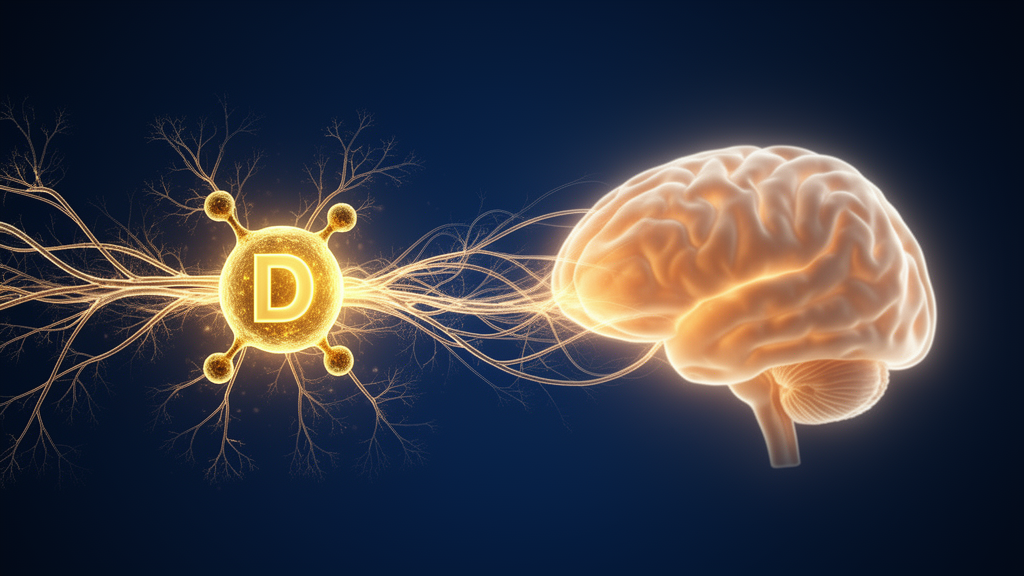
Into this mechanistic landscape steps vitamin D, redefined in recent decades as a pleiotropic secosteroid rather than a mere bone hormone. Its active form, 1,25-dihydroxyvitamin D3, crosses the blood-brain barrier and binds the vitamin D receptor, which is densely expressed in the hippocampal CA1-CA4 regions and dentate gyrus, the hypothalamic suprachiasmatic and paraventricular nuclei, the amygdala, and dopaminergic neurons of the substantia nigra. Mechanistically, the review details how the active vitamin binds VDR to form a transcriptional complex that inhibits the NF-κB inflammatory pathway through a dual mechanism involving physical interaction with IκB kinase β and the p50 subunit of NF-κB, steering microglia away from the pro-inflammatory M1 phenotype toward the reparative M2 state that releases IL-10, TGF-β and BDNF.
Vitamin D also appears to act on nearly every other shared pathway. It upregulates GLT-1 to clear synaptic glutamate, promotes GABA synthesis to restore inhibitory tone, strengthens hippocampal glucocorticoid receptor feedback to calm the HPA axis, and regulates genes of the endogenous opioid system including Penk and Pomc, offering an analgesic mechanism independent of its anti-inflammatory effects. It may even intervene epigenetically: studies cited report that the VDR gene promoter becomes hypermethylated under pain conditions, and vitamin D can reverse this modification, while also enhancing methylation activity of protein phosphatase 2A to reduce aggregation of hyperphosphorylated Tau protein. In the gut, VDR signaling tightens junction proteins, reverses dysbiosis and participates in a positive feedback loop with butyrate that inhibits histone deacetylase 3.
The clinical picture, however, is far more cautious than the mechanism is elegant. Observational studies consistently link low vitamin D status to diabetic peripheral neuropathy, postherpetic neuralgia and dementia risk; a 2025 dose-response meta-analysis of 22 observational studies covering 53,122 participants found low vitamin D associated with a 49 percent increased dementia risk, with each 10 nmol/L rise in serum 25-hydroxyvitamin D corresponding to a 1.2 percent lower risk. A 2025 meta-analysis of four randomized trials in 320 patients with painful diabetic neuropathy found supplementation significantly reduced short-term pain, equivalent to an 11-point drop on common pain scales, though with moderate heterogeneity and small samples.
Yet trials in replete populations tell a different story. In the D-Health cohort analysis, monthly 60,000 IU vitamin D3 for up to five years had little effect on pain in people whose baseline levels already exceeded 50 nmol/L. The VITAL cognitive substudy found 2000 IU daily did not slow cognitive decline in community-dwelling older adults, and the 2025 VitaMIND trial of 620 adults aged 50 and over with mild deficiency and early cognitive impairment showed no significant benefit on executive function or cognition over 24 months. A meta-analysis of 24 randomized trials did detect a statistically significant but very small overall cognitive effect, with benefits concentrated in frail elderly participants and those with baseline deficiency, supporting a threshold hypothesis: once serum levels are adequate, extra supplementation offers little.
The review’s authors conclude that vitamin D supplementation may serve as a potential adjunctive strategy for patients with comorbid neuropathic pain and cognitive impairment, particularly given its safety, low cost and accessibility compared with opioids, which carry dependence risks, and anticonvulsants, which often cause cognitive dulling. But they are explicit that the evidence does not yet justify routine clinical recommendations. No high-quality randomized trials have targeted comorbid patients with both pain relief and cognitive improvement as dual primary endpoints, no consensus exists on screening or dosing protocols for this population, and the adult tolerable upper intake level remains 4000 IU per day. Future priorities include trials stratified by baseline vitamin D status and VDR gene polymorphisms, biomarker-driven enrichment of deficient subgroups, and multi-omics work to map how one secosteroid might simultaneously quiet inflamed glia, rebalance brain networks and protect a fading hippocampus.
Subject of Research: The shared mechanisms linking neuropathic pain, cognitive impairment and vitamin D status
Article Title: Neuropathic Pain Comorbid Cognitive Impairment and Vitamin D: A Narrative Review From Mechanisms to Clinical Management
Article References: Zhao, N., Yang, Y., Yu, W., Zhu, Y., & Zhu, Z. (2026). Neuropathic Pain Comorbid Cognitive Impairment and Vitamin D: A Narrative Review From Mechanisms to Clinical Management. Food Science & Nutrition, 14(10), Article e72440. https://doi.org/10.1002/fsn3.72440
Image Credits: AI Generated
DOI: 10.1002/fsn3.72440
Keywords: neuropathic pain, cognitive impairment, vitamin D, neuroinflammation, microglia, gut-brain axis, hippocampus, blood-brain barrier, vitamin D receptor, randomized controlled trials, HPA axis, brain networks
Cite Scienmag News
Cassandra Pierce. (October 25, 2026). Vitamin D Emerges as Possible Bridge Between Neuropathic Pain and Brain Fog. Scienmag. https://scienmag.com/vitamin-d-emerges-as-possible-bridge-between-neuropathic-pain-and-brain-fog/
Cassandra Pierce. "Vitamin D Emerges as Possible Bridge Between Neuropathic Pain and Brain Fog." Scienmag, 25 October 2026, https://scienmag.com/vitamin-d-emerges-as-possible-bridge-between-neuropathic-pain-and-brain-fog/. Accessed 25 October 2026.
Cassandra Pierce. "Vitamin D Emerges as Possible Bridge Between Neuropathic Pain and Brain Fog." Scienmag. October 25, 2026. https://scienmag.com/vitamin-d-emerges-as-possible-bridge-between-neuropathic-pain-and-brain-fog/


