


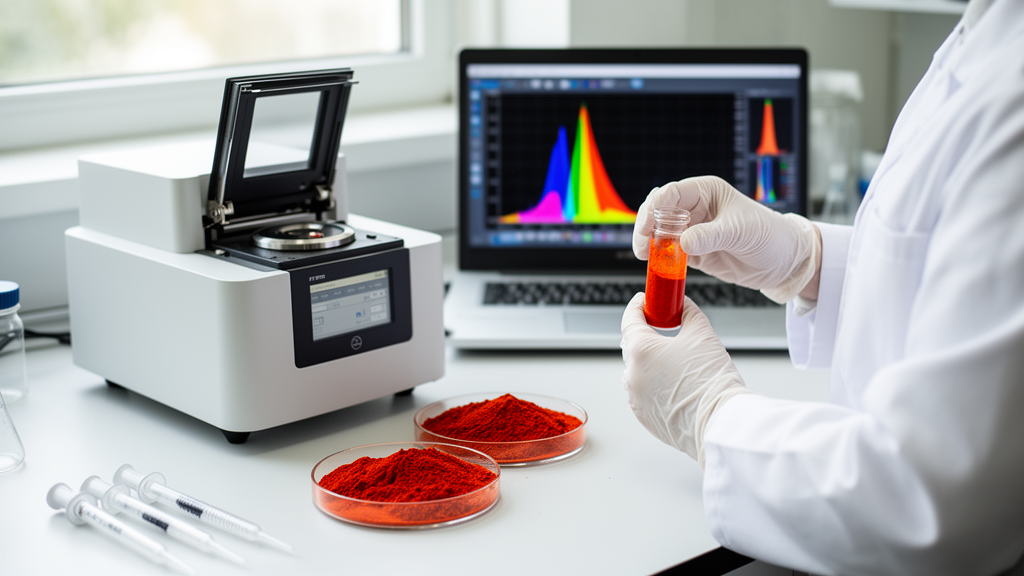
Researchers have developed a rapid analytical method that combines magnetic molecularly imprinted solid-phase extraction with machine learning-assisted Fourier transform infrared (FTIR) spectroscopy to quantify Sudan I in chili powder. The study, published in npj Science of Food, reports that the complete workflow, from sample extraction through machine learning-based prediction, can be completed within 90 minutes, offering a faster alternative to conventional confirmatory techniques for monitoring illicit dyes in food commodities.
Sudan I is among the illicit dyes that food safety authorities seek to monitor in food commodities, and its detection in complex matrices such as chili powder has traditionally required chromatographic confirmatory techniques. While these methods deliver high accuracy, they are time-consuming and costly. Rapid screening tools, by contrast, are fast but often less precise. The new method was designed to bridge this trade-off between accuracy and speed.
The key methodological innovation lies in a ratio-based feature engineering strategy. Peak areas of Sudan I characteristic bands at 1600, 1550, and 1350 cm⁻¹ are normalized against reference bands at 590 and 425 cm⁻¹ that originate from the Fe3O4 magnetic core of the extraction material. According to the authors, this approach effectively compensates for variability in sample mass and in potassium bromide (KBr) pellet preparation, which they describe as a long-standing but previously unaddressed challenge in quantitative FTIR analysis.
The extraction relies on Fe3O4@SiO2@MIPS nanoparticles, which are magnetic molecularly imprinted polymers built around an iron oxide core. These particles selectively adsorb Sudan I from the sample. Notably, the method requires no elution step: instead of washing the captured dye off the particles for separate analysis, the nanoparticles with adsorbed Sudan I are directly mixed with KBr for FTIR measurement.
This design gives the Fe3O4 core a dual role. It simultaneously serves as the carrier for the adsorbent and as an internal standard in the FTIR spectrum. Because the magnetic reference bands are measured in the same pellet as the Sudan I bands, the ratio-based normalization can correct for differences in how much material ends up in each pellet, improving the quantitative reliability of the spectral data.
To turn the normalized spectral features into concentration estimates, the researchers systematically compared ten regression algorithms. Random Forest emerged as the optimal model, achieving a coefficient of determination (R²) of 0.938, a root mean square error (RMSE) of 7.459 mg/L, and a ratio of performance to deviation (RPD) of 4.017 on an independent test set. These metrics indicate that the model captured the relationship between the spectral ratios and Sudan I concentrations with substantial predictive strength.
Method validation using spiked chili powder samples yielded recoveries between 92.0 and 97.0 percent, with good precision reflected in relative standard deviations below 9.5 percent. Recovery values in this range indicate that the measured concentrations closely tracked the amounts of Sudan I added to the samples, while the low relative standard deviations show that repeated measurements were consistent.
The authors position the platform as a practical route to high-throughput, lower-cost monitoring of illicit dyes in food commodities. They also note its potential adaptation to portable FTIR instrumentation for on-site applications, which could move testing out of centralized laboratories and closer to points of production or inspection.
Subject of Research: Machine learning-assisted FTIR detection of Sudan I in chili powder using magnetic molecularly imprinted solid-phase extraction
Article Title: Machine learning-assisted detection of Sudan I in chili powder using FT-IR coupled with magnetic molecular imprinting extraction
Article References: Zhang, Y., Chen, Z., Coghi, P., Feng, X., Li, Z., Zhong, T., Xiao, Y., Gao, P., & Yu, X. (2026). Machine learning-assisted detection of Sudan I in chili powder using FT-IR coupled with magnetic molecular imprinting extraction. npj Science of Food. https://doi.org/10.1038/s41538-026-01155-1
Image Credits: AI Generated
DOI: 10.1038/s41538-026-01155-1
Keywords: Sudan I, chili powder, FTIR spectroscopy, machine learning, Random Forest, magnetic molecularly imprinted polymers, solid-phase extraction, food safety, food adulteration, analytical chemistry, Machine, learning-assisted
Cite Scienmag News
Teresa Odom. (October 24, 2026). Machine Learning and FTIR Spectroscopy Team Up to Detect Sudan I Dye in Chili Powder. Scienmag. https://scienmag.com/machine-learning-and-ftir-spectroscopy-team-up-to-detect-sudan-i-dye-in-chili-powder/
Teresa Odom. "Machine Learning and FTIR Spectroscopy Team Up to Detect Sudan I Dye in Chili Powder." Scienmag, 24 October 2026, https://scienmag.com/machine-learning-and-ftir-spectroscopy-team-up-to-detect-sudan-i-dye-in-chili-powder/. Accessed 24 October 2026.
Teresa Odom. "Machine Learning and FTIR Spectroscopy Team Up to Detect Sudan I Dye in Chili Powder." Scienmag. October 24, 2026. https://scienmag.com/machine-learning-and-ftir-spectroscopy-team-up-to-detect-sudan-i-dye-in-chili-powder/


