


Scientists have unveiled a computational framework that can simulate one of the most versatile tools of nanotechnology — focused electron beam-induced deposition, or FEBID — under the same millisecond timescales and submicrometer dimensions used in real laboratories, while still tracking the fate of individual molecules. The new study, published in Frontiers in Physics, was led by Ilia Solov'yov of Carl von Ossietzky Universität Oldenburg together with Alexey Prosvetov, Gennady Sushko and Andrey Solov'yov of the MBN Research Center in Frankfurt. Rather than optimizing parameters for a single material system, the team set out to establish a general, transferable modeling methodology built on stochastic dynamics and implemented in the MBN Explorer and MBN Studio software packages.
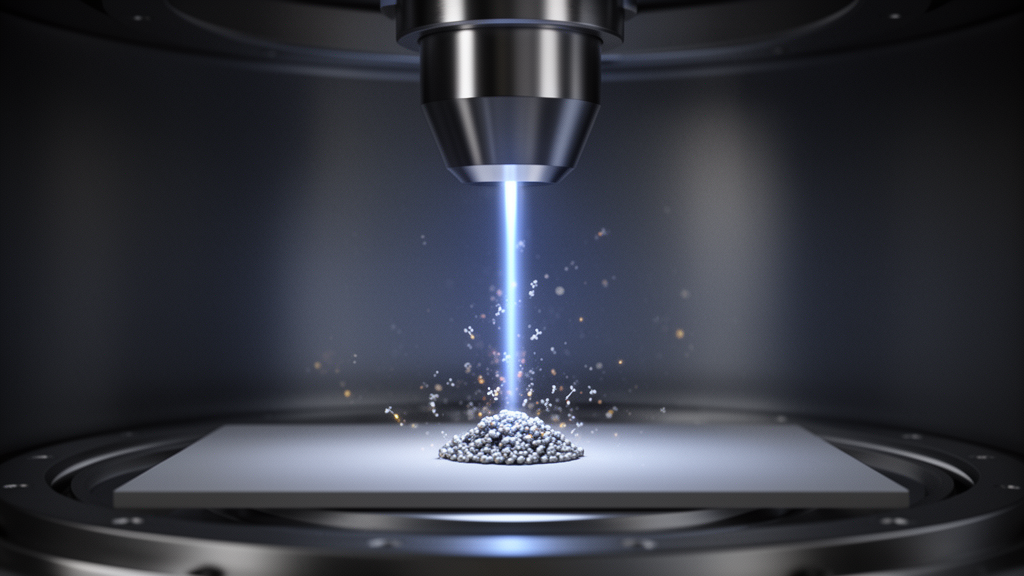
As a benchmark, they simulated the deposition of tungsten hexacarbonyl, W(CO)6, precursor molecules onto a hydroxylated silicon surface irradiated by a 30 keV electron beam, and the simulated deposits reproduced key experimental trends in growth behavior, geometry and composition. FEBID is a direct-write nanofabrication technique capable of creating metal nanostructures with complex three-dimensional geometries. Organometallic precursor molecules are injected into a vacuum chamber, adsorb onto a substrate surface, and are then bombarded by a tightly focused electron beam.
The volatile molecular fragments released during electron-induced decomposition are pumped away by the vacuum system, while metal-containing fragments remain behind, forming a deposit whose smallest features are set by the beam itself — down to a few nanometers. By steering the beam position, tuning its current and controlling the precursor flux, operators can grow three-dimensional metal structures with designed properties. Yet the technique has a persistent Achilles' heel: contamination.
Deposits typically incorporate carbon and oxygen residues from incomplete precursor fragmentation, and low-energy secondary electrons emitted outside the focal point of the primary beam trigger reactions beyond the intended spot, producing an undesired halo and edge broadening of the structure. The central difficulty in modeling FEBID is the staggering range of timescales involved. Electron-induced precursor fragmentation occurs within femtoseconds, while surface kinetic processes such as adsorption, diffusion and desorption unfold over microseconds to milliseconds.
Earlier continuum models based on reaction-diffusion equations described adsorbed precursors only in terms of average surface concentrations and relied on predefined empirical rate constants, capturing growth rates and gross geometry but offering no information about the deposit's internal structure or elemental composition. At the other extreme, irradiation-driven molecular dynamics simulations resolve every atom and incorporate quantum processes such as ionization and dissociative electron attachment as stochastic, fast and local transformations within a classical molecular dynamics framework. These atomistic simulations have demonstrated FEBID for several precursors, but their computational cost limits them to tens of nanometers and tens of nanoseconds, forcing researchers to rescale electron fluxes and dwell times away from experimental values.
The new approach bridges these scales through stochastic dynamics, which describes a system probabilistically by defining a set of constituent species, the transformation processes between them, and the rate constants governing those processes. The simulation unfolds stepwise on a cubic grid whose cell size, 0.63 nanometers, matches the physical size of a W(CO)6 molecule. Each cell can host a particle of a defined type: intact precursors, partially fragmented species W(CO)6-i with varying numbers of attached ligands, pure tungsten atoms, and detached carbon monoxide ligands.
The hydroxylated substrate is modeled as a monolayer of immobile particles at the lower boundary. Notably, the team restricted the description to neutral species, arguing that transient ionized intermediates formed during electron-induced fragmentation exist in a dense molecular environment where frequent interactions with surrounding fragments and the substrate drive rapid charge neutralization, so the longer-lived mobile species governing diffusion, detachment and uptake can be treated as effectively neutral. The rate constants feeding the stochastic model were derived from atomistic molecular dynamics simulations using a reactive CHARMM force field.
The team computed interaction potential energy curves for W(CO)6 molecules and tungsten atoms detaching from both the substrate and from islands of precursor molecules, fitting each profile with a Morse potential to extract detachment energies and characteristic vibrational frequencies. Applying an Arrhenius approximation at 300 K then yielded detachment rate constants based on detachment energies of, for example, 0.33 electronvolts for the intact precursor binding to the substrate and 0.48 electronvolts for a tungsten atom. Because the actual energy landscapes deviate substantially from harmonic behavior, featuring anharmonicity and multistep dissociation pathways, the authors introduced an empirical correction factor to account phenomenologically for the expected reduction in true rates.
Detachment parameters for the fragmented precursors were obtained by linear extrapolation between the simulated extremes, and surface diffusion coefficients were adapted from the literature. To probe the sensitivity of predictions to these microscopic inputs, the team ran simulations with three distinct parameter sets of pairwise detachment probabilities. The simulation protocol mirrors experimental practice with remarkable fidelity.
FEBID was modeled as a sequence of 100 irradiation and replenishment cycles, each irradiation phase lasting 1.01 milliseconds and each replenishment phase 0.40 milliseconds, for a total simulated time of 141 milliseconds — durations consistent with experimentally reported values, and with every process operating at its actual rate. The fragmentation rate distribution of precursors under the focused beam was taken from an earlier track-structure Monte Carlo study and fitted with a piecewise function capturing both the primary electron contribution within the 5-nanometer beam spot and the broader secondary electron contribution outside it. During fragmentation events, the remaining W(CO)x fragment retains the grid position of its parent while the detached CO ligand is randomly placed into a vacant neighboring cell; if no such cell exists, fragmentation cannot occur, naturally accounting for steric inhibition in densely occupied regions.
The simulation box was dynamically extended in the vertical direction as material accumulated, preserving realistic free volume for precursor injection. The simulated deposit evolves through recognizable stages. After three cycles, only a thin, disordered layer of precursors and fragments has formed, dotted with a few isolated clusters where the beam strikes the substrate.
By the tenth cycle, a three-dimensional structure is emerging, and all precursors above the surface have disappeared by the end of the replenishment phase. By cycle 20, metal-containing species concentrate near the beam center with increasing vertical build-up, and by cycle 50 a well-defined bell-shaped structure has formed, its dense tungsten-rich core surrounded by a less dense periphery of partially fragmented precursors undergoing lateral diffusion. After 100 complete cycles, a pronounced nanostructure with a peak height of approximately 15 nanometers stands on the surface, its core composed of highly fragmented W(CO)6 derivatives while peripheral regions show metal-rich islands and dispersed fragments — features attributed to secondary electrons and stochastic diffusion beyond the primary beam spot.
One of the most striking results is the spatial composition profile. The tungsten content does not peak at the beam center but reaches its maximum at an intermediate radial distance, forming a distinct ring-like, crown-shaped feature. The authors explain this inhomogeneity through constrained molecular mobility: as the structure thickens at the center, its dense particle network increasingly restricts the escape of CO ligands, suppressing further dissociation and lowering the net metal fraction, while the more accessible beam periphery allows efficient ligand escape and higher metal accumulation.
This crown-like distribution agrees qualitatively with prior experimental observations of metal-enriched rings surrounding FEBID structures. Among the three parameter sets, Set 3 proved the most physically realistic, yielding a final tungsten content of roughly 15 percent in the central deposit region and a height near 15 nanometers after 100 cycles, corresponding to a vertical growth rate of 0.11 nanometers per millisecond. The authors note that typical experimental tungsten contents for W(CO)6-based FEBID fall within 25 to 40 percent depending on conditions, and that experimentally reported vertical deposition rates typically range from 150 to 500 nanometers per second, so the simulated values remain below these experimental ranges while capturing the qualitative trends.
The authors emphasize that the specific numerical values used here serve to demonstrate the framework's functioning rather than to provide the most accurate possible parametrization, and that measurable characteristics such as metal content and growth rate proved relatively insensitive to the small parameter variations considered. The strength of the methodology lies in its flexibility: different precursors, substrates, beam conditions and even co-reactants such as oxygen can be incorporated simply by supplying the corresponding input parameters. Nor is the approach limited to FEBID — the team notes it can be applied to other nanoscale growth techniques including atomic layer deposition, chemical vapor deposition and physical vapor deposition, whether driven by radiation, plasma or thermal processes.
Future extensions will add beam-induced heating effects and push simulations to the still larger scales needed for FEBID-based 3D nanoprinting, bringing predictive, atomistically informed design of nanostructures a decisive step closer to the fabrication floor.
Subject of Research: Multiscale stochastic dynamics simulation of focused electron beam-induced deposition
Article Title: Stochastic dynamics simulation of the focused electron beam induced deposition process
Article References: Solov’yov, I. A., Prosvetov, A., Sushko, G., & Solov’yov, A. V. (2026). Stochastic dynamics simulation of the focused electron beam induced deposition process. Frontiers in Physics, 14, Article 1918870. https://doi.org/10.3389/fphy.2026.1918870
Image Credits: AI Generated
DOI: 10.3389/fphy.2026.1918870
Keywords: FEBID, stochastic dynamics, multiscale modeling, nanofabrication, W(CO)6 precursor, electron beam, MBN Explorer, molecular dynamics, 3D nanoprinting, tungsten nanostructures, irradiation-driven chemistry, kinetic Monte Carlo
Cite Scienmag News
Bethany Barker. (October 24, 2026). Research report: Stochastic dynamics simulation of the focused electron beam induced deposition process. Scienmag. https://scienmag.com/research-report-stochastic-dynamics-simulation-of-the-focused-electron-beam-induced-deposition-process/
Bethany Barker. "Research report: Stochastic dynamics simulation of the focused electron beam induced deposition process." Scienmag, 24 October 2026, https://scienmag.com/research-report-stochastic-dynamics-simulation-of-the-focused-electron-beam-induced-deposition-process/. Accessed 24 October 2026.
Bethany Barker. "Research report: Stochastic dynamics simulation of the focused electron beam induced deposition process." Scienmag. October 24, 2026. https://scienmag.com/research-report-stochastic-dynamics-simulation-of-the-focused-electron-beam-induced-deposition-process/


