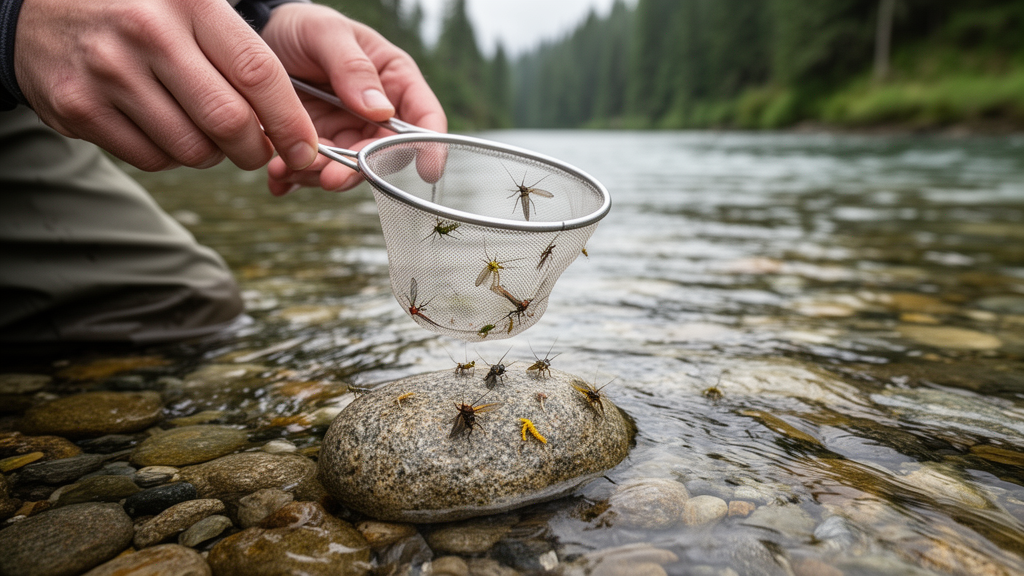
When the largest dams ever dismantled came down on Washington State’s Elwha River, the sediment pulse that followed wiped out as much as 95 percent of the river’s benthic macroinvertebrate community in the most affected sections. Yet within three years of peak sediment transport subsiding, invertebrate densities had rebounded to near baseline levels. The surprise, documented in a nine-year monitoring study published in Frontiers in Ecology and Evolution, is that abundance recovered far faster than diversity: taxa richness and community composition remained significantly altered three years after dam removal was complete, with persistent losses concentrated among caddisflies and long-lived taxa. The findings draw a sharp line between numerical recovery and ecological recovery, and suggest that restoration trajectories following large dam removal extend well beyond the period of active sediment release.
The Elwha and Glines Canyon dams, removed in phases between 2011 and 2014, were at the time of their dismantling the largest dams yet taken down worldwide, a distinction later surpassed by the Klamath River removals. The 32-meter Elwha Dam, completed in 1912 near the river mouth, and the 64-meter Glines Canyon Dam, completed in 1927 further upstream, had blocked anadromous fish from roughly 90 percent of the watershed for a century. Neither dam included fish passage, and total salmon abundance in the river declined by an estimated 95 percent over the following decades. Their removal reconnected the watershed, released more than 20 megatonnes of reservoir sediment downstream, and restored natural sediment and wood transport processes. Roughly 30 megatonnes of sediment, approximately evenly divided between fine and coarse material, had accumulated behind the two dams, with 77 percent stored in the Mills Reservoir upstream of Glines Canyon Dam.
A team led by researchers at the National Oceanic and Atmospheric Administration’s Northwest Fisheries Science Center, the U.S. Geological Survey, the U.S. Fish and Wildlife Service, and the Lower Elwha Klallam Tribe monitored benthic macroinvertebrates across five distinct river sections: the Lower Elwha downstream of both dams, the Middle Elwha between them, the former Aldwell and Mills reservoir reaches, and four tributaries. The sections spanned three overlapping impact gradients: downstream sediment disturbance, floodplain succession within the former reservoirs, and anadromous fish reintroduction upstream of the former dams. Sampling covered three years before dam removal (2004 to 2006), three years during (2012 to 2014), and three years after (2015 to 2017), capturing both the acute pulse phase of disturbance and the first three years of the longer press phase of adjustment.
The physical changes to the riverbed were dramatic. Before dam removal, fine sediment comprised less than 1 percent of particles in sampled riffles in the Lower and Middle Elwha. Following the initial dam breaches, percent fines increased to more than 13 times baseline in 2012, reaching a mean of 25 percent in both sections. Median substrate size declined by 20 to 50 percent relative to baseline, and embeddedness, the degree to which coarse particles are surrounded by fine sediment, peaked at 7.4 times baseline in the Middle Elwha in 2013. The river became more braided, pools and riffles filled with fine sediments, and bed aggradation of 1 to 1.5 meters was documented. Sediment transport peaked in 2013 at 70 times background levels when erosion activated the Mills delta, and releases still exceeded natural background sources by over 30 times in 2014, with elevated suspended sediment concentrations downstream of both dams throughout the removal period.
The biological response tracked the sediment pulse closely. In the Lower Elwha, which received sediment from both reservoirs, mean invertebrate densities dropped from 4,234 to a low of 112 individuals per square meter in 2013, a decline of over 95 percent that persisted throughout all three years of active removal. Densities in the Middle Elwha and the former Aldwell Reservoir fell below 10 percent of baseline during the final year of removal. The mechanisms were likely severe: sustained exposure to elevated suspended sediment, combined with channel aggradation of up to a meter of sediment, probably caused mortality through burial, abrasion, suffocation, reduced food availability, physical displacement, and widespread habitat loss. Streambed elevations fluctuated by as much as 0.5 to 1.0 meters over periods of only months, preventing any stabilization of benthic habitat.
Recovery of abundance, once it began, was rapid. After dam removal, densities in all three sediment-impacted sections quickly rebounded and were no longer statistically distinguishable from baseline levels. The pattern is consistent with other dam-removal studies in which invertebrate abundance declines during periods of elevated sediment transport and rebounds once geomorphic conditions begin to settle, but the magnitude and duration of the Elwha response exceeded that documented for other large removals, reflecting the exceptional volume of stored sediment and the scale of downstream channel adjustment.
Diversity told a different story. Unlike density, taxa richness remained depressed throughout the three-year period after dam removal in all sediment-impacted sections. The most severe losses occurred in the Lower Elwha, where total richness dropped from a mean of 37.3 to 9.0 taxa by 2013, a decline of nearly 75 percent. Half of the taxa lost there were EPT taxa, the mayflies, stoneflies, and caddisflies widely used as indicators of river condition. Trichoptera, the caddisflies, were particularly affected and were the only major order that failed to return to baseline relative abundance by the end of the study. Many of the caddisfly taxa that declined more than two-fold possessed traits associated with sediment sensitivity, including clinging behavior, filter feeding, large body size, soft-bodied morphology, and filamentous gills. Burial of larvae, clogging of gills or filtering structures, and loss of suitable case-building material provide plausible mechanisms for their decline.
Community composition shifted in parallel. During and immediately after dam removal, the dipteran families Chironomidae and Simuliidae recovered rapidly and temporarily dominated the sediment-impacted sections, comprising up to 90 percent of individuals in the Lower Elwha, whereas many mayfly, stonefly, and caddisfly taxa increased more gradually. Shredders, which process coarse particulate organic matter, declined by one to two orders of magnitude and remained depressed longer than most other feeding groups. Richness declines were also most pronounced among long-lived taxa, those with life cycles exceeding two years, consistent with the expectation that species with multi-year life cycles require longer periods to recover following severe habitat disturbance. Yet several long-lived taxa, including predaceous diving beetles and the stoneflies Hesperoperla pacifica, Pteronarcys, and Calineuria californica, persisted, indicating that life-cycle duration alone did not determine response.
Statistical analysis confirmed that fine sediment was the environmental variable most strongly associated with changes in community structure across the watershed, with a Spearman correlation of 0.36. Within the sediment-impacted sections, the strongest associations were all measures of substrate condition: percent fines in the Lower Elwha, median substrate size in the Middle Elwha, and the combination of substrate size and embeddedness in the former Aldwell Reservoir. Multivariate ordinations showed that every section remained taxonomically distinct from baseline after dam removal, and none of the sections returned to their starting point in multivariate space. By the end of monitoring, communities in the Lower Elwha, the former Aldwell Reservoir, and the Middle Elwha were more similar to one another than they had been before removal, a convergence that may reflect the homogenizing influence of widespread sediment redistribution.
The study also yielded encouraging results from the former reservoirs and the tributaries. Newly exposed river channels within the former reservoir reaches were rapidly inhabited despite ongoing geomorphic adjustment and limited early successional riparian vegetation: invertebrate densities in the former Aldwell Reservoir were comparable to or greater than those in the adjacent Middle Elwha only four months after removal of the Elwha Dam. Tributaries, which received no reservoir sediment, showed no significant substrate changes and much smaller biological responses, strengthening the interpretation that the severe declines downstream were primarily associated with sediment release rather than watershed-wide variation. However, modest density declines in tributaries in 2014, and depressed dipteran richness there throughout the study, suggest that the rapid return of anadromous fish, through natural migration and assisted translocation by the Lower Elwha Klallam Tribe, may have contributed through predation or spawning disturbance, though the authors consider fish reintroduction a plausible contributor rather than a demonstrated cause.
The authors frame their results around the distinction between the pulse phase, dominated by acute disturbance during removal, and the press phase, encompassing prolonged geomorphic and ecological adjustment. Interpreting persistent compositional differences as restoration failure, they argue, would overlook that dam removal was intended to restore ecosystem processes rather than recreate the regulated river that existed before. The more relevant question is whether diverse, functioning invertebrate communities develop that reflect a dynamic, connected river ecosystem. As dam removal becomes an increasingly important restoration tool, with more than 2,240 dams removed in the United States alone, the Elwha demonstrates that short-term monitoring may adequately characterize acute disturbance but fails to capture subsequent ecological change. The final years of this study likely mark not an endpoint but a transition to a prolonged period of adjustment whose trajectory will continue to unfold over coming decades.
Subject of Research: Benthic macroinvertebrate response to sediment release and ecological recovery following the Elwha River dam removals
Article Title: From sediment pulse to ecological recovery: a nine-year study of benthic macroinvertebrate response to Elwha River dam removal
Article References: Morley, S. A., Duda, J. J., Coe, H. J., Peters, R. J., Liermann, M. C., Pess, G. R., McHenry, M. L., & Miller, A. R. (2026). From sediment pulse to ecological recovery: a nine-year study of benthic macroinvertebrate response to Elwha River dam removal. Frontiers in Ecology and Evolution, 14, Article 1914975. https://doi.org/10.3389/fevo.2026.1914975
Image Credits: AI Generated
DOI: 10.3389/fevo.2026.1914975
Keywords: dam removal, river restoration, benthic macroinvertebrates, Elwha River, sediment pulse, ecological recovery, long-term monitoring, caddisflies, anadromous fish, Pacific Northwest, community composition, taxa richness
Cite Scienmag News
Violet Maxwell. (October 24, 2026). River insects rebound fast after Elwha dam removal, but diversity lags behind. Scienmag. https://scienmag.com/river-insects-rebound-fast-after-elwha-dam-removal-but-diversity-lags-behind/
Violet Maxwell. "River insects rebound fast after Elwha dam removal, but diversity lags behind." Scienmag, 24 October 2026, https://scienmag.com/river-insects-rebound-fast-after-elwha-dam-removal-but-diversity-lags-behind/. Accessed 24 October 2026.
Violet Maxwell. "River insects rebound fast after Elwha dam removal, but diversity lags behind." Scienmag. October 24, 2026. https://scienmag.com/river-insects-rebound-fast-after-elwha-dam-removal-but-diversity-lags-behind/