


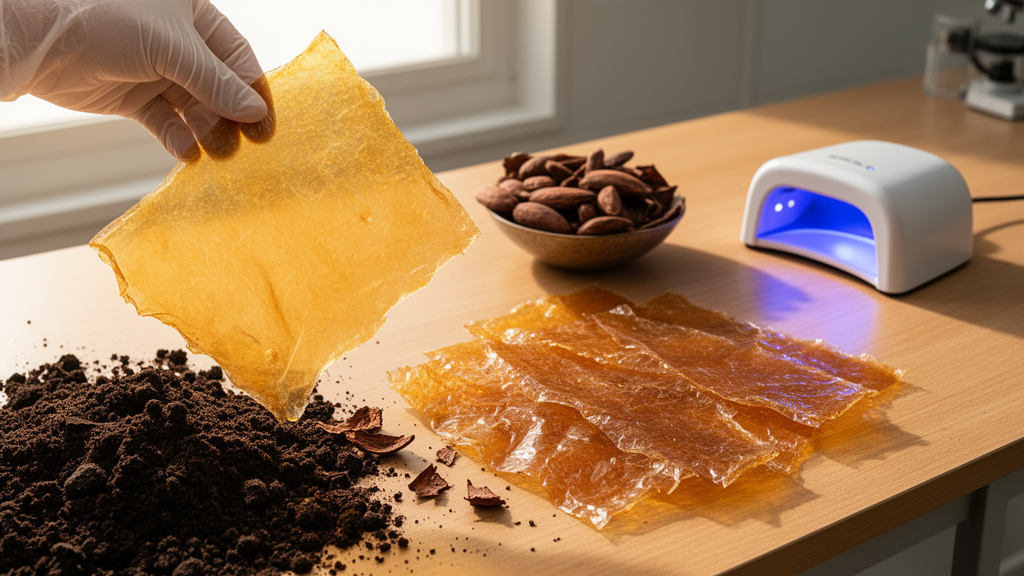
Pectin extracted from cocoa husk waste has been fabricated into biodegradable films that shield ultraviolet light, scavenge free radicals, disintegrate rapidly in soil, and can be regenerated by dissolution and recasting, according to a new study. The researchers demonstrated that the composition of the films could be tuned during solvent casting, allowing the balance between mechanical strength, hydrophilicity, optical transparency, and functional performance to be adjusted for different applications. The motivation for the work stems from persistent environmental pressures associated with conventional plastics.
Petroleum-derived packaging materials are cheap, durable, and easy to process, yet only a small fraction of plastic waste is effectively recycled. Much of the remainder accumulates in landfills or escapes into terrestrial and marine environments, where weathering breaks it into microplastics. These particles persist in soil and water, enter food chains, and can be ingested or inhaled by humans.
Biopolymers derived from agricultural residues offer one route toward reducing reliance on these materials, provided they can deliver comparable functionality. Cocoa husk is generated in large quantities as a by-product of bean harvesting, and improper disposal of this residue can exacerbate phytosanitary issues. Rather than treating the husk solely as a waste stream, the research team identified pectin, a structural polysaccharide naturally abundant in the husk, as a candidate film-forming biopolymer.
Pectin is valued in materials research for its hydrophilic functional groups, which support intermolecular hydrogen bonding and enable the formation of coherent films through solvent casting. To obtain the pectin, cocoa pods were cross-sectioned and the husk was separated, dried, and ground before being treated with dilute nitric acid. The extracted pectin was characterized in terms of its degree of esterification, methoxyl content, surface charge, and functional groups, confirming the presence of the carboxyl and hydroxyl groups that underpin film formation and intermolecular interactions within the cast matrix.
The films were fabricated by solvent casting, with glycerol incorporated as a plasticizer to disrupt the dense polysaccharide network and improve flexibility. By varying the relative proportions of pectin and glycerol, the researchers prepared a series of films with systematically different compositions. Increasing the plasticizer content softened the network and increased elongation at break, while higher pectin content reinforced the films and supported greater tensile strength, illustrating the trade-off between rigidity and flexibility that governs the mechanical performance of plasticized polysaccharide films.
Measurements of water contact angle, water vapor permeability, and ultraviolet-visible transmittance revealed how composition influenced the films' interaction with moisture and light. The hydrophilic functional groups of pectin imparted strong affinity for water, and the films transmitted little ultraviolet radiation, indicating inherent UV-shielding capability that could benefit light-sensitive packaged goods. Water vapor permeability was assessed across the compositional series, providing a basis for evaluating the films' suitability as moisture barriers relative to conventional packaging materials.
Antioxidant activity was evaluated using the ABTS radical scavenging assay. Contrary to what might be expected from simply increasing the biopolymer content, radical scavenging decreased with increasing pectin concentration in the films, with the highest scavenging observed at the lowest pectin content. This trend suggests that the functional performance of the films depends on the balance between the polysaccharide matrix and the other film components rather than on pectin content alone.
The films' environmental behavior was assessed through soil burial testing, which showed rapid physical disintegration of the cast films, consistent with the hydrophilic character of the polysaccharide network and its susceptibility to microbial action in soil. The researchers also demonstrated that the films could be regenerated by dissolving them in water and recasting the solution, indicating that the material can be reprocessed rather than discarded after use. The findings position cocoa husk pectin as a renewable feedstock for biodegradable films with inherent UV shielding, measurable antioxidant activity, and rapid soil disintegration.
Further work is needed to quantify long-term durability, optimize barrier performance, and evaluate the films' performance in real packaging and agricultural settings before cocoa husk pectin films can compete with established petroleum-based materials at scale. Quantitatively, the extraction process yielded approximately 101.75 grams of pectin per kilogram of dry cocoa husk, a figure the authors note is comparable to yields reported for pectin recovered from other plant sources. The recovered polysaccharide was classified as a low-to-mid methoxyl pectin, with a degree of esterification of about 29.38 percent and a methoxylation content of roughly 4.79 percent.
These values were obtained by integrating the infrared absorbance bands associated with esterified carbonyl groups near 1740 wavenumbers and non-esterified carboxylate groups near 1630 wavenumbers, a ratio-based approach that links the proportion of methyl-esterified galacturonic acid residues directly to the spectral signature of the material. Surface charge measurements reinforced this structural picture. The pectin displayed a zeta potential of approximately negative 44.61 millivolts, indicating a high density of deprotonated carboxyl groups along the polymer backbone.
Because the magnitude of this value exceeds the commonly cited 30 millivolt threshold for electrostatic stabilization, the extracted pectin remained well dispersed in aqueous solution, with strong repulsive forces between chains preventing aggregation and sedimentation. This colloidal stability is relevant not only to extraction handling but also to the homogeneity of the casting solutions used to prepare the films. The precipitation chemistry underlying the extraction also merits attention.
Pectin recovery from the nitric acid extract relied on ethanol addition, which lowers solvent polarity and water activity and thereby reduces the solvation of negatively charged galacturonate chains, driving them to agglomerate and phase-separate. The researchers found that a supernatant-to-ethanol ratio of 1:1.5 maximized single-step precipitation, while cumulative yields increased monotonically across successive ethanol treatments. This behavior points to multiple pectin subpopulations with differing solubility, and the multi-stage approach allowed the team to maximize recovery while limiting total ethanol consumption, a consideration with practical implications for process economics.
On the performance side, the reported figures are notable. The glycerol-free films achieved water vapor permeability values in the range of roughly 5.9 to 8.0 times ten to the negative eighth grams per meter per square meter per pascal per hour, placing them within the same order of magnitude as commercial bioplastics such as polylactide, polyhydroxyalkanoates, polycaprolactone, and polybutylene succinate, and comparable to oriented polypropylene and high-density polyethylene. They also outperformed films made from alginate, carboxymethyl cellulose, carrageenan, and pullulan in this respect, and showed permeability two orders of magnitude lower than several starch-based biomass films.
Only high-barrier fossil plastics such as oriented polyethylene terephthalate and ethylene vinyl alcohol copolymer exceeded their moisture barrier performance. Optical characterization quantified the ultraviolet protection across three bands. The films blocked essentially all UVC radiation, resisted 85 to 99 percent of UVB, and blocked 57 to 95 percent of UVA depending on formulation, while opacity ranged from about 31 to 71 percent.
The authors attribute this shielding to strong absorption by chromophores within the pectin matrix, potentially including phenolic compounds co-extracted from the husk, combined with light scattering by the polysaccharide network. Notably, the films outperformed polyethylene cling film in ultraviolet transmittance tests, underscoring that the protection arises from the material itself rather than from added synthetic absorbers. The antioxidant behavior was substantial, with radical scavenging reaching approximately 67 to 88 percent in the ABTS assay.
The proposed mechanism involves electron transfer and hydrogen donation from the abundant hydroxyl and carboxyl groups of the polysaccharide backbone, as well as from residual phenolics such as catechins, procyanidins, and other flavonoids carried over from the husk. The observation that denser films scavenged less effectively, despite potentially containing more total antioxidant species, highlights how matrix architecture can govern the diffusion of active compounds to the surrounding medium, a consideration directly relevant to active packaging design. The regeneration experiments add an unusual dimension to the material profile.
Because the films are held together by reversible physical interactions, principally hydrogen bonding and chain entanglement, rather than irreversible covalent crosslinks, they could be crushed, dissolved in water at 85 degrees Celsius under stirring, and recast into new films without synthetic solvents. A Pearson correlation analysis across the formulation series clarified the structure-property relationships. Pectin content correlated positively with tensile strength, yellowness, and ultraviolet shielding, while glycerol content correlated positively with elongation at break and toughness but negatively with tensile strength, water contact angle, and opacity.
The analysis also exposed the classic strength-extensibility trade-off and linked ultraviolet resistance to opacity, confirming that transparency and protection must be balanced when selecting formulations for specific packaging roles. The authors are candid about limitations. The soil burial observations demonstrate physical disintegration rather than verified biodegradation, and they identify quantitative mass-loss measurements, thermal degradation kinetics, pyrolysis activation energy determination, and testing under ISO 17556 standards as necessary next steps.
They also acknowledge that glycerol-plasticized films suffered from poor wet stability and could not be measured for permeability or radical scavenging under hydrated conditions, and they note that molecular weight distribution, monosaccharide composition, and residual phenolic content, which vary with extraction method, were not fully characterized here. Looking forward, the team proposes hydrophobic functionalization to shield polar groups and reduce hygroscopicity, along with the incorporation of waxes, graphene-based materials, silica nanoparticles, and other hydrophobic fillers to create tortuous diffusion pathways for water vapor. They also suggest life cycle assessment to evaluate energy use, greenhouse gas emissions, and cost-effectiveness at scale, and they envision incorporating antimicrobials, crosslinkers, and bio-nanomaterials for active packaging, with trials in meat wrapping and modified atmosphere storage of perishable produce as logical next applications.
Subject of Research: Materials Science
Article Title: Developing renewable polysaccharide-based bioplastic films using pectin derived from agricultural cocoa husk byproducts: fabrication, characterization, and performance assessment
Article References: Lin, J.-T., Lai, J.-J., Yang, C.-H., Chang, Y.-T., & Lai, Y.-R. (2026). Developing renewable polysaccharide-based bioplastic films using pectin derived from agricultural cocoa husk byproducts: fabrication, characterization, and performance assessment. Journal of Agriculture and Food Research, 32, Article 103393. https://doi.org/10.1016/j.jafr.2026.103393
Image Credits: AI Generated
DOI: 10.1016/j.jafr.2026.103393
Keywords: cocoa husk, pectin, bioplastic, biodegradable films, UV shielding, antioxidant activity, soil degradation, renewable materials, Developing, renewable, polysaccharide-based, films
Cite Scienmag News
Alan Morgan. (October 24, 2026). Cocoa Husk Pectin Films Show UV Shielding, Antioxidant Activity, and Rapid Soil Disintegration. Scienmag. https://scienmag.com/cocoa-husk-pectin-films-show-uv-shielding-antioxidant-activity-and-rapid-soil-disintegration/
Alan Morgan. "Cocoa Husk Pectin Films Show UV Shielding, Antioxidant Activity, and Rapid Soil Disintegration." Scienmag, 24 October 2026, https://scienmag.com/cocoa-husk-pectin-films-show-uv-shielding-antioxidant-activity-and-rapid-soil-disintegration/. Accessed 24 October 2026.
Alan Morgan. "Cocoa Husk Pectin Films Show UV Shielding, Antioxidant Activity, and Rapid Soil Disintegration." Scienmag. October 24, 2026. https://scienmag.com/cocoa-husk-pectin-films-show-uv-shielding-antioxidant-activity-and-rapid-soil-disintegration/


