Stroke survivors who take the sedative-hypnotic drug estazolam for post-stroke insomnia may face a lower likelihood of depressive and anxiety symptoms when they drink more fluids each day, according to a prospective cohort study published in BMC Psychiatry. The study followed 453 people with ischemic stroke who were on long-term estazolam treatment and found that higher average daily liquid intake during the first six months after stroke was significantly associated with a reduced risk of screening-positive depressive and anxiety symptoms at both seven and twelve months after stroke. Insomnia is common among ischemic stroke survivors, and estazolam, a long-acting benzodiazepine, is frequently prescribed to manage it.
However, both stroke itself and long-term benzodiazepine use are recognized risk factors for post-stroke depressive and anxiety symptoms, making this population particularly vulnerable to neuropsychiatric complications. The researchers designed the study to examine whether a modifiable daily behavior, fluid consumption, might be associated with these manifestations in patients receiving estazolam, with the aim of informing their clinical management. To capture drinking habits over time rather than at a single moment, the investigators measured each participant's 24-hour liquid intake repeatedly between one and six months after stroke and averaged the results.
Depressive and anxiety symptoms were then assessed at two follow-up points, seven and twelve months after stroke, using four validated clinical instruments: the 17-item Hamilton Depression Rating Scale (HAM-D-17), the nine-item Patient Health Questionnaire (PHQ-9), the Hamilton Anxiety Rating Scale (HAM-A), and the seven-item Generalized Anxiety Disorder scale (GAD-7). Depressive symptoms were defined as screening-positive at a HAM-D-17 score of 7 or higher or a PHQ-9 score of 5 or higher, while anxiety symptoms were defined as screening-positive at a HAM-A score of 7 or higher or a GAD-7 score of 5 or higher. In multivariate logistic regression analyses, higher long-term 24-hour liquid intake from one to six months after stroke was significantly associated with a reduced risk of screening-positive depressive symptoms and anxiety symptoms at both the seven-month and twelve-month assessments, with all reported associations reaching statistical significance.
Dose-response analyses demonstrated a graded relationship, meaning the association strengthened across increasing levels of intake rather than emerging only above a single threshold. Sensitivity analyses, which test whether results hold under alternative analytical assumptions, confirmed the robustness of the findings. Because liquid intake was not assigned by the researchers, the results demonstrate an association rather than a causal effect.
Residual confounding therefore cannot be excluded as an explanation for the observed relationship. The study's conclusion states that, among ischemic stroke survivors receiving long-term estazolam for insomnia, higher liquid intake was associated with a lower risk of screening-positive post-stroke depressive and anxiety symptoms. The authors note that whether deliberately increasing liquid intake would improve mental health outcomes in this population remains to be determined, and that interventional studies are needed before any such recommendation can be made.
Subject of Research: The association between daily liquid intake and post-stroke depressive and anxiety symptoms in ischemic stroke survivors treated with estazolam
Article Title: Association of liquid intake with post-stroke depressive and anxiety symptoms in subjects using estazolam: a prospective cohort study
Article References: Jing, J., Du, R., Wen, L., & Fang, Y. (2026). Association of liquid intake with post-stroke depressive and anxiety symptoms in subjects using estazolam: a prospective cohort study. BMC Psychiatry. https://doi.org/10.1186/s12888-026-08771-x
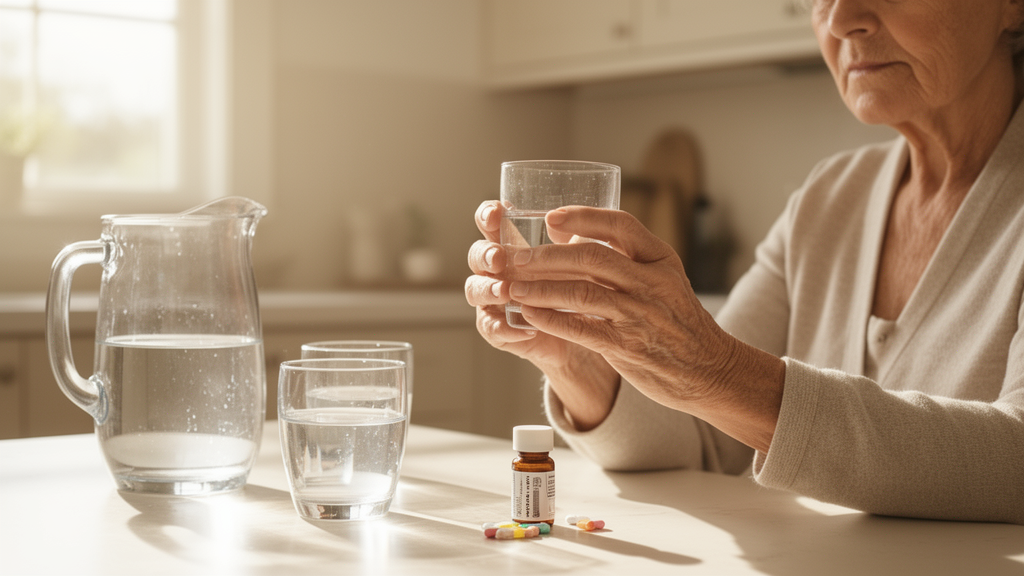
Image Credits: AI Generated
DOI: 10.1186/s12888-026-08771-x
Keywords: stroke, estazolam, liquid intake, depression, anxiety, insomnia, prospective cohort, neuropsychiatry, HAM-D-17, PHQ-9, GAD-7, observational study
Cite Scienmag News
Glenn Wilkins. (October 24, 2026). Higher Daily Liquid Intake Linked to Lower Post-Stroke Depression and Anxiety Risk in Estazolam Users. Scienmag. https://scienmag.com/higher-daily-liquid-intake-linked-to-lower-post-stroke-depression-and-anxiety-risk-in-estazolam-users/
Glenn Wilkins. "Higher Daily Liquid Intake Linked to Lower Post-Stroke Depression and Anxiety Risk in Estazolam Users." Scienmag, 24 October 2026, https://scienmag.com/higher-daily-liquid-intake-linked-to-lower-post-stroke-depression-and-anxiety-risk-in-estazolam-users/. Accessed 24 October 2026.
Glenn Wilkins. "Higher Daily Liquid Intake Linked to Lower Post-Stroke Depression and Anxiety Risk in Estazolam Users." Scienmag. October 24, 2026. https://scienmag.com/higher-daily-liquid-intake-linked-to-lower-post-stroke-depression-and-anxiety-risk-in-estazolam-users/