


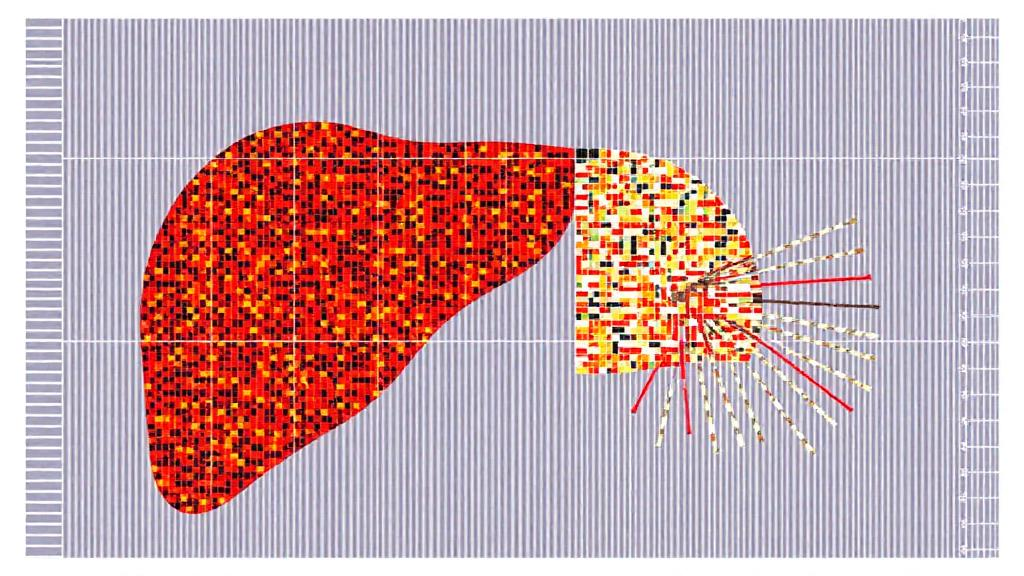
Researchers have built a spatially resolved molecular map of human livers affected by metabolic dysfunction-associated steatohepatitis (MASH), showing that different tissue compartments undergo distinct metabolic and inflammatory reprogramming as the disease progresses. The study, published open access in Genome Medicine, used the GeoMx Digital Spatial Profiler to profile liver tissue from 16 patients with MASH across fibrosis stages and eight non-MASH controls. Rather than homogenizing the tissue, the team defined regions of interest enriched for hepatocytes, hepatic stellate cells, and immune cells using immunofluorescence-guided pathological annotation, allowing gene expression to be read within preserved tissue architecture.
The analysis showed that each hepatic region type carried its own molecular signature of disease. Cytochrome P450 genes were significantly downregulated not only in hepatocyte-enriched regions but also in hepatic stellate cell- and immune cell-enriched regions, and their expression was negatively correlated with nuclear receptor and pro-inflammatory genes. This coordinated suppression of CYP450 metabolism across parenchymal and nonparenchymal compartments suggests that inflammatory activation and metabolic gene programs shift together as MASH advances. With advanced fibrosis, the nonparenchymal regions displayed marked mitochondrial dysfunction, indicating that energy metabolism in stromal and immune compartments is also compromised in late-stage disease.
Ligand-receptor analysis of the spatial data revealed disrupted communication between tissue regions, including the loss of protective signals and enhanced pro-fibrotic interactions. Because spatial omics preserves where cells sit relative to one another, this approach allowed the team to infer cell-cell and ligand-receptor interactions, particularly those involving macrophages, that single-cell dissociation methods cannot fully capture. Among the consistent findings, IL32 stood out: the gene was upregulated across all three region types in MASH versus non-MASH livers, making it one of the few signatures shared by hepatocyte, stellate cell, and immune cell compartments.
To check that these spatial signatures were not artifacts of the profiling platform, the researchers integrated their data with several public single-cell RNA sequencing datasets and confirmed the findings computationally. They then identified 19 MASH-associated genes whose expression correlated with clinical and histologic parameters, including fibrosis stage, and whose expression reversed following bariatric surgery. This reversibility observation, drawn from patients undergoing weight-loss intervention, provides a clinical anchor for the molecular map and hints that at least some of the compartment-specific reprogramming is not fixed. The team selectively validated hepatic expression of CYP1A2, IL32, and S100A8/9 at the protein level in patients with MASH, extending the transcriptomic results beyond RNA measurements.
The authors conclude that the results reveal compartment-specific metabolic and inflammatory reprogramming in human MASH, highlighting CYP450 suppression, immune activation, disrupted intercellular signaling, and reversibility after bariatric surgery, with therapeutic implications. As a cross-sectional profiling study of a limited number of tissue samples, the findings describe molecular associations within the sampled livers rather than proving causal mechanisms, and the bariatric surgery comparison reflects paired observations in the studied cohort. Even so, by tying gene programs to specific tissue locations, fibrosis stage, clinical parameters, and protein-level validation, the study offers a spatial framework for understanding how parenchymal and nonparenchymal cells coordinate their responses during MASH progression, and it nominates IL32 and other consistently altered genes as candidates for further investigation.
Subject of Research: Spatial transcriptomics of liver tissue in metabolic dysfunction-associated steatohepatitis
Article Title: Spatial transcriptomics landscape of livers from patients with metabolic dysfunction-associated steatohepatitis
Article References: Kang, B. E., Park, A., Lee, M., Kim, S., Kang, H., Kim, S. M., Park, J.-H., Ryu, D., Kim, J., Nam, S., & Lee, D. H. (2026). Spatial transcriptomics landscape of livers from patients with metabolic dysfunction-associated steatohepatitis. Genome Medicine. https://doi.org/10.1186/s13073-026-01807-7
Image Credits: AI Generated
DOI: 10.1186/s13073-026-01807-7
Keywords: spatial transcriptomics, MASH, liver, fibrosis, cytochrome P450, IL32, hepatic stellate cells, macrophages, bariatric surgery, mitochondrial dysfunction, ligand-receptor signaling, protein validation
Cite Scienmag News
Juliet Wilcox. (October 24, 2026). Spatial gene map reveals compartment-specific reprogramming in inflamed fatty livers. Scienmag. https://scienmag.com/spatial-gene-map-reveals-compartment-specific-reprogramming-in-inflamed-fatty-livers/
Juliet Wilcox. "Spatial gene map reveals compartment-specific reprogramming in inflamed fatty livers." Scienmag, 24 October 2026, https://scienmag.com/spatial-gene-map-reveals-compartment-specific-reprogramming-in-inflamed-fatty-livers/. Accessed 24 October 2026.
Juliet Wilcox. "Spatial gene map reveals compartment-specific reprogramming in inflamed fatty livers." Scienmag. October 24, 2026. https://scienmag.com/spatial-gene-map-reveals-compartment-specific-reprogramming-in-inflamed-fatty-livers/


