


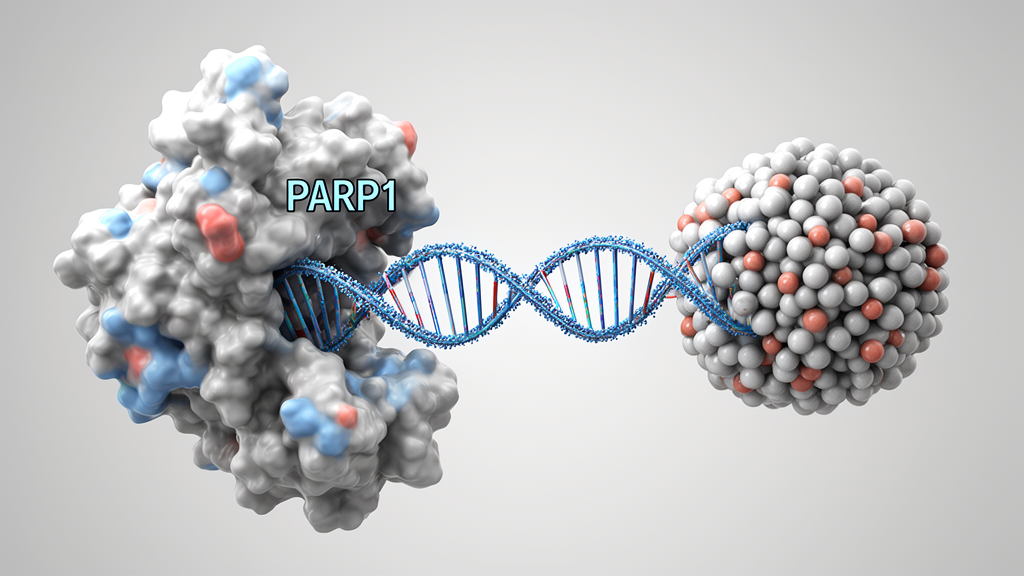
When DNA inside a cell is damaged, a cascade of molecular first responders rushes to the scene. One of the earliest is poly (ADP-ribose) polymerase 1, or PARP1, an enzyme long known to sense DNA damage and broadcast a chemical signal that initiates repair. Now, scientists at St. Jude Children’s Research Hospital have characterized a previously undescribed function of this enzyme: it directly disassembles the nucleosome, the structural unit that packages DNA, to make damaged regions physically accessible to the repair machinery.
The findings, published in Molecular Cell, come from a combination of biochemical and cellular testing carried out by a team led by corresponding author Hai Dao, PhD, of the St. Jude Department of Chemical Biology & Therapeutics. The work addresses a question that has lingered at the heart of the DNA damage response: how does PARP1 overcome the nucleosome barrier to begin repair?
PARP1 was already credited with two primary roles. It senses DNA damage, and it sends a signal through protein poly (ADP-ribosyl)ation that initiates DNA repair inside the cell. What remained unknown was how the enzyme deals with the physical obstacle that stands between the damage signal and the repair proteins that must reach the broken DNA.
That obstacle is formidable. The nucleosome is the repeating structural unit of chromatin, the material that compacts DNA so it can fit inside a cell’s nucleus. Each nucleosome consists of DNA wrapped around a symmetric core of eight histone proteins. This packaging keeps the genome organized, but it also blocks direct access to the DNA strand, meaning repair proteins cannot simply reach a damaged site without the structure being loosened first.
Using biochemical and cellular tests, the St. Jude researchers found that PARP1 asymmetrically evicts two histone proteins next to the site of DNA damage. This eviction leads to the formation of a hexasome, a nucleosomal structure that uses six histone proteins instead of eight. The change partially opens the nucleosome, and the modified hexasome then serves as a bifunctional hub for recruiting proteins to the site of DNA damage to facilitate repair.
“Our study revealed a third, previously undescribed role of PARP1 in DNA damage repair, where we observed that the enzyme disassembles the nucleosome to facilitate chromatin accessibility so other downstream repair mechanisms can come in to do their job,” said Dao. “But, to our surprise, we observed that PARP1 disassembles the nucleosome in a very unique way.”
The uniqueness lies in the asymmetry. Rather than dismantling the entire nucleosome, PARP1 removes only the two histones adjacent to the damage, leaving a six-histone hexasome in place. That partial opening appears to be enough to grant downstream repair mechanisms access to the DNA while preserving a modified structure that can actively gather the proteins needed for the job.
The team also uncovered a second surprise involving histone H2A. A component of the nucleosome called the C-terminal tail, which can contain cancer-associated mutations, molecularly controls PARP1-mediated nucleosome disassembly. The investigators showed that removal of the H2A tail increases sensitivity to DNA-damaging therapies, raising the possibility that the remodeling activity itself could contribute to disease formation.
Because inhibiting DNA damage repair can be therapeutically beneficial in cancers with genetic vulnerabilities related to the DNA damage response, the mechanism carries direct implications for treatment. Current PARP inhibitors target PARP catalytic activity broadly, shutting down all PARP activity, which can have a toxic effect. By revealing a previously undescribed function of PARP1, the study opens the possibility of future therapeutics that shut down specific kinds of PARP1-related enzymatic activity, such as the remodeling activity, while sparing the rest.
“We are excited about the discovery because current PARP inhibitors target PARP catalytic activity broadly, so they shut down all PARP activity, which can have a toxic effect,” Dao said. “By revealing a previously undescribed function of PARP1, it opens the possibility for future studies into therapeutics where we shut down certain kinds of PARP1-related enzymatic activity, like the remodeling activity. That would be a new way of targeting the cells that depend on that activity.”
The study’s co-first authors are Ashish Verma, PhD, and Changlei Zhu, PhD, of St. Jude. Other authors are Bernadette Truong, Silvija Bilokapic, Rebekah DeVries, Aaron Pitre, Younus Bhat, Anang Shelat and Mario Halic, all of St. Jude. The work was supported by grants from the NIH/NIGMS (R35GM160211) and the American Lebanese Syrian Associated Charities (ALSAC), the fundraising and awareness organization of St. Jude. For now, the discovery stands as foundational insight into how one of the cell’s first responders physically opens the genome for repair, and how that opening might one day be selectively blocked in cancer cells that depend on it.
Subject of Research: Molecular mechanism of PARP1-mediated nucleosome disassembly in DNA damage repair
Article Title: Mechanism behind PARP1-mediated DNA repair characterized for first time
Article References: Mechanism behind PARP1-mediated DNA repair characterized for first time. Original publication (Bibliographic details unavailable.)
Image Credits: AI Generated
DOI: Not provided
Keywords: PARP1, DNA repair, nucleosome, chromatin remodeling, hexasome, histone H2A, PARP inhibitors, cancer therapy, St. Jude, Molecular Cell, Mechanism, behind
Cite Scienmag News
Nathaniel Bowman. (October 24, 2026). PARP1 Disassembles Nucleosomes to Open DNA for Repair. Scienmag. https://scienmag.com/parp1-disassembles-nucleosomes-to-open-dna-for-repair/
Nathaniel Bowman. "PARP1 Disassembles Nucleosomes to Open DNA for Repair." Scienmag, 24 October 2026, https://scienmag.com/parp1-disassembles-nucleosomes-to-open-dna-for-repair/. Accessed 24 October 2026.
Nathaniel Bowman. "PARP1 Disassembles Nucleosomes to Open DNA for Repair." Scienmag. October 24, 2026. https://scienmag.com/parp1-disassembles-nucleosomes-to-open-dna-for-repair/


