


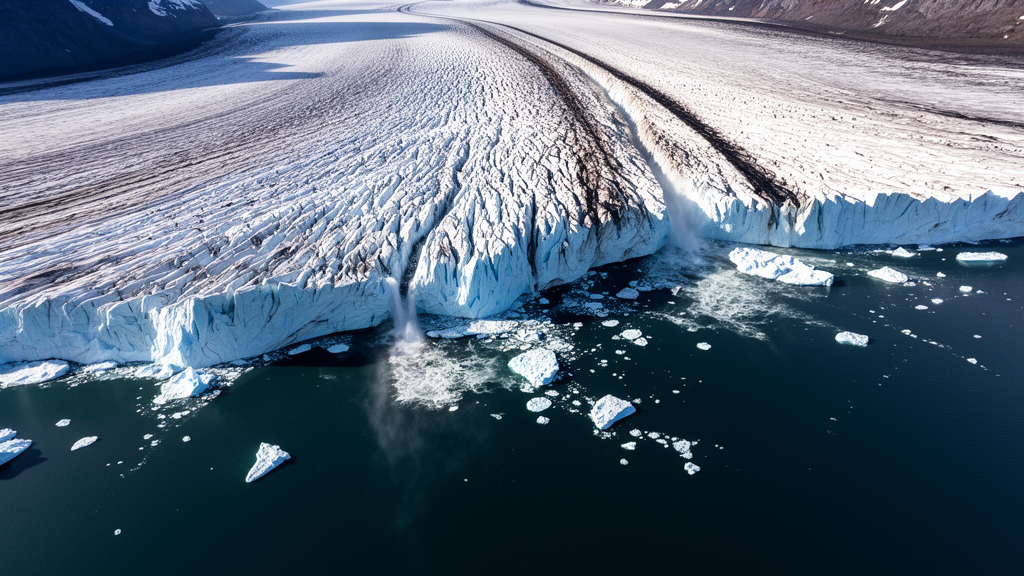
Glaciers that terminate in lakes, oceans or ice shelves make up just 3.2% of the world’s glaciers, yet they lost an estimated 134 billion tonnes of ice each year between 2000 and 2019, accounting for more than half of all glacier ice loss worldwide. That is the central finding of a new study published in Nature Communications, led by scientists from the University of Birmingham and the University of Leeds. The result highlights how unevenly glacier decline is distributed across different settings, and points to a blind spot in many of the models used to project future sea-level rise and water availability.
The research team catalogued 216,502 glaciers worldwide, excluding the Greenland and Antarctic ice sheets, and classified each one by the environment in which it ends: land, ocean, ice shelf or lake. Adding lake-ending glaciers to existing records of the other three types allowed the researchers to compare ice flow velocities and mass loss across all four categories on a global scale. One immediate explanation for the outsized contribution of these glaciers is their size. Glaciers ending in lakes, oceans or ice shelves tend to be much larger than those ending on land, and together they cover more than half of the world’s total glacier area.
For glaciers ending in lakes, however, size turned out not to be the whole story. After accounting for factors such as climate, glacier size and elevation, the analysis found that lake-ending glaciers lost around 57% more ice than land-ending glaciers relative to their size over the 2000 to 2019 period. The same comparison showed that glaciers ending in lakes flow on average 10% faster than land-ending glaciers, while ocean-ending glaciers flow 44% faster. Dr Joe Mallalieu, who conducted the research at the University of Birmingham and is now based at the University of Leeds, said the lake-ending glaciers stand out because they are losing ice particularly quickly, and that the reasons are not yet clear. He suggested it could be the lakes themselves, the size and shape of the glaciers, or a combination of both, and noted that untangling this is the next big question, especially as glacier lakes are becoming more common in a warming climate.
There are plausible physical mechanisms linking lakes to accelerated ice loss. Glaciers ending in lakes can shed large chunks of ice from their fronts as icebergs, a process known as calving, and lake water can also melt the ice below the waterline. Both processes can speed up the retreat and thinning of the glacier front in ways that do not occur where a glacier simply ends on dry land. The study found lake-ending glaciers in every major glacier region of the world, and in most regions they were losing ice faster than glaciers ending on land or in oceans.
The classification also matters because glacier terminus environments are not fixed. As the climate warms, ocean-ending glaciers are retreating onto land in parts of the Arctic, while the worldwide growth of glacier lakes is converting some land-ending glaciers into lake-ending ones. According to the study’s results, these shifts could have contrasting effects: glaciers that retreat onto land are likely to slow down, while those that newly end in lakes could lose ice faster than before. Dr Nicholas Barrand of the University of Birmingham noted that the last decade has seen a huge increase in the global glacier and climate data available to researchers, and that bringing these datasets together makes it possible to compare how glaciers in different settings behave. As more glaciers shift from one setting to another, he said, understanding those differences will only become more important. Many existing models used to project glacier change do not yet fully account for glaciers ending in lakes, and the team’s new global classification is intended to help other researchers close that gap, improving projections of sea-level rise, water resources and natural hazards.
The study, titled Global-scale variability of glacier velocity and mass loss across terminus environments, was published in Nature Communications on 23 October 2026. Its headline numbers, a 3.2% share of glacier count producing more than half of annual ice loss, and a 57% faster relative loss rate for lake-ending glaciers, give glaciologists a clearer map of where the planet’s most vulnerable ice sits. The findings are based on observations from 2000 to 2019 and cover all glaciers outside the two great ice sheets, so they capture the vast majority of the world’s glacier ice but not the ice losses of Greenland and Antarctica, which were outside the scope of this analysis.
Subject of Research: Global comparison of glacier ice loss and flow speed across lake, ocean, ice-shelf and land terminus environments
Article Title: Just 3% of the world’s glaciers account for over half of glacier ice loss
Article References: Just 3% of the world’s glaciers account for over half of glacier ice loss. Original publication (Bibliographic details unavailable.)
Image Credits: AI Generated
DOI: Not provided
Keywords: glaciers, glacier lakes, ice loss, calving, sea-level rise, glacier velocity, terminus environments, Nature Communications, climate change, cryosphere, mass loss, glacier classification
Cite Scienmag News
Violet Maxwell. (October 24, 2026). Small fraction of lake, ocean and ice-shelf glaciers drives most ice loss. Scienmag. https://scienmag.com/small-fraction-of-lake-ocean-and-ice-shelf-glaciers-drives-most-ice-loss/
Violet Maxwell. "Small fraction of lake, ocean and ice-shelf glaciers drives most ice loss." Scienmag, 24 October 2026, https://scienmag.com/small-fraction-of-lake-ocean-and-ice-shelf-glaciers-drives-most-ice-loss/. Accessed 24 October 2026.
Violet Maxwell. "Small fraction of lake, ocean and ice-shelf glaciers drives most ice loss." Scienmag. October 24, 2026. https://scienmag.com/small-fraction-of-lake-ocean-and-ice-shelf-glaciers-drives-most-ice-loss/


