


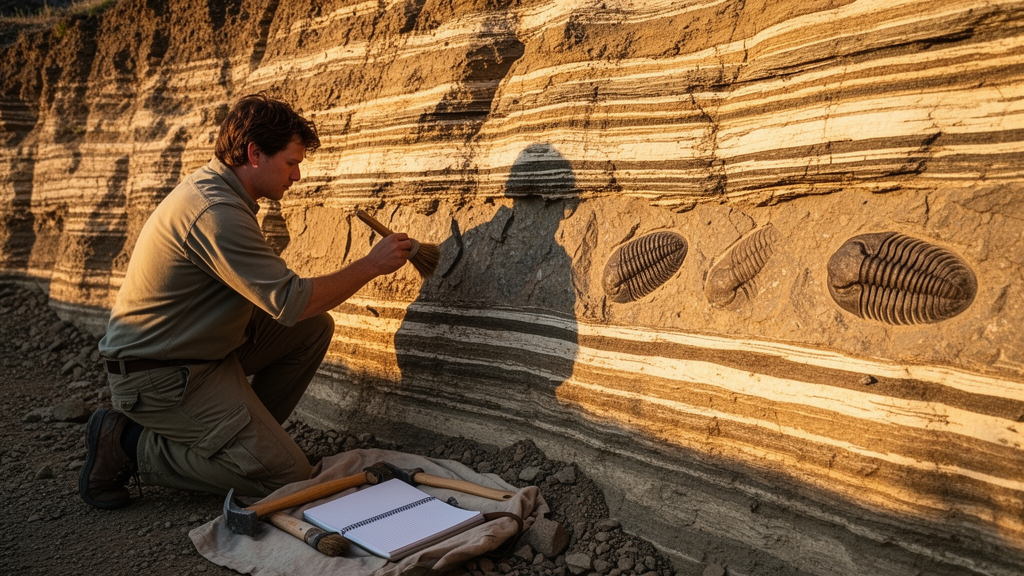
A new study published in Nature Communications links one of Earth's largest carbon cycle perturbations, the Cambrian Steptoean Positive Carbon Isotope Excursion (SPICE), to astronomically paced sea-level changes that preceded shifts in marine biodiversity. The research team, led by Meng Wang and Mingsong Li, integrated high-resolution astrochronology, carbonate carbon isotope records from the North China Block, and marine species richness data to reconstruct how sedimentary and biogeochemical systems responded during the SPICE interval. The SPICE event is marked in the geological record by widespread marine anoxia, climatic upheaval, and major biotic turnover.
Despite its significance, the full extent of these environmental changes and the ways they interacted remained poorly resolved. The new analysis addresses this gap by combining precisely dated strata with independent records of sea level and biodiversity. Time series analysis of the sedimentary archives revealed a distinct rhythm of approximately 2 million years that aligns with cycles in reconstructed sea-level fluctuations and biodiversity dynamics.
Most strikingly, the researchers found that sea-level changes preceded shifts in benthic species richness by about 70,000 years. This lag links astronomically driven eustatic oscillations, meaning global changes in sea level, to marine redox fluctuations and concurrent biodiversity turnover. The finding connects orbital forcing to ocean chemistry and biological change during this critical interval of Earth history, with sea-level variation operating as a leading signal ahead of the ecological response recorded in seafloor-dwelling communities.
The results offer pivotal constraints on ocean-climate interactions during the Cambrian and provide insight into Earth system resilience to extreme climatic and biogeochemical perturbations.
Subject of Research: Coupled sea-level and biodiversity dynamics during the Cambrian SPICE event
Article Title: Coupled sea-level and biodiversity dynamics during the Cambrian SPICE event
Article References: Wang, M., Shi, Y., Yang, A., Zhang, H., Zhang, X., Wu, Y., Shi, Y., Liu, J., Wei, R., Jin, Z., & Li, M. (2026). Coupled sea-level and biodiversity dynamics during the Cambrian SPICE event. Nature Communications. https://doi.org/10.1038/s41467-026-78601-x
Image Credits: AI Generated
DOI: 10.1038/s41467-026-78601-x
Keywords: Cambrian, SPICE event, carbon isotope excursion, astrochronology, sea level, biodiversity, marine anoxia, North China Block, ocean-climate interactions, Coupled, sea-level, dynamics
Cite Scienmag News
Violet Maxwell. (October 24, 2026). Ancient sea-level swings tracked biodiversity during Cambrian carbon crisis. Scienmag. https://scienmag.com/ancient-sea-level-swings-tracked-biodiversity-during-cambrian-carbon-crisis/
Violet Maxwell. "Ancient sea-level swings tracked biodiversity during Cambrian carbon crisis." Scienmag, 24 October 2026, https://scienmag.com/ancient-sea-level-swings-tracked-biodiversity-during-cambrian-carbon-crisis/. Accessed 24 October 2026.
Violet Maxwell. "Ancient sea-level swings tracked biodiversity during Cambrian carbon crisis." Scienmag. October 24, 2026. https://scienmag.com/ancient-sea-level-swings-tracked-biodiversity-during-cambrian-carbon-crisis/


