


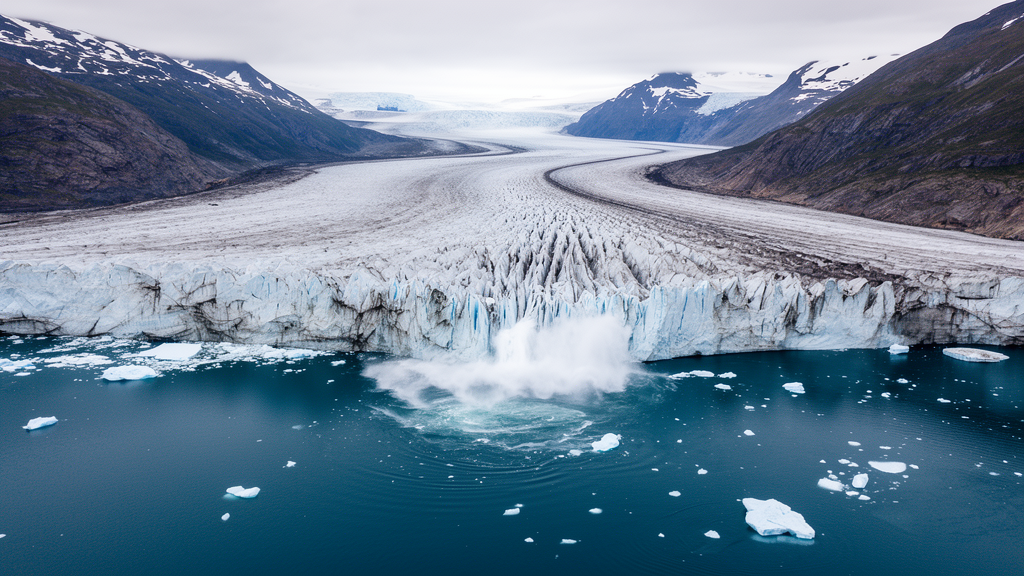
A tiny fraction of the world’s glaciers is responsible for more than half of its ice loss. A new global analysis, published in Nature Communications, has classified the terminus environment of every glacier in a widely used global inventory and linked those classifications to measured ice flow speeds and mass change. The result is striking: although glaciers that end in lakes, the ocean or on ice shelves make up just 3.2 percent of the world’s roughly 216,000 glaciers, they drain more than half of global glacier area and account for over half of the mass lost between 2000 and 2019. The study also shows that where a glacier ends is associated with how fast it flows and how quickly it thins, patterns that persist even after the researchers statistically controlled for climate, size, slope and elevation.
The team, led by Joseph Mallalieu with colleagues including Jonathan Carrivick and Matthias Huss, built their classification on the Randolph Glacier Inventory version 6.0, which contains approximately 216,000 glaciers worldwide. Using the existing inventory attributes for land, marine and shelf termini, they added a new global classification of lake-terminating glaciers, which the original inventory had identified in only three of its nineteen regions. To do this, they drew on a global glacier lake database derived from more than 250,000 Landsat satellite scenes spanning 1990 to 2018, merging lake outlines from four multi-year epochs to capture the maximum extent of each lake during a period broadly matching the glacier outlines, the velocity data and the mass change record. Lakes touching a glacier front were labelled terminus lakes, those along lateral margins or sitting on the ice were classed as ice-marginal or supraglacial, and water bodies lying beyond a 60-metre buffer of the glacier outline were treated as proglacial. Only glaciers meeting a terminus lake were counted as lake-terminating.
The headline numbers reveal a profound imbalance between glacier counts and glacier consequences. Of all glaciers in the inventory, 96.8 percent terminate on land, 1.6 percent in lakes and 1.5 percent in the sea, with shelf-terminating glaciers making up just 0.1 percent. Yet marine-terminating glaciers drain 31.0 percent of global glacier area, lake-terminating glaciers 11.5 percent and shelf-terminating glaciers 11.3 percent. The mass loss picture is similarly skewed. Between 2000 and 2019, land-terminating glaciers accounted for 49.4 percent of global glacier mass loss, while lake-terminating glaciers contributed 24.0 percent, marine-terminating glaciers 22.8 percent and shelf-terminating glaciers 3.9 percent. In other words, the small population of water-terminating glaciers collectively lost more ice than the vast majority that end on dry ground.
The regional geography of these losses varies enormously. In lower latitudes, more than 87 percent of glacier area in each of several mid-latitude regions drains to land termini. At higher latitudes the balance shifts dramatically: marine termini drain 63.2 percent of glacier area in the Russian Arctic, roughly 45 percent in Arctic Canada North, the Greenland Periphery and Svalbard, and 36.2 percent in the Antarctic and Subantarctic. Lake termini dominate in some surprisingly temperate places, draining 65.1 percent of glacier area in Iceland and 37.8 percent in the Southern Andes, with more than 21 percent in Alaska, Arctic Canada South, Scandinavia and New Zealand. Shelf termini are confined to the Russian Arctic and the Antarctic and Subantarctic, where they drain 62.6 percent of the region’s glacier area. When the researchers examined regional mass loss, non-land termini dominated in Iceland, the Southern Andes, Svalbard and the Russian Arctic, each losing more than half of its glacier mass at lake- or marine-terminating glaciers.
Glacier velocity, measured as median surface speed for 2017 to 2018 across 181,603 glaciers, followed a clear gradient by terminus type. Land-terminating glaciers were the slowest, with a median speed of 5.1 metres per year. Shelf- and lake-terminating glaciers moved at intermediate speeds of 7.2 and 7.4 metres per year respectively, while marine-terminating glaciers were the fastest at 9.7 metres per year. This ordering held across most regions, with marine glaciers outpacing lake glaciers, which in turn outpaced land glaciers. The physical properties of the glaciers themselves also formed a continuum: glaciers ending in water tend to be larger, longer and thicker, sit at higher latitudes and lower elevations, and have gentler surface slopes than their land-terminating counterparts, with lake-terminating glaciers occupying intermediate values between the two extremes.
Because bigger, flatter, lower glaciers might flow faster for reasons unrelated to their terminus, the team used linear mixed-effects statistical models to isolate the association of terminus type while holding other factors constant. These models accounted for climate, represented by a composite of mean annual air temperature and total annual precipitation derived from the ECMWF ERA5 reanalysis, as well as glacier morphometry, combining ice thickness and slope into a single principal component, plus median elevation. After these adjustments, lake-terminating glaciers flowed significantly faster than land-terminating glaciers by 10 percent, and marine-terminating glaciers by 44 percent. Shelf-terminating glaciers were excluded from the velocity model because only four had sufficient velocity data to fit the analysis.
The mass loss results were more surprising. Median specific mass change rates, meaning mass change normalised by glacier area, were negative for every terminus type between 2000 and 2019, but the magnitude varied enormously. Lake-terminating glaciers lost mass fastest, with a median rate of minus 0.490 metres of water equivalent per year, roughly double the rates at land-terminating and marine-terminating glaciers, which recorded minus 0.245 and minus 0.239 metres of water equivalent per year respectively. Shelf-terminating glaciers showed the smallest losses at minus 0.051 metres of water equivalent per year. When the researchers controlled for climate and a range of geometric and topographic factors including elevation, area, debris cover and orientation, lake-terminating glaciers still lost significantly more mass than land-terminating glaciers, by an additional 0.162 metres of water equivalent per year, equivalent to 57 percent greater losses. Marine- and shelf-terminating glaciers, by contrast, lost significantly less mass than land-terminating glaciers once these factors were accounted for.
The physical mechanisms behind these patterns are well understood in principle, even though their global expression had not previously been quantified. At marine termini, calving reduces the back pressure resisting ice flow, subaqueous melting can destabilise the ice front and promote faster movement, and deep water allows thicker ice and higher driving stresses. Some marine-terminating glaciers also experience dynamic instability, in which retreat across a reverse, or retrograde, seabed slope drives enhanced flow that can become self-sustaining. Lake-terminating glaciers lack the deep-water effect but share the first two mechanisms, which the authors suggest explains their more moderate velocity enhancement relative to marine glaciers. The elevated mass loss at lake termini may arise from a thermal heat flux delivered by the lake to the ice front, promoting subaqueous ablation and undercut-driven calving, from buoyancy-driven calving as the terminus lifts and floats, and from lake water propagating beneath and into the ice front, reducing basal friction. Proglacial lakes may also respond rapidly to atmospheric warming because of their small volume and limited water exchange, potentially storing seasonal heat that further promotes frontal melting.
The authors also raise a geometric explanation for the lake glacier anomaly. Lake-terminating glaciers tend to be larger and have gentler ice surface slopes in their lowermost reaches than land-terminating glaciers, which may both precondition lake formation and lengthen glacier response times, favouring higher specific mass loss. Land and marine glaciers show nearly identical specific mass loss rates despite their divergent physical properties, and the researchers hypothesise that the more efficient frontal ablation at marine termini allows faster geometric adjustment to climatic forcing, limiting overall specific losses. They caution that their lake category includes all glaciers with terminus lakes regardless of the degree of lake contact, so glaciers with limited lake interaction may behave more like land-terminating glaciers, meaning the reported differences are likely conservative. It is also possible that terminus type partly reflects underlying glacier dynamics, with larger, faster-flowing systems more likely to reach marine settings in the first place.
These findings matter because glaciers worldwide are actively switching between terminus types. Marine-terminating glaciers are retreating onto land across the Arctic, while the global proliferation of glacier lakes is converting land-terminating glaciers into lake-terminating ones. The study suggests these transitions carry contrasting consequences: glaciers retreating from the sea onto land are likely to slow markedly, whereas newly lake-terminating glaciers will probably speed up moderately but suffer substantially greater mass losses. Continued growth in glacier lake abundance could therefore push overall global rates of glacier mass loss higher. Because more than half of global glacier area and mass loss is attributable to glaciers capable of non-linear responses to atmospheric warming, the authors argue that these feedbacks must be explicitly incorporated into glacier evolution models, particularly for regional assessments where water-terminating glaciers predominate. The terminus inventory and accompanying database, released openly alongside the study, provide a foundation for refined global glacier modelling and improved projections of sea-level rise, regional water resources and natural hazard risk.
Subject of Research: Global relationship between glacier terminus type, ice velocity and mass loss
Article Title: Global-scale variability of glacier velocity and mass loss across terminus environments
Article References: Mallalieu, J., Carrivick, J. L., Huss, M., Barr, I. D., Barrand, N. E., & Raby, C. L. (2026). Global-scale variability of glacier velocity and mass loss across terminus environments. Nature Communications, 17(1), Article 10873. https://doi.org/10.1038/s41467-026-78654-y
Image Credits: AI Generated
DOI: 10.1038/s41467-026-78654-y
Keywords: glaciers, glacier termini, proglacial lakes, marine-terminating glaciers, ice velocity, mass loss, sea-level rise, calving, Randolph Glacier Inventory, climate change, glacier dynamics, remote sensing
Cite Scienmag News
Violet Maxwell. (October 24, 2026). Glaciers That End in Water Drive Most of the World’s Ice Loss. Scienmag. https://scienmag.com/glaciers-that-end-in-water-drive-most-of-the-worlds-ice-loss/
Violet Maxwell. "Glaciers That End in Water Drive Most of the World’s Ice Loss." Scienmag, 24 October 2026, https://scienmag.com/glaciers-that-end-in-water-drive-most-of-the-worlds-ice-loss/. Accessed 24 October 2026.
Violet Maxwell. "Glaciers That End in Water Drive Most of the World’s Ice Loss." Scienmag. October 24, 2026. https://scienmag.com/glaciers-that-end-in-water-drive-most-of-the-worlds-ice-loss/


