


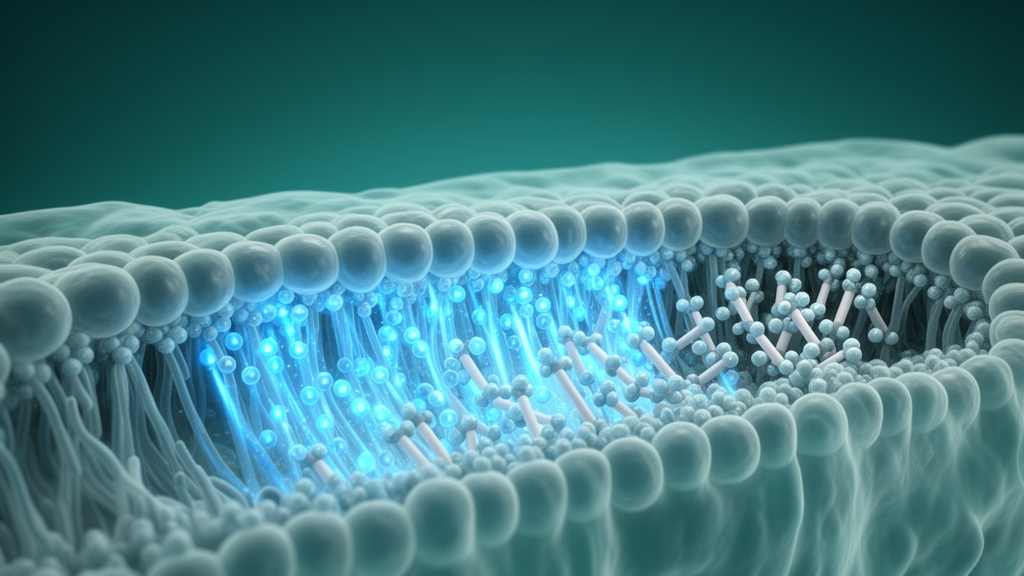
Synthetic derivatives of the ion channel-forming natural product amphotericin B can outperform the parent compound at standing in for the defective anion channel in cystic fibrosis airway epithelia, according to a peer-reviewed study published in Nature Communications. Earlier work had shown that amphotericin B, which inserts into cell membranes and forms ion channels, could serve as a small-molecule surrogate for the cystic fibrosis transmembrane conductance regulator, or CFTR, and restore host defenses in cultured cystic fibrosis airway epithelia. That approach carried two significant limitations, however.
Amphotericin-based channels favor cation permeability, whereas CFTR is fundamentally an anion channel. In addition, the AmB channels lose their capacity to increase the pH of the airway surface liquid in cystic fibrosis airway epithelia at high concentrations. These properties led the team to hypothesize that chemically tuning such channels to favor anion permeability would improve their capacity to restore physiology in disease-relevant model systems.
To test that hypothesis, the researchers synthesized AmB-AA, a derivative of amphotericin B bearing an added positively charged appendage. This structural change produced ion channels with an improved relative permeability to anions. In cultured cystic fibrosis airway epithelia, AmB-AA increased airway surface liquid pH more effectively than amphotericin B, and it maintained that benefit at both low and high concentrations, addressing the concentration-dependent loss of activity seen with the parent compound.
The team then pushed the design further with a second derivative, C2'epiAmB-AA. This molecule was engineered to minimize cholesterol binding, and in doing so it reduced toxicity to cultured cystic fibrosis airway epithelia. Crucially, C2'epiAmB-AA functioned as an effective surrogate for CFTR in primary cultured airway epithelia obtained from people with cystic fibrosis, the disease-relevant model tissue for this line of research.
The findings demonstrate that both the selectivity and the toxicity of a molecular prosthetic can be addressed rationally rather than accepting the properties of a naturally occurring molecule. By adding a positive charge to bias the channel toward anions and further modifying the structure to reduce cholesterol interactions, the researchers improved physiological performance and the toxicity profile in cultured epithelia simultaneously. Important caveats remain.
All results come from laboratory models: cultured airway epithelia, including primary cultures derived from people with cystic fibrosis, not from living patients. Increasing airway surface liquid pH in a culture model is a measured laboratory outcome and a step toward therapy, not a demonstrated clinical benefit. Even with those limits, the study offers a concrete demonstration that molecular prosthetics can be iteratively engineered, in much the way an engineer refines a mechanical prosthesis, to better match the biological function they are meant to replace.
Anion-selective derivatives of amphotericin B now represent a measured improvement over the natural product that started this approach in cystic fibrosis airway models.
Subject of Research: Engineering anion-selective amphotericin B derivatives as molecular prosthetics for the CFTR channel in cystic fibrosis airway epithelia
Article Title: Molecular prosthetics for CFTR designed for anion selectivity outperform amphotericin B in cystic fibrosis airway epithelia
Article References: Marin-Toledo, J. P., Greenan, D. M., Celis, N., Haske, L., Lewandowska, A., Rakowski, C. K., Shastry, S., Gworek, B., Maji, A., Green, K. J., Welsh, M. J., Thornell, I. M., Pogorelov, T. V., & Burke, M. D. (2026). Molecular prosthetics for CFTR designed for anion selectivity outperform amphotericin B in cystic fibrosis airway epithelia. Nature Communications. https://doi.org/10.1038/s41467-026-78819-9
Image Credits: AI Generated
DOI: 10.1038/s41467-026-78819-9
Keywords: cystic fibrosis, CFTR, amphotericin B, molecular prosthetics, ion channels, anion selectivity, airway surface liquid pH, airway epithelia, drug design, cholesterol binding, Nature Communications, Molecular
Cite Scienmag News
Ophelia Keating. (October 24, 2026). Designer Amphotericin Derivatives Outperform Parent Drug as CFTR Surrogates in Airway Cells. Scienmag. https://scienmag.com/designer-amphotericin-derivatives-outperform-parent-drug-as-cftr-surrogates-in-airway-cells/
Ophelia Keating. "Designer Amphotericin Derivatives Outperform Parent Drug as CFTR Surrogates in Airway Cells." Scienmag, 24 October 2026, https://scienmag.com/designer-amphotericin-derivatives-outperform-parent-drug-as-cftr-surrogates-in-airway-cells/. Accessed 24 October 2026.
Ophelia Keating. "Designer Amphotericin Derivatives Outperform Parent Drug as CFTR Surrogates in Airway Cells." Scienmag. October 24, 2026. https://scienmag.com/designer-amphotericin-derivatives-outperform-parent-drug-as-cftr-surrogates-in-airway-cells/


