


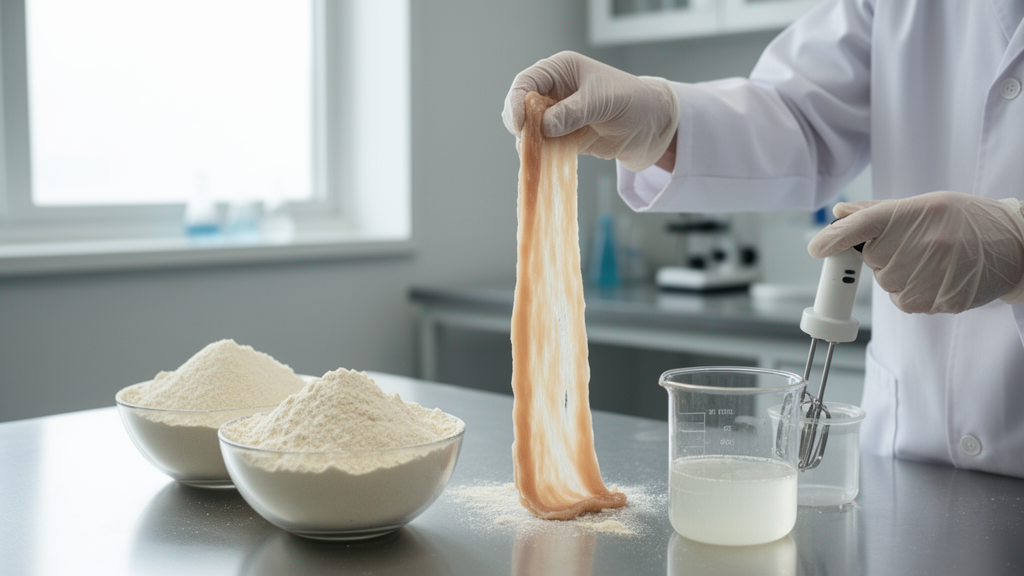
Potato protein could serve as a gluten-free alternative to wheat gluten in plant-based meat products, according to new research from the University of Greenwich and Heriot-Watt University in Edinburgh. The study, published in the journal Food Hydrocolloids, investigated whether potato protein could be combined with fava bean protein to create the firm, fibrous structure needed to mimic meat. The work addresses a specific challenge in the meat-free sector: wheat gluten is commonly added to vegan and vegetarian meat substitutes because it helps give products their characteristic chewiness, but this makes them unsuitable for people with coeliac disease or gluten sensitivity.
The research team combined fava bean protein with either wheat gluten or potato protein, then processed the mixtures using a technique known as high-moisture extrusion. This method uses heat, pressure and mechanical force to reshape proteins into fibrous structures similar to those found in meat. The researchers tested a blend containing 75 per cent fava bean protein and 25 per cent potato protein, comparing it against fava bean protein alone and a mixture containing wheat gluten. They found that the potato protein formed a particularly strong network with the fava bean protein, providing the structural framework needed for a meat alternative.
Dr Parag Archaya, from the Bezos Centre for Sustainable Protein at the University of Greenwich, said the gluten version was softer and springier, but the potato protein version was still able to provide the structure required for a meat alternative. He noted that fava beans are increasingly being investigated as a source of plant protein because they can be grown in cooler climates and contain high levels of protein. According to Dr Archaya, fava beans remain underused in the meat-free sector, which relies heavily on soy, pea protein and wheat gluten, and combining them with potato protein could be the secret ingredient to more realistic plant-based meat.
Texture, however, was only half of the challenge. Once the structural properties were established, the researchers turned to the question of taste. They used an electronic taste sensing system capable of detecting bitterness, astringency, umami and aftertastes in the extruded products. The results on this front were less favourable for the potato protein formulation.
Professor Stephen Euston, a food scientist from Heriot-Watt’s School of Engineering and Physical Sciences, said that while the potato protein version had a great structure, its taste was more bitter and astringent, and it left a stronger lingering aftertaste. He cautioned that food companies would need to find ways of reducing the bitterness before the blend could be widely used in consumer products. The researchers say more work is needed in the flavour department before potato protein can match the sensory profile of gluten-containing formulations.
The contrast between the two formulations highlights the trade-off the study documents. Wheat gluten remains the benchmark for the soft, springy texture that manufacturers seek, and the fava bean and gluten mixture performed better on those qualities. The potato protein blend did not fully replicate that texture, but it delivered enough structural integrity to function as a meat alternative, which is the central finding of the extrusion experiments.
The choice of fava beans as the base protein reflects their growing role in alternative protein research. As Dr Archaya explained, they can be grown in cooler climates and contain high levels of protein, yet they are still underused in the meat-free sector compared with soy and pea protein. Pairing them with potato protein, the study suggests, could expand the ingredients available to formulators seeking gluten-free products.
The research was funded by the Bezos Earth Fund through the Bezos Centre for Sustainable Protein (BCSP/IC/001) and by the UK Department for Environment, Food & Rural Affairs (Defra). The study, titled ‘High moisture extrusion of fava bean protein blend: Evaluating potato protein as gluten replacement for texture enhancement’, was published on 23 October 2026 in Food Hydrocolloids.
For now, the potato and fava bean blend remains a research finding rather than a consumer product. The structural results demonstrate that potato protein can replace wheat gluten’s textural role in high-moisture extrusion, but the bitterness and astringency identified by the electronic taste sensing system represent a significant hurdle. As Professor Euston indicated, further work to reduce the bitterness will determine whether the combination can be widely used in consumer products.
Subject of Research: Potato protein as a gluten replacement in high-moisture extrusion of fava bean protein for plant-based meat
Article Title: Potatoes could be the secret to better plant-based meat, say food scientists
Article References: Potatoes could be the secret to better plant-based meat, say food scientists. Original publication (Bibliographic details unavailable.)
Image Credits: AI Generated
DOI: Not provided
Keywords: plant-based meat, potato protein, fava bean, gluten-free, high-moisture extrusion, food hydrocolloids, food science, alternative protein, texture, bitterness, coeliac disease, Potatoes
Cite Scienmag News
Daisy Hatcher. (October 24, 2026). Potato protein offers gluten-free structure for plant-based meat, study finds. Scienmag. https://scienmag.com/potato-protein-offers-gluten-free-structure-for-plant-based-meat-study-finds/
Daisy Hatcher. "Potato protein offers gluten-free structure for plant-based meat, study finds." Scienmag, 24 October 2026, https://scienmag.com/potato-protein-offers-gluten-free-structure-for-plant-based-meat-study-finds/. Accessed 24 October 2026.
Daisy Hatcher. "Potato protein offers gluten-free structure for plant-based meat, study finds." Scienmag. October 24, 2026. https://scienmag.com/potato-protein-offers-gluten-free-structure-for-plant-based-meat-study-finds/


