


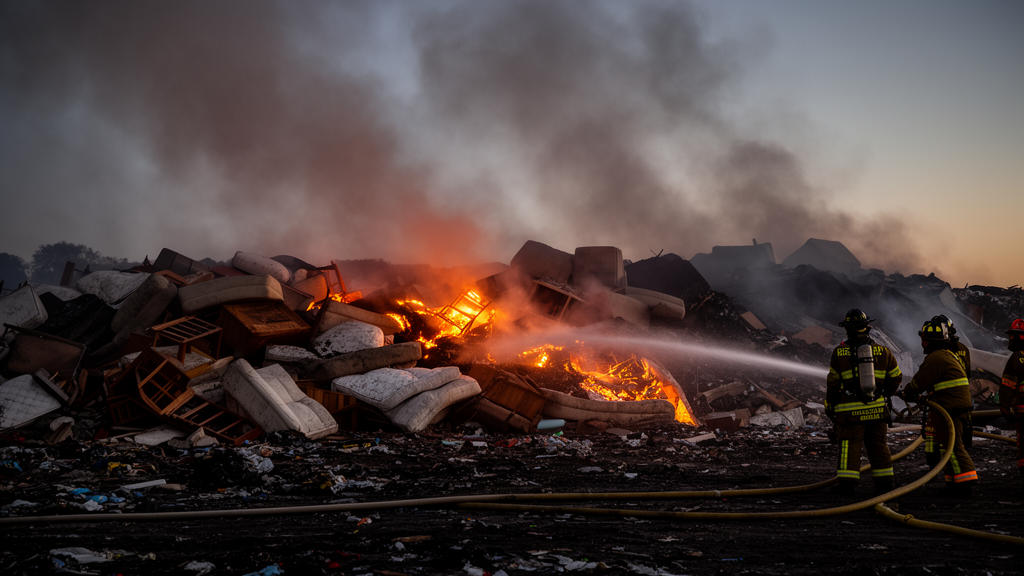
A fire that tore through a furniture waste storage site at a municipal landfill in Tychy, southern Poland, transformed the charred remains into a chemically hazardous repository of heavy polycyclic aromatic hydrocarbons (PAHs) and organophosphate ester flame retardants, according to an open-access study published in Environmental Geochemistry and Health. Researchers from the University of Silesia in Katowice collected thirteen samples of burnt furniture waste from the site six days after the August 19, 2025 blaze and subjected them to gas chromatography-mass spectrometry, producing what they describe as the first field-scale chemical characterization of a furniture waste landfill fire under real conditions.
The fire itself began around 4:00 a.m., likely ignited by spontaneous biochemical combustion deep within waste piles that reached six meters in height. It spread across roughly 1,000 square meters, generating thick black smoke visible from many kilometers away before seven fire crews extinguished it after 6:00 a.m. No one was injured. The dense packing of bulky furniture, which combines wood, particleboard, polyurethane foams, textiles, adhesives and lacquers, created severe oxygen deficits in the pile core while temperatures climbed high enough to drive intense pyrolysis, conditions that shaped the unusual chemical signature the team later recovered from the ash and char.
The analytical results reveal the scale of contamination. Total PAH concentrations across the thirteen samples, coded TM1 through TM13, ranged from 34.56 to 3,031.86 micrograms per gram, with an average of 526.35 micrograms per gram. The most intensely burned sample, TM7, taken from the fire’s core, fell into the extreme contamination category and recorded a maximum benzo(a)pyrene-equivalent concentration of 155.31 micrograms per gram. The authors classified the samples into four tiers, from minimal contamination below 50 micrograms per gram to extreme levels above 1,000 micrograms per gram, and found that one sample occupied the highest tier while three others, all recovered near the fire center, ranked as high.
One of the study’s most striking findings is how the fire selectively concentrated the heaviest, most toxic PAH fractions in the solid residue. Four-ring compounds, mainly fluoranthene and pyrene, dominated ten of the samples, accounting for 60.5 to 76.9 percent of the PAH load, consistent with combustion at 400 to 600 degrees Celsius and the breakdown of lignin combined with synthetic binders. But in the three hottest core samples, five-ring PAHs dominated, making up 69.9 to 71.5 percent of the total. The researchers attribute this to high-temperature, oxygen-starved pyrolysis, in which reactive hydrocarbon radicals recombine through the hydrogen-abstraction-carbon-addition mechanism into heavy, thermally stable structures. Meanwhile, light two-ring naphthalene, with its low boiling point of 218 degrees Celsius, was almost entirely volatilized and carried away in the smoke, leaving the solid residue acting as a retention matrix for the least volatile and most genotoxic compounds.
Diagnostic ratios of parent PAHs told a consistent story about the combustion regime. The anthracene-to-phenanthrene ratio hovered between 0.09 and 0.13 across most samples, near the conventional threshold separating petrogenic from pyrogenic sources, while fluoranthene-to-pyrene ratios above 0.50 indicated low-temperature smoldering within the deeper waste strata. The benzo(a)anthracene-to-chrysene ratio of 0.42 to 0.46 matched published values for wood combustion under oxygen-limited conditions. The indeno[1,2,3-cd]pyrene-to-benzo(ghi)perylene ratio, at 0.19 to 0.25, initially appeared to contradict this picture, but the authors explain that the photochemical instability of indeno[1,2,3-cd]pyrene and the flaming combustion of petroleum-derived varnishes and laminates within the furniture artificially suppressed the value without indicating crude oil contamination.
Alkylated PAHs provided an independent thermal map of the fire. The methylnaphthalene ratio remained tightly clustered between 1.31 and 1.59 in peripheral samples exposed to uniform, lower-temperature smoldering, but stretched from 1.26 to 2.25 in the fire epicenter, where the less stable alpha isomer of methylnaphthalene degraded faster than its beta counterpart. Conversely, the methylphenanthrene indices, which normally increase with temperature, were paradoxically suppressed in the core, reflecting a regime in which rapid thermal dealkylation and molecular destruction outpaced structural isomerization at extreme temperatures. The dimethylphenanthrene ratio followed the same spatial pattern, compressing from a broad 0.78 to 1.48 in the periphery to 0.66 to 1.30 in the core. A calculated vitrinite reflectance equivalent, ranging from 0.58 to 0.66, showed that the transient thermal shock of the fire core arrested the optical maturation of the char even as molecular markers recorded intense heating.
The team also identified a suite of abietane derivatives, including dehydroabietic acid, dehydroabietic aldehyde, and methyl and ethyl dehydroabietates, together with their aromatization products retene and simonellite, in every sample. These diterpenoid compounds form when coniferous resin acids from pine and spruce chipboard, the dominant materials in inexpensive furniture, are heated and transformed into wood tar. Their survival through the fire provides a botanical fingerprint that, combined with synthetic markers, allows investigators to reconstruct both the source material and the combustion pathways of complex waste fires.
Three organophosphate esters were detected in all thirteen samples: tris(1-chloro-2-propyl) phosphate (TCiPP), triphenyl phosphate (TPhP) and tricresyl phosphate (TCP). TCiPP, a flame retardant used in upholstery foams, exceeded 5 micrograms per gram in three samples, while TPhP, a plasticizer in varnishes, polishes and wood adhesives, reached an extraordinary 43.97 milligrams per gram in one sample. TCP, used in wood lacquers and fabric coatings, reached several milligrams per gram in others. Because these additives are artificial chemicals found only in manufactured goods, their co-occurrence with abietane derivatives constitutes a distinctive fingerprint separating furniture fires from other waste fire scenarios, where chlorinated retardants typically prevail at much lower concentrations.
The health risk assessments, all explicitly screening-level calculations rather than measurements of actual exposure, revealed a striking asymmetry between pathways. Under a hypothetical water-ingestion scenario assuming equilibrium partitioning and no dilution or attenuation, estimated pore-water benzo(a)pyrene-equivalent concentrations ranged from 0.24 to 5.53 micrograms per liter, and calculated cancer-risk estimates spanned 2.78 times ten to the minus six to 6.50 times ten to the minus five, elevated but below the unacceptable threshold. In that water-phase model, fluoranthene, with its relatively low organic carbon partition coefficient, emerged as the dominant risk driver, accounting for nearly 77 percent of the mixture risk on average. Under an upper-bound direct-contact scenario assuming 100 milligrams per day of incidental soil and dust ingestion, total cancer risk ranged from 9.20 times ten to the minus seven to 1.39 times ten to the minus four, with sample TM7 exceeding the 1.0 times ten to the minus four threshold regarded as unacceptable. In this scenario benzo(a)pyrene and other high-molecular-weight PAHs dominated the risk, with soil and dust ingestion contributing about 77 percent of the total and inhalation less than 0.01 percent. The authors stress that these figures identify conditions warranting monitoring, not actual doses, and that measured leachate and groundwater data are needed for confirmation.
The ecological assessment was unambiguous. Risk quotients for benzo(a)pyrene, calculated against a predicted no-effect concentration for soil organisms of 0.0006 milligrams per kilogram, ranged from 1,206 to 47,309, meaning every sample exceeded the ecological threshold by three to five orders of magnitude. All samples also surpassed Polish regulatory soil quality standards for both residential and industrial land-use categories. Combined with the finding that post-fire ash concentrates the heaviest, most toxic PAHs more densely than the original unburned waste, the results led the researchers to conclude that burned furniture waste should be treated as a priority source requiring immediate containment, protective handling during site reclamation, and systematic monitoring of leachate and groundwater, particularly given the propensity of the retained organophosphate esters to mobilize on contact with rainwater or firefighting water.
Subject of Research: Chemical fingerprinting and risk assessment of contaminants in charred furniture waste after a landfill fire in Poland
Article Title: Chemical fingerprinting of a furniture waste landfill fire: parent and alkylated PAHs, organophosphates and environmental-health risk assessments
Article References: Rykała, W., Fabiańska, M. J., & Dąbrowska, D. (2026). Chemical fingerprinting of a furniture waste landfill fire: parent and alkylated PAHs, organophosphates and environmental-health risk assessments. Environmental Geochemistry and Health, 48(16), Article 658. https://doi.org/10.1007/s10653-026-03555-4
Image Credits: AI Generated
DOI: 10.1007/s10653-026-03555-4
Keywords: PAHs, organophosphate esters, landfill fire, furniture waste, benzo(a)pyrene, flame retardants, GC-MS, diagnostic ratios, groundwater, ecological risk, Tychy Poland, pyrolysis
Cite Scienmag News
Sloane Callahan. (October 23, 2026). Landfill Fire Leaves Furniture Waste Loaded with Toxic PAHs and Flame Retardants. Scienmag. https://scienmag.com/landfill-fire-leaves-furniture-waste-loaded-with-toxic-pahs-and-flame-retardants/
Sloane Callahan. "Landfill Fire Leaves Furniture Waste Loaded with Toxic PAHs and Flame Retardants." Scienmag, 23 October 2026, https://scienmag.com/landfill-fire-leaves-furniture-waste-loaded-with-toxic-pahs-and-flame-retardants/. Accessed 23 October 2026.
Sloane Callahan. "Landfill Fire Leaves Furniture Waste Loaded with Toxic PAHs and Flame Retardants." Scienmag. October 23, 2026. https://scienmag.com/landfill-fire-leaves-furniture-waste-loaded-with-toxic-pahs-and-flame-retardants/


