


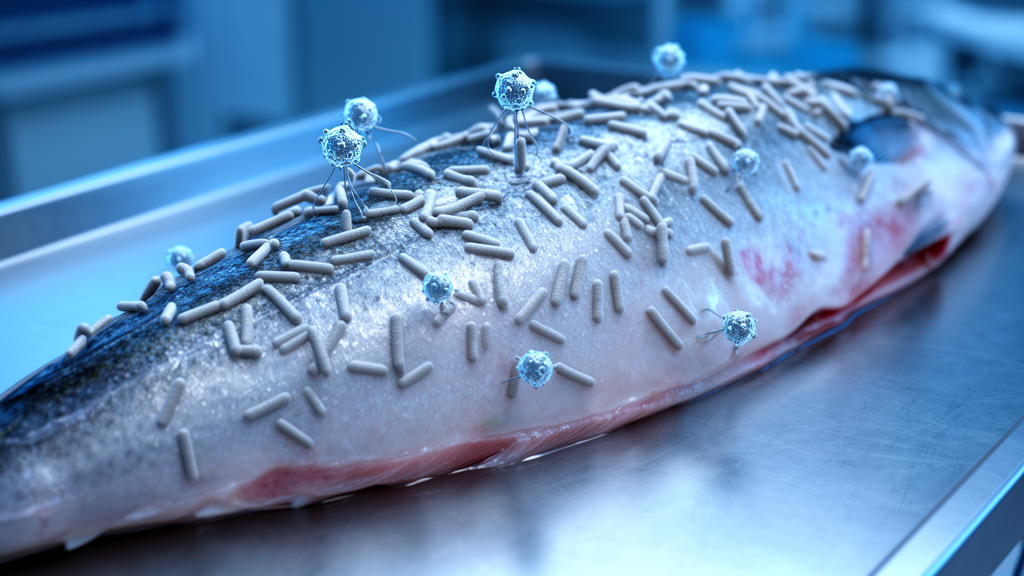
Researchers in China have isolated and characterized a new lytic bacteriophage, vB_VpaS_R27Z, that kills Vibrio parahaemolyticus, a leading cause of seafood-borne gastroenteritis, and significantly reduced the pathogen on artificially contaminated fish muscle and skin in laboratory challenge assays. The work extends phage efficacy evaluation beyond in vitro cultures into representative seafood matrices, providing experimental evidence for the postharvest biocontrol potential of the isolate. Vibrio parahaemolyticus is a halophilic Gram-negative bacterium abundant in marine and estuarine environments and is a major bacterial cause of seafood-associated diarrheal illness.
Infection typically follows consumption of raw or undercooked seafood from warm coastal waters and produces watery diarrhea, abdominal cramps, nausea, vomiting, fever, and chills, with severe disease possible in susceptible individuals. In the United States, Vibrio species cause an estimated 80,000 illnesses each year, roughly 52,000 of them linked to contaminated food. According to the review cited by the authors, the public-health risk posed by Vibrio species is expected to increase as rising sea surface temperatures, altered coastal salinity, and globalized seafood trade expand the ecological niche and transmission opportunities of these bacteria.
The pathogen also threatens aquaculture directly. Strains carrying plasmid-encoded pirA and pirB toxin genes cause acute hepatopancreatic necrosis disease in shrimp, a destructive condition first reported in China in 2009 and subsequently documented in Vietnam, Thailand, Malaysia, Mexico, and the Philippines, inflicting heavy economic losses during early rearing. Because V. parahaemolyticus therefore bridges on-farm disease burdens and postharvest safety risks, the research team argued that effective control measures are needed across both aquaculture and seafood processing.
Existing control options each carry limitations for raw or minimally processed seafood. Refrigeration slows bacterial growth but may not eliminate the pathogen, and low-temperature or starvation stress can drive cells into a viable-but-nonculturable state, first described for Escherichia coli and Vibrio cholerae in estuarine and marine environments, that evades routine culture-based testing while remaining metabolically viable. Thermal treatment is unsuitable where sensory quality must be preserved, while high-pressure processing, irradiation, and ultraviolet treatment can demand specialized equipment, show limited penetration, or affect food structure.
Chemical sanitizers and organic acids act in a matrix-dependent fashion and may raise residue or consumer acceptance concerns. Antibiotic use in aquaculture has been undermined by the growing occurrence of antimicrobial-resistant V. parahaemolyticus in shrimp and seafood systems, motivating the search for targeted, residue-free biological alternatives such as lytic phages, which selectively attack susceptible hosts while sparing non-target food-associated microbiota. To find such an alternative, the researchers collected environmental water from seafood markets in Guangdong and enriched phages against V. parahaemolyticus ATCC 17802ᵀ, the type strain obtained from the Marine Culture Collection of China.
After filtration, centrifugation, and at least five rounds of plaque purification using the double-layer agar method, they recovered a phage designated vB_VpaS_R27Z, isolated from the sewage drains of Bao'an Agricultural Wholesale Market in Shenzhen. High-titer stocks were produced through stepwise amplification from 20 milliliters to 1 liter, DNase and RNase treatment, polyethylene glycol precipitation, and cesium chloride density gradient ultracentrifugation at 200,000 × g. Transmission electron microscopy revealed an icosahedral head measuring 84 ± 2 nm by 71 ± 2 nm and a long, flexible, non-contractile tail of about 141 ± 3 nm, a siphovirus-like morphotype reflected in the phage's name.
One-step growth experiments showed a total lytic cycle of approximately 70 minutes, with a latent period of roughly 20 minutes and a burst size of 58 plaque-forming units per infected cell, indicating rapid replication that can outpace bacterial proliferation during early contamination. Chloroform exposure at 2 and 20 percent had no significant effect on titer or plaque morphology, consistent with a lipid-free capsid typical of marine tailed phages. The phage's host range proved narrow and specialized.
Among 51 Vibrio strains tested, spanning eleven species, R27Z produced clear lysis on nine, including the type strain of V. parahaemolyticus, several V. alginolyticus isolates, and single strains of V. neocaledonicus, V. tubiashii, and V. brasiliensis, for a strain-level coverage of 17.65 percent. Physicochemical stability assays showed the phage retained high activity between 4°C and 37°C, surviving with about 51.69 percent activity at 50°C but dropping to 0.09 ± 0.04 percent at 55°C and near-undetectable levels at 60°C. Optimal stability occurred between pH 5.0 and 10.0, with no viable particles detected below pH 4.0 or above pH 11.0. The authors noted that these ranges overlap the temperatures and pH typical of aquaculture and seafood handling, though the findings reflect short-term tolerance under tested conditions rather than long-term preservation capability.
Whole-genome sequencing showed a linear double-stranded DNA genome of 51,052 base pairs with 41.65 percent GC content, encoding 64 predicted open reading frames and two transfer RNA genes organized into functional modules for DNA metabolism and replication, structural proteins, DNA packaging, host lysis, and auxiliary functions. The lysis module includes a putative endolysin, ORF4, carrying a lysozyme-like domain consistent with peptidoglycan hydrolysis, and ORF1, predicted to be a unimolecular spanin based on an N-terminal lipoprotein signal peptide and a C-terminal transmembrane helix, although the authors emphasized that these predicted roles remain to be experimentally validated. Screening against the Comprehensive Antibiotic Resistance Database and the Virulence Factor Database identified no antibiotic resistance genes, virulence factors, or lysogeny-associated sequences.
Comparative genomics placed R27Z in a clade with seven related Vibrio phages, closest to KIT05, with intergenomic similarities of 81.3 to 92.8 percent; because average nucleotide identity fell below the 95 percent species threshold, R27Z was designated a novel species. The study also documented a marked mismatch between genomic conservation and virion architecture: although KIT05 has a genome of similar size, it was previously reported with a tail of only about 24 nm, and the authors could not identify a definitive molecular explanation, discussing possible modular replacement of tail-morphogenesis genes or methodological variation during electron microscopy preparation, while repeated TEM experiments confirmed R27Z's long-tailed morphology. In laboratory cultures, R27Z suppressed host growth at all tested multiplicities of infection, from 0.01 to 100, with stronger inhibition at higher phage doses and the greatest differential between treated and untreated cultures occurring between three and seven hours of co-incubation.
The decisive food-matrix tests used surface-decontaminated fish muscle and skin pieces artificially inoculated with exponentially growing V. parahaemolyticus and incubated at 28°C for seven hours. On fish muscle, phage treatment at multiplicities of 1 and 0.01 reduced viable counts by 3.62 and 3.26 log10 CFU/cm³, corresponding to 99.97 and 99.94 percent inactivation, while untreated bacterial loads rose by roughly 3.32 log10 over the same period. On fish skin, reductions reached 2.84 log10 CFU/cm² at multiplicity 1 and 2.24 log10 CFU/cm² at multiplicity 0.01, or 99.85 and 99.42 percent.
Recoverable phage titers increased over time in both matrices, rising 105-fold and 190-fold respectively, which the authors interpreted as indicating active phage replication on the food surfaces under the tested conditions. The reductions were comparable to or greater than the approximately 1.14 to 2.0 log CFU reductions reported for the V. parahaemolyticus phages vB_Va_ZWPVA056 and OY1 under food-related conditions, although those studies used different matrices, doses, and incubation periods. The authors caution that several caveats frame these results.
The fish tissues were decontaminated with ethanol and ultraviolet light to remove native microbiota, so the model does not reproduce the microbial complexity of untreated seafood, and such pretreatment may alter tissue properties that influence phage-host encounters, an effect not directly assessed. No bacterial regrowth appeared during the seven-hour trial, but the study was designed to evaluate rapid pathogen suppression under growth-permissive conditions rather than refrigerated storage, and the effect of phage treatment on seafood appearance, texture, and odor was not evaluated. Because V. parahaemolyticus is Gram-negative, phage-mediated lysis may release lipopolysaccharide-containing outer membrane components, which the researchers say should be considered in future biosafety assessments.
The narrow host range also suggests R27Z is best viewed as a candidate component of a multi-phage cocktail rather than a standalone intervention, since other V. parahaemolyticus phages such as VPT02 and pVp-JHP1101 have shown activity under refrigerated conditions on raw fish slices and in clams respectively. With these limitations in mind, the team concludes that R27Z, whose genome is deposited in GenBank under accession PZ311400, warrants further testing under cold-chain storage conditions, in naturally contaminated seafood, and in combination with complementary phages.
Subject of Research: Isolation and biocontrol evaluation of the novel lytic Vibrio parahaemolyticus phage vB_VpaS_R27Z for seafood safety
Article Title: Isolation, characterization, and biocontrol potential of a novel lytic phage vB_VpaS_R27Z against Vibrio parahaemolyticus for mitigating seafood contamination
Article References: Xiao, H., Taj, M. I., Zhu, B., Xia, C., Wang, M., Xu, B., & Zhang, R. (2026). Isolation, characterization, and biocontrol potential of a novel lytic phage vB_VpaS_R27Z against Vibrio parahaemolyticus for mitigating seafood contamination. Current Research in Food Science, Article 101602. https://doi.org/10.1016/j.crfs.2026.101602
Image Credits: AI Generated
DOI: 10.1016/j.crfs.2026.101602
Keywords: bacteriophage, Vibrio parahaemolyticus, seafood safety, biocontrol, foodborne pathogens, siphovirus, aquaculture, phage genome, postharvest intervention, fish matrix, antimicrobial resistance, endolysin
Cite Scienmag News
Kristina Jarvis. (October 23, 2026). Novel phage R27Z targets Vibrio parahaemolyticus on contaminated fish surfaces. Scienmag. https://scienmag.com/novel-phage-r27z-targets-vibrio-parahaemolyticus-on-contaminated-fish-surfaces/
Kristina Jarvis. "Novel phage R27Z targets Vibrio parahaemolyticus on contaminated fish surfaces." Scienmag, 23 October 2026, https://scienmag.com/novel-phage-r27z-targets-vibrio-parahaemolyticus-on-contaminated-fish-surfaces/. Accessed 23 October 2026.
Kristina Jarvis. "Novel phage R27Z targets Vibrio parahaemolyticus on contaminated fish surfaces." Scienmag. October 23, 2026. https://scienmag.com/novel-phage-r27z-targets-vibrio-parahaemolyticus-on-contaminated-fish-surfaces/


