

Friday, October 23, 2026
Science
No Result
View All Result
  • Login
  • HOME
  • SCIENCE NEWS
  • CONTACT US
  • HOME
  • SCIENCE NEWS
  • CONTACT US
No Result
View All Result
Scienmag
No Result
View All Result
Home Science News Biology

Drivers’ Brains Simplify: Eye, Head and Steering Movements Collapse Onto Few Dimensions at Hazardous Moments

October 23, 2026
in Biology, Technology and Engineering
Drew Townsend
By Drew Townsend Scienmag Editorial Profile - Cell Biology
Reading Time: 3 mins read
0
Drivers’ Brains Simplify: Eye, Head and Steering Movements Collapse Onto Few Dimensions at Hazardous Moments

Drivers' Brains Simplify: Eye, Head and Steering Movements Collapse Onto Few Dimensions at Hazardous Moments

65
SHARES
587
VIEWS
Share on FacebookShare on Twitter
ADVERTISEMENT

When drivers approach a hazard on the road, their behavior does not become more complex — it becomes simpler, according to a new study of 284 people navigating an immersive virtual drive. Researchers found that the combined movements of the eyes, head, steering wheel and vehicle heading, which together span a high-dimensional behavioral space, reliably collapse onto fewer effective dimensions around critical events, signaling tighter coordination between perception and action precisely when it matters most.

The team, led by John Madrid-Carvajal, Shadi Derakhshan and Peter König, recreated ten hazardous on-road events in a virtual driving simulator. Participants were assigned either to drive manually or to ride in an automated mode, and their eye, head and vehicle movements were recorded throughout. Using principal component analysis across all participants, the researchers built a common, time-resolved behavioral state space — a shared low-dimensional map of visuomotor coordination that captures strategies generalizing across drivers.

Throughout the entire drive, just a few components accounted for most of the variance in behavior. But the study’s key finding concerned how this dimensionality changed over time. Using cosine similarity and several measures of effective dimensionality, the researchers showed that the behavioral state reliably compressed around hazardous events. During these periods of low effective dimensionality, the relative contributions of eye movements, head movements, steering and vehicle heading reorganized toward the leading dimensions in a task-dependent manner, suggesting that the visuomotor system flexibly reallocates its degrees of freedom according to contextual demands.

The compression also carried information about the driving mode. Discriminant analysis revealed that during reorganization, behaviors became more distinct between manual and automated conditions, to the point that the first two components alone were sufficient to classify which driving condition a participant was in. Between-subject similarity across events was partially stable overall, and notably stronger among manual drivers, hinting that active control imposes a more stereotyped coordination pattern than passive travel in an automated vehicle.

The findings support the idea that naturalistic behavior is generated through patterns within a low-dimensional structure, extending evidence from laboratory tasks to the unconstrained, real-world-like setting of driving. Because the same low-dimensional framework links naturally to neural manifold research, human driver modeling and the design of adaptive automated vehicles, the authors propose it as a principled behavioral bridge between neuroscience and automotive engineering. As automated driving systems become more common, understanding how human visuomotor coordination reshapes itself around hazards — and how it differs when the driver is out of the loop — could inform vehicles that monitor and adapt to the behavioral state of the person behind the wheel. The study, based on a virtual simulation, establishes a behavioral framework whose links to neural activity and real-road performance remain to be tested in future work.

Subject of Research: Low-dimensional visuomotor coordination in naturalistic driving behavior

Article Title: Visuomotor coordination on the road: Low-dimensional representations reveal adaptive, context-dependent reductions in the dimensionality of natural driving behavior

Article References: Madrid-Carvajal, J., Derakhshan, S., & König, P. (2026). Visuomotor coordination on the road: Low-dimensional representations reveal adaptive, context-dependent reductions in the dimensionality of natural driving behavior. PLOS Computational Biology, 22(10), e1014056. https://doi.org/10.1371/journal.pcbi.1014056

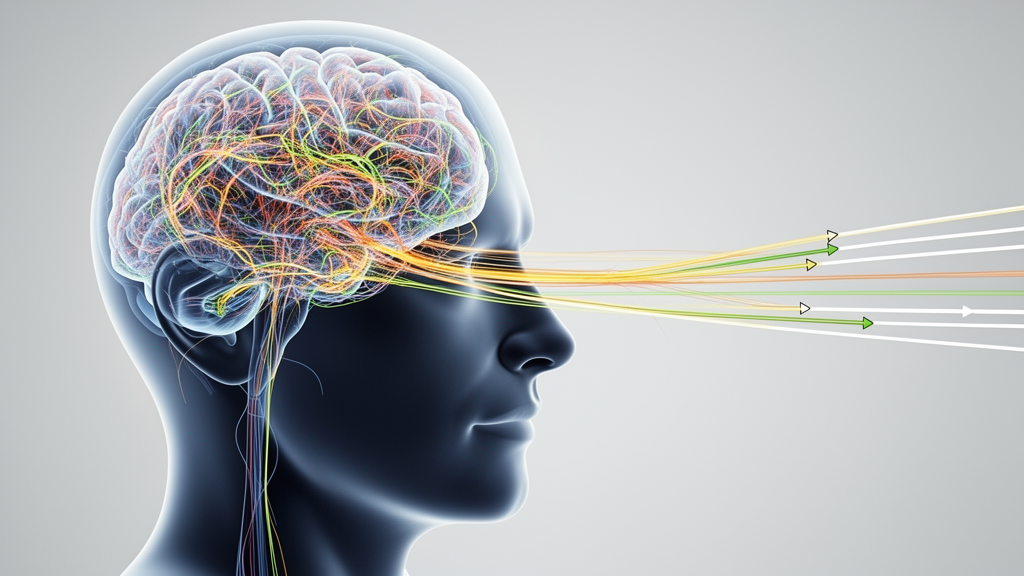
Image Credits: AI Generated

DOI: 10.1371/journal.pcbi.1014056

Keywords: driving behavior, visuomotor coordination, principal component analysis, effective dimensionality, virtual reality, hazard perception, automated vehicles, eye movements, steering, neural manifolds, driver modeling, perception-action

Cite Scienmag News

Drew Townsend. (October 23, 2026). Drivers’ Brains Simplify: Eye, Head and Steering Movements Collapse Onto Few Dimensions at Hazardous Moments. Scienmag. https://scienmag.com/drivers-brains-simplify-eye-head-and-steering-movements-collapse-onto-few-dimensions-at-hazardous-moments/


Drew Townsend. "Drivers’ Brains Simplify: Eye, Head and Steering Movements Collapse Onto Few Dimensions at Hazardous Moments." Scienmag, 23 October 2026, https://scienmag.com/drivers-brains-simplify-eye-head-and-steering-movements-collapse-onto-few-dimensions-at-hazardous-moments/. Accessed 23 October 2026.

Drew Townsend. "Drivers’ Brains Simplify: Eye, Head and Steering Movements Collapse Onto Few Dimensions at Hazardous Moments." Scienmag. October 23, 2026. https://scienmag.com/drivers-brains-simplify-eye-head-and-steering-movements-collapse-onto-few-dimensions-at-hazardous-moments/

Tags: automated vehiclesautomated vs manual driving behaviorcritical event-driven behavior simplificationdriver behavior dimensionality reductiondriver modelingdriving behavioreffective dimensionalityeye movementseye-head-steering coordination during hazardshazard perceptionhazard response in simulated drivingimmersive virtual driving hazard responselow-dimensional behavioral state spacemultidimensional analysis of driver reactionsneural manifoldsperception-actionPrincipal Component Analysisprincipal component analysis in driving studiesreal-time driver behavior monitoringsteeringvirtual driving hazard analysisvirtual realityvisuomotor coordinationvisuomotor coordination in drivers
Share26Tweet16
Previous Post

Echocardiography reveals heart abnormalities in 86% of hemodialysis patients

Next Post

Urban Schistosomiasis Persists in Salvador, Brazil, but Falls Sharply Over 13 Years

Related Posts

Everleap Fertility to Present 19 Studies at ASRM 2026
Biology

Everleap Fertility to Present 19 Studies at ASRM 2026

October 23, 2026
Low-Dose Cancer Immunotherapy Matches Standard Dose Efficacy
Technology and Engineering

Low-Dose Cancer Immunotherapy Matches Standard Dose Efficacy

October 23, 2026
Coal Production Emerges as Key Bottleneck in Yellow River Basin’s Water-Energy-Land-Carbon Coordination
Biology

Coal Production Emerges as Key Bottleneck in Yellow River Basin’s Water-Energy-Land-Carbon Coordination

October 23, 2026
Facial Landmarks Let Autonomous Vehicles Read Driver States in Real Time
Science News

Facial Landmarks Let Autonomous Vehicles Read Driver States in Real Time

October 23, 2026
Random Skin Wiring Beats Neat Layouts in Self-Calibrating Touch Circuits
Medicine

Random Skin Wiring Beats Neat Layouts in Self-Calibrating Touch Circuits

October 23, 2026
A 400-Dollar LEGO Tomograph Puts Real CT Scanning in Students’ Hands
Technology and Engineering

A 400-Dollar LEGO Tomograph Puts Real CT Scanning in Students’ Hands

October 23, 2026
Next Post
Urban Schistosomiasis Persists in Salvador, Brazil, but Falls Sharply Over 13 Years

Urban Schistosomiasis Persists in Salvador, Brazil, but Falls Sharply Over 13 Years

  • Mothers who receive childcare support from maternal grandparents show more optimized

    Mothers who receive childcare support from maternal grandparents show more parental warmth, finds NTU Singapore study

    27656 shares
    Share 11059 Tweet 6912
  • University of Seville Breaks 120-Year-Old Mystery, Revises a Key Einstein Concept

    1061 shares
    Share 424 Tweet 265
  • Bee body mass, pathogens and local climate influence heat tolerance

    682 shares
    Share 273 Tweet 171
  • Researchers record first-ever images and data of a shark experiencing a boat strike

    546 shares
    Share 218 Tweet 137
  • Groundbreaking Clinical Trial Reveals Lubiprostone Enhances Kidney Function

    531 shares
    Share 212 Tweet 133
Science

Embark on a thrilling journey of discovery with Scienmag.com—your ultimate source for cutting-edge breakthroughs. Immerse yourself in a world where curiosity knows no limits and tomorrow’s possibilities become today’s reality!

RECENT NEWS

  • Urban Schistosomiasis Persists in Salvador, Brazil, but Falls Sharply Over 13 Years
  • Drivers’ Brains Simplify: Eye, Head and Steering Movements Collapse Onto Few Dimensions at Hazardous Moments
  • Echocardiography reveals heart abnormalities in 86% of hemodialysis patients
  • New furthest-first algorithm sharpens the ocean’s carbon record in GLODAPv3

Categories

  • Agriculture
  • Anthropology
  • Archaeology
  • Athmospheric
  • Biology
  • Biotechnology
  • Blog
  • Bussines
  • Cancer
  • Chemistry
  • Climate
  • Earth Science
  • Editorial Policy
  • Marine
  • Mathematics
  • Medicine
  • Pediatry
  • Policy
  • Psychology & Psychiatry
  • Science Education
  • Science News
  • Social Science
  • Space
  • Technology and Engineering

Subscribe to Blog via Email

Enter your email address to subscribe to this blog and receive notifications of new posts by email.

Join 5,152 other subscribers

© 2025 Scienmag - Science Magazine

Welcome Back!

Login to your account below

Forgotten Password?

Retrieve your password

Please enter your username or email address to reset your password.

Log In
No Result
View All Result
  • HOME
  • SCIENCE NEWS
  • CONTACT US

© 2025 Scienmag - Science Magazine

Discover more from Science

Subscribe now to keep reading and get access to the full archive.

Continue reading