


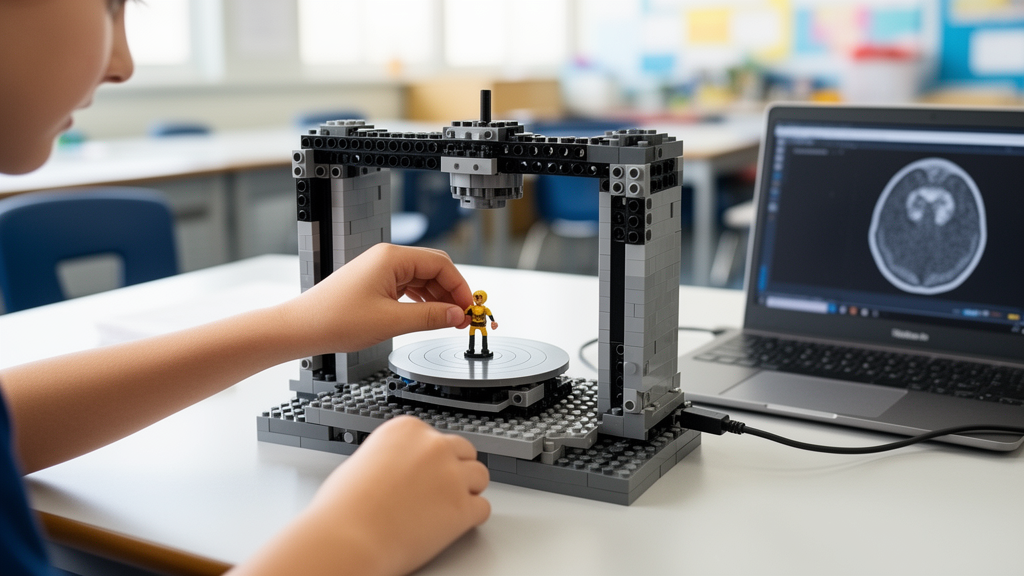
A team of engineers has unveiled an open-source optical computed tomography platform that students can physically build, operate and rebuild for roughly 408 to 631 US dollars, using nothing more exotic than LEGO bricks, a laser pointer-class diode, a single photodiode and a microcontroller. Unlike the software-only simulators that dominate tomography classrooms, the device forces learners to confront the messy physical realities of real imaging hardware: mechanical misalignment, sensor noise and synchronization errors that never appear on a screen. All design files, firmware, reconstruction code and datasets are freely available under open-source licenses.
The project addresses a persistent pedagogical gap. Computed tomography is a cornerstone of diagnostic imaging and industrial inspection, reconstructing the internal distribution of physical properties, such as the linear attenuation coefficient, from projections acquired around an object. Yet commercial scanners cost tens of thousands of euros and rely on ionizing X-rays, so most courses relegate students to simulations. The developers argue that software-only teaching hides the technical challenges of acquiring real physical signals, which are fundamental to understanding why clinical images look the way they do.
Architecturally, the platform mirrors the workflow of a first-generation clinical scanner in miniature. A manually rotated platform holds the specimen, while a four-wheeled carriage built from a U-shaped LEGO chassis glides along two ruler rails, carrying a 635-nanometer laser module on one side and a photodiode detector on the other. The collimated, monochromatic beam approximates the pencil-beam geometry of early X-ray CT. A pair of lenses focuses the light, and an optional 3D-printed pinhole in front of the photodiode limits scattered light from reaching the sensor, trading signal intensity for sharper projections.
The most distinctive engineering choice is how the system synchronizes position and intensity. Rather than relying on open-loop stepper-motor timing, the carriage carries a capacitive incremental encoder that tracks its real-time linear position at roughly 0.012 millimeters per count. Every photodiode voltage sample is thereby indexed to its measured spatial coordinate during the manual 50-millimeter sweep at each angle, a capability the authors highlight as the key novelty distinguishing their design from previous DIY optical tomographs. At each angular step the firmware records a window of about 35 millimeters, or 690 samples, and 36 such profiles at 5-degree increments from 0 to 175 degrees assemble into a complete sinogram.
The electronics revolve around an iMXRT1062 microcontroller on a Teensy 4.0 board, whose 12-bit analog-to-digital converter digitizes the photodiode current after amplification by an LMH6644 operational amplifier in a transimpedance configuration with a 49-kilo-ohm feedback resistor. The measured dark current was about 20 nanoamperes, roughly 0.03 percent of the operating photocurrent, small enough to skip dark-current correction entirely. Reconstruction runs in an open Python environment: a JupyterLab notebook applies filtered back-projection, the classic inverse-Radon-transform algorithm, using the scikit-image library, and students can switch filters or try iterative SART methods to see how algorithm choices alter sharpness and noise.
Validation scans used gummy bears as tissue-mimicking phantoms, chosen because their translucent hydrogel composition scatters and absorbs light in ways that roughly approximate soft biological tissue. The system resolved the phantom’s internal morphology and clearly detected a metal screw embedded inside it. A glass marble in a plastic cap revealed a striking optical lesson: the bright annulus at the marble’s edge comes from rays strongly deflected at the curved air-glass interface that miss the pinhole-limited detector and are recorded as attenuated. This makes the point that visible-light tomography does not obey the straight-line ray assumption of X-ray CT, and the reconstructed values are apparent extinction combining absorption, scattering and refraction, not true attenuation coefficients.
Quantitative checks confirmed respectable geometric fidelity. A 3D-printed cylinder was reconstructed with a relative area error of just 0.94 percent at 36 projections, while a cube fared worse at 32.19 percent, an effect attributed to corner-rounding and tangential streak artifacts under sparse-view sampling. The detector chain achieved a signal-to-noise ratio of 2257, about 67 decibels, with baseline noise of only 1.3 to 1.7 millivolts. Three independent acquisitions of the same phantom showed Pearson correlations of 0.991 to 0.998 between matching raw projections, with lateral shifts of as little as 0.01 millimeters between the two best scans, evidence that the encoder-based synchronization holds up end to end despite the fully manual operation.
The authors are candid about the intentional limits. Thirty-six projections violate the Nyquist sampling criterion, producing characteristic streaking and blurring; the visible laser cannot penetrate opaque or dense objects; and refraction introduces distortions that clinical CT never sees. But these constraints are the point. Refraction-induced edge artifacts echo beam-hardening effects, doubled contours from misalignment mimic gantry errors, and sparse-angle streaks resemble those of dose-reduced medical scans. Students can watch each artifact appear, diagnose its physical cause and correct it, all on a platform that carries zero radiation risk and costs less than a mid-range laptop. The team’s comparison with other educational scanners found it was the cheapest system reporting hardware cost, and roughly two orders of magnitude less expensive than commercial educational CT kits, while remaining the only one combining hardware-level position synchronization with fully open design files.
Preliminary evidence suggests the approach works in the classroom. In a single-group pilot with 16 undergraduate bioengineering students, a short guided session of laser alignment, manual scanning and sinogram observation raised the mean score on a five-item conceptual quiz from 3.8 to 4.3 out of 5, with perfect scores rising from two students to five, although the change did not reach statistical significance in the small sample. Perception was emphatically positive: 95 percent of all survey ratings were the top mark, no response was negative, and 79 percent of students who answered open questions named the sinogram as the concept the device finally made clear. Two experienced instructors rated the platform equally highly, highlighting the link between sinogram acquisition and the sampling theorem. The authors caution that the pilot tested feasibility, not learning effectiveness, and was limited by its size, a ceiling effect and an immediate post-test. Suggestions for future versions include motorized rotation, ambient-light shielding and a web-based reconstruction interface, alongside a planned calibration of angular and centering errors.
Subject of Research: A low-cost open-source optical computed tomography platform for hands-on education in tomography
Article Title: Modular, low-cost optical CT platform for hands-on tomography education
Article References: Rodriguez-Dueñas, W. R., & Bernal-Muñoz, H. A. (2026). Modular, low-cost optical CT platform for hands-on tomography education. HardwareX, Article e00852. https://doi.org/10.1016/j.ohx.2026.e00852
Image Credits: AI Generated
DOI: 10.1016/j.ohx.2026.e00852
Keywords: computed tomography, open-source hardware, tomography education, optical imaging, sinogram, filtered back-projection, photodiode, Teensy microcontroller, LEGO, gummy bear phantom, image reconstruction, engineering education
Cite Scienmag News
Denise Maddox. (October 23, 2026). A 400-Dollar LEGO Tomograph Puts Real CT Scanning in Students’ Hands. Scienmag. https://scienmag.com/a-400-dollar-lego-tomograph-puts-real-ct-scanning-in-students-hands/
Denise Maddox. "A 400-Dollar LEGO Tomograph Puts Real CT Scanning in Students’ Hands." Scienmag, 23 October 2026, https://scienmag.com/a-400-dollar-lego-tomograph-puts-real-ct-scanning-in-students-hands/. Accessed 23 October 2026.
Denise Maddox. "A 400-Dollar LEGO Tomograph Puts Real CT Scanning in Students’ Hands." Scienmag. October 23, 2026. https://scienmag.com/a-400-dollar-lego-tomograph-puts-real-ct-scanning-in-students-hands/


