Across rural Africa and Asia, small-scale biogas digesters have long been promoted as a win-win technology: they turn manure and other organic residues into gas for cooking and heating, while producing a nutrient-rich slurry for crops and easing pressure on forests. Yet a growing body of evidence shows that the hardest part of these programs begins not at installation, but the day the installers walk away. A new mini-review published in Frontiers in Sustainable Energy Policy argues that the field has been measuring the wrong thing for decades, counting digesters installed rather than digesters still working, and that this blind spot is quietly undermining one of the world’s most promising clean-cooking interventions.
The review, authored by Vhutshilo Nekhubvi of the Department of Physics at the University of Venda in South Africa, draws on peer-reviewed studies and major institutional reports published between 2005 and 2026. Its central claim is stark: long-term sustainability remains the unresolved weakness of small-scale biogas programs worldwide. While the literature is rich in studies of adoption—why households choose to install a digester in the first place—comparatively few papers examine what happens after handover, when feeding routines, repair needs, water access and household priorities begin to test the technology in earnest.
The stakes are enormous. Global energy-access tracking still shows roughly 2.1 billion people relying on polluting fuels and technologies for cooking, and rural Africa faces persistent gaps in energy infrastructure, distribution, affordability and policy capacity. Anaerobic digesters appear attractive precisely because they address several problems at once: household air pollution, waste management, fertilizer supply, women’s time burdens and greenhouse gas emissions. But benefits only materialize when plants actually run. In Nepal, where biogas has been associated with time savings, lower fuelwood consumption and reduced forest pressure when systems work, a survey of 2,559 households across 10 districts found that 54 percent of surveyed plants had been abandoned—and many of the plants still functioning were producing well below their expected levels.
That Nepalese survey is one of the more methodologically robust studies in the field, combining a large household sample with visual inspection of plant components, which strengthens the identification of operational problems. Still, the review is careful about what such evidence can and cannot show. Associations between faults, maintenance access and abandonment do not by themselves establish causation. Other studies carry different limits: Vietnamese research comparing continuing and former users through interviews and logistic regression relied on a purposive sample from a single province, and satisfaction with maintenance may reflect continued use as much as influence it. Ethnographic work, meanwhile, offers rich insight into household priorities but should not be used to estimate national abandonment rates. Adoption predictors, observed functionality, perceived value and continued use, the review stresses, are not interchangeable outcomes.
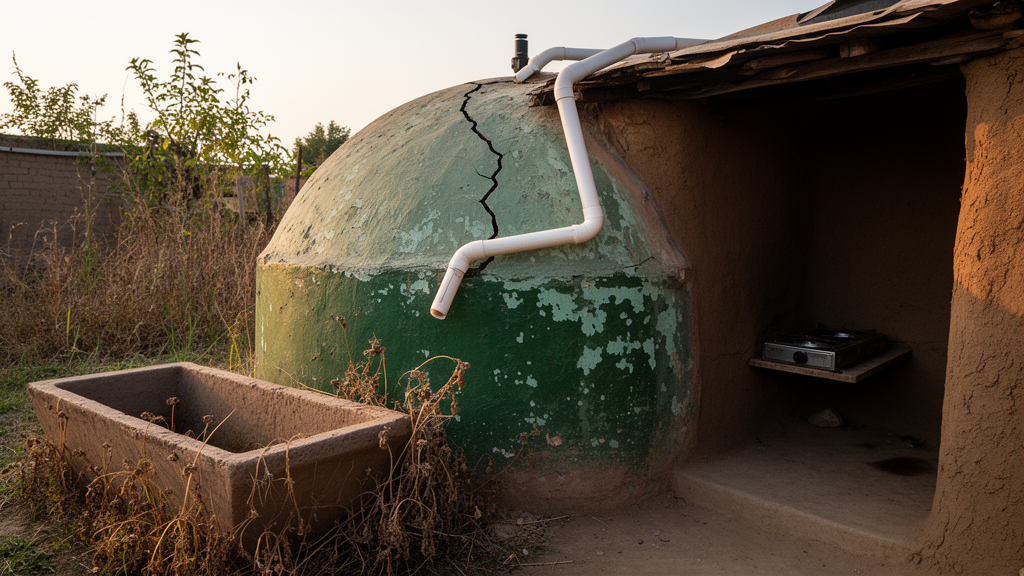
From this evidence, Nekhubvi distills seven interacting determinants of post-installation sustainability. The first is technical quality at commissioning: poor construction, faulty valves, blocked pipes, unsuitable siting and inadequate appliances cause early frustration and costly repairs, and component failures are repeatedly linked to abandonment. Quality assurance, the review argues, should include siting, gas-tightness testing, appliance suitability and documented handover—not merely construction completion. The second is resource continuity: daily gas production depends on a reliable supply of manure or organic waste, water access, suitable temperatures and operator time. Livestock ownership and husbandry practices vary by region and season, so inadequate feedstock commonly limits use. In Nepal, abandonment was linked to insufficient livestock and poor routine cleaning of digesters and outlets.
The third determinant is user capability and behavioral fit. Domestic biogas demands feeding, mixing, slurry handling, stove use, cleaning and basic fault response, and one-off training at installation is rarely enough because operating needs change over time. Capability also has a gender dimension: women often benefit most from less smoke and time savings but may have limited control over investment or repair decisions. The review calls for refresher training, local-language manuals, peer demonstrations and gender-aware household engagement, and for training more than one household member so that know-how survives when the trained operator is absent. The fourth determinant is the after-sales service ecosystem—local technicians, spare parts, warranties and service records—which the review describes as core program infrastructure rather than an optional extra. Evidence from the Africa Biogas Partnership Program in East Africa shows that a nascent biodigester market can emerge, but long-term maintenance remains dependent on quality assurance, business models and local sector capacity.
The fifth determinant is financial durability after installation. Capital subsidies can increase uptake, but they do not automatically finance cleaning, spare parts, stove replacement, technician visits or system upgrades. Bangladesh evidence shows household plants can be financially attractive when functionality is maintained, while recent South African analysis argues for hybrid financing combining subsidies, microfinance, community contributions, public-private partnerships and carbon or results-based mechanisms. The sixth determinant is bioslurry and its productive value: digestate reinforces continued use only when households can transport, store and apply it effectively and observe real benefits for crops. The seventh is governance, monitoring and accountability—program agencies need information about gas production, user satisfaction, component failures and repair responsiveness, and critical scholarship argues that failed projects can impose costs on users, underscoring the need for clearer accountability among donors, implementers and governments.
To organize these determinants, the review proposes the Post-Installation Sustainability Model, or PISM, which arranges the seven factors into four interacting layers: quality commissioning, covering technical quality, testing and handover; operating capability, combining resource continuity with user capability and behavioral fit; the service ecosystem, combining after-sales support with life-cycle finance; and value reinforcement, encompassing bioslurry and the wider household benefits that make continued use worthwhile. Governance, monitoring and accountability cut across all four layers. PISM’s unit of analysis is deliberately the household–digester–local-service configuration rather than the installed digester alone, and it treats installation as a transition to continuing service rather than the endpoint of implementation. The model’s contribution is integrative and operational rather than the discovery of new factors; it is a conceptual synthesis, not a validated predictive model, and it explicitly does not assume that all determinants exert equal influence—their relative importance is expected to vary across households, technologies, seasons and institutional settings.
PISM also generates testable propositions. It proposes that verified commissioning will be associated with higher functionality at 12 months; that refresher training will strengthen use where resources are adequate; that accessible technicians and spare parts will reduce prolonged non-use following faults; that repair finance becomes particularly important after warranties expire; and that practical bioslurry support can reinforce continued use. Testing these claims requires longitudinal and comparative research, including assessment of whether the combined structure adds explanatory or predictive value beyond simpler models. The review outlines four research priorities: longitudinal cohorts following installations through 6-, 12-, 24- and 36-month assessments, tracking continuing users, temporary non-users and abandoners alike; a common indicator set separating technical performance, household value and support capacity, with gas output, days of use, downtime, repair response times, maintenance expenditure and user satisfaction as candidate measures; prospective studies testing whether training, resource adequacy and service access interact; and comparative evaluations of subsidy arrangements, warranties, service contracts and accountability mechanisms across institutional settings.
The practical implications are equally concrete. Program monitoring should move beyond installed-unit reporting, with functionality checks at 6, 12, 24 and 36 months tracking gas production, usage days, stove condition, user satisfaction, feedstock, bioslurry use and repair response. Performance-based payments could sharpen accountability: instead of paying installers in full after construction, programs can split payment between verified installation and later evidence of functionality, technician visits and resolved repair requests, creating incentives for technicians to return after handover. Beneficiary selection should assess resource fit—feedstock, water, labor and repair access—though the review is careful to note this does not mean automatically excluding poorer households, who can be supported through shared digesters, smaller systems, repair funds or complementary clean-cooking options such as improved stoves. Bioslurry advice should be linked to agricultural extension, and accountability should include accessible complaint mechanisms, transparent performance records and independent review of unresolved failures.
The review acknowledges its own limits. Source selection was focused and interpretive rather than based on an exhaustive systematic search, no formal risk-of-bias instrument was applied, and publication and reporting biases may make well-documented programs and prominent failures more visible than routine experience or unpublished evaluations. Differences in digester design, household resources, institutional context and definitions of functionality or abandonment further constrain direct comparison, and much of the synthesis concerns household-scale applications, so transfer to shared or community systems requires additional investigation. Even so, the central message lands with force. Small-scale biogas programs should be financed, monitored and governed as long-term energy services rather than one-time technology transfers. A digester, the review makes clear, is not a gift delivered once; it is a service that must be sustained, measured and repaired for years after the ribbon is cut.
Subject of Research: Post-installation sustainability of small-scale biogas programs: a mini review conceptual model
Article Title: Post-installation sustainability of small-scale biogas programs: a mini review conceptual model
Article References: Nekhubvi, V. (2026). Post-installation sustainability of small-scale biogas programs: a mini review conceptual model. Frontiers in Sustainable Energy Policy, 5, Article 1995404. https://doi.org/10.3389/fsuep.2026.1995404
Image Credits: AI Generated
DOI: 10.3389/fsuep.2026.1995404
Keywords: biogas, clean cooking, anaerobic digestion, renewable energy, energy access, rural development, sustainability, energy policy, Post-installation, small-scale, programs, mini
Cite Scienmag News
Denise Maddox. (October 23, 2026). Why So Many Household Biogas Plants Fail After the Installers Leave. Scienmag. https://scienmag.com/why-so-many-household-biogas-plants-fail-after-the-installers-leave/
Denise Maddox. "Why So Many Household Biogas Plants Fail After the Installers Leave." Scienmag, 23 October 2026, https://scienmag.com/why-so-many-household-biogas-plants-fail-after-the-installers-leave/. Accessed 23 October 2026.
Denise Maddox. "Why So Many Household Biogas Plants Fail After the Installers Leave." Scienmag. October 23, 2026. https://scienmag.com/why-so-many-household-biogas-plants-fail-after-the-installers-leave/