

Thursday, October 22, 2026
Science
No Result
View All Result
  • Login
  • HOME
  • SCIENCE NEWS
  • CONTACT US
  • HOME
  • SCIENCE NEWS
  • CONTACT US
No Result
View All Result
Scienmag
No Result
View All Result
Home Science News Climate

Carbamazepine increases marbled crayfish movement in laboratory exposure study

October 22, 2026
in Climate
Sloane Callahan
By Sloane Callahan Scienmag Editorial Profile - Climate Mitigation
Reading Time: 2 mins read
0
Carbamazepine increases marbled crayfish movement in laboratory exposure study

Carbamazepine increases marbled crayfish movement in laboratory exposure study

65
SHARES
587
VIEWS
Share on FacebookShare on Twitter
ADVERTISEMENT

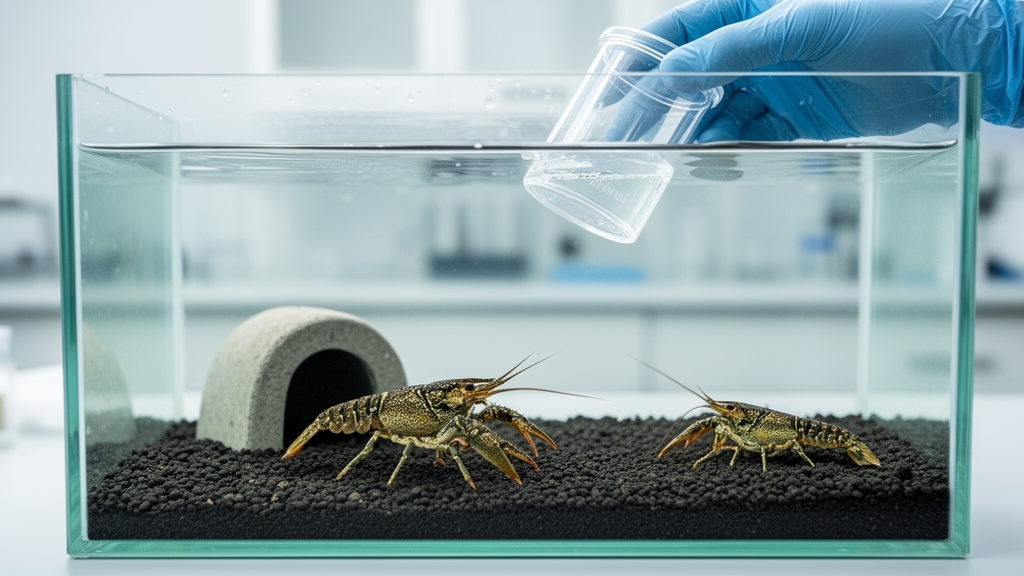
Marbled crayfish exposed to an environmentally relevant concentration of the anticonvulsant carbamazepine became more active in a laboratory study, nearly doubling the distance moved and increasing walking speed compared with a solvent control. The 96-hour experiment found no detectable behavioural changes in crayfish exposed to either diclofenac or diphenhydramine at the tested concentrations. The study examined whether pharmaceutical residues can alter behaviour in aquatic crustaceans.

Researchers exposed marbled crayfish, Procambarus virginalis , to one of three drugs at either an environmentally relevant concentration or a lowest observed effect concentration. Carbamazepine, a neutral compound, was tested at 11.6 and 116 micrograms per litre. Diclofenac, an ionisable weak acid, was tested at 31 and 310 micrograms per litre, while diphenhydramine, an ionisable weak base, was tested at 1.4 and 95 micrograms per litre.

The exposures took place under laboratory conditions in water with a pH of 7.6 and a temperature of 22 °C. The researchers assessed several movement-related behaviours, including the percentage of movement activity, distance travelled and walking speed, and compared each exposure group with a solvent control. Carbamazepine produced the clearest response. At 11.6 micrograms per litre, the concentration classified by the researchers as environmentally relevant, exposed crayfish showed a higher percentage of movement activity, nearly twice the distance moved and a higher walking speed than the solvent-control animals.

At the drug’s lowest observed effect concentration of 116 micrograms per litre, the only reported change was increased relative movement activity. The results therefore did not amount to an increase in every measured movement variable at both exposure levels. Neither diclofenac nor diphenhydramine was associated with detected behavioural changes under the tested conditions.

This null finding is limited to the concentrations, species and laboratory protocol used in the experiment; it does not demonstrate that the two drugs are incapable of affecting marbled crayfish behaviour. The study was also conducted in a controlled setting and therefore did not directly establish whether the observed responses occur in natural waterways. Nevertheless, its results show that pharmaceutical exposure can produce measurable changes in a movement-related trait at a concentration described as environmentally relevant, while also illustrating that the response depends on the specific compound and exposure level tested.

Subject of Research: Laboratory assessment of pharmaceutical-induced behavioural changes in marbled crayfish

Article Title: Behavioural impacts of ionisable and neutral pharmaceuticals on marbled crayfish (Procambarus virginalis)

Article References: Koubová, A., Thammatorn, W., Kubec, J., Nováková, P., Fedorova, G., Kouba, A., & Žlábek, V. (2026). Behavioural impacts of ionisable and neutral pharmaceuticals on marbled crayfish (Procambarus virginalis). Ecotoxicology, 35(9), 185. https://doi.org/10.1007/s10646-026-03166-w

Image Credits: AI Generated

DOI: 10.1007/s10646-026-03166-w

Keywords: marbled crayfish, carbamazepine, diclofenac, diphenhydramine, behavioural toxicology, pharmaceutical residues, aquatic pollution, ecotoxicology, laboratory exposure, crustaceans, Behavioural, impacts

Cite Scienmag News

Sloane Callahan. (October 22, 2026). Carbamazepine increases marbled crayfish movement in laboratory exposure study. Scienmag. https://scienmag.com/carbamazepine-increases-marbled-crayfish-movement-in-laboratory-exposure-study/


Sloane Callahan. "Carbamazepine increases marbled crayfish movement in laboratory exposure study." Scienmag, 22 October 2026, https://scienmag.com/carbamazepine-increases-marbled-crayfish-movement-in-laboratory-exposure-study/. Accessed 22 October 2026.

Sloane Callahan. "Carbamazepine increases marbled crayfish movement in laboratory exposure study." Scienmag. October 22, 2026. https://scienmag.com/carbamazepine-increases-marbled-crayfish-movement-in-laboratory-exposure-study/

Tags: aquatic pollutionaquatic toxicity of pharmaceuticalsbehavioral changes in marbled crayfish due to drug exposurebehaviouralbehavioural toxicologycarbamazepineCarbamazepine effects on crustacean behaviorcrayfish locomotion response to pharmaceuticalscrustacean movement assays in toxicology studiescrustaceansdiclofenacdiphenhydramineecotoxicologyenvironmental concentrations of carbamazepine and crustacean behaviorenvironmental impact of anticonvulsants on freshwater speciesimpactsinfluence of pharmaceutical residues on aquatic invertebrateslaboratory exposurelaboratory exposure studies on crayfish activitymarbled crayfishnon-toxic effects of dicpharmaceutical contamination in aquatic environmentspharmaceutical residues
Share26Tweet16
Previous Post

Antimicrobial activity of antibiotic-induced resistant lactobacilli against carbapenemase-producing Enterobacterales

Next Post

3D scan method quantifies skull remodelling in two craniosynostosis cases

Related Posts

Behavioral Model Links Waste Bank Retention to Landfill Pressure
Climate

Behavioral Model Links Waste Bank Retention to Landfill Pressure

October 22, 2026
Sentinel-5P/TROPOMI review maps air-pollution applications and limitations
Climate

Sentinel-5P/TROPOMI review maps air-pollution applications and limitations

October 22, 2026
Terrain and road proximity statistically associated with spring persistence in Nepal
Climate

Terrain and road proximity statistically associated with spring persistence in Nepal

October 22, 2026
Fast avalanches may hit tall but not load tall
Climate

Fast avalanches may hit tall but not load tall

October 22, 2026
Updated arsenic toxicity values shift risk estimates in Eskişehir water study
Climate

Updated arsenic toxicity values shift risk estimates in Eskişehir water study

October 22, 2026
Modeled 2050 Luxembourg food transition could cut sector emissions 53%
Climate

Modeled 2050 Luxembourg food transition could cut sector emissions 53%

October 22, 2026
Next Post
3D scan method quantifies skull remodelling in two craniosynostosis cases

3D scan method quantifies skull remodelling in two craniosynostosis cases

  • Mothers who receive childcare support from maternal grandparents show more optimized

    Mothers who receive childcare support from maternal grandparents show more parental warmth, finds NTU Singapore study

    27656 shares
    Share 11059 Tweet 6912
  • University of Seville Breaks 120-Year-Old Mystery, Revises a Key Einstein Concept

    1061 shares
    Share 424 Tweet 265
  • Bee body mass, pathogens and local climate influence heat tolerance

    682 shares
    Share 273 Tweet 171
  • Researchers record first-ever images and data of a shark experiencing a boat strike

    546 shares
    Share 218 Tweet 137
  • Groundbreaking Clinical Trial Reveals Lubiprostone Enhances Kidney Function

    531 shares
    Share 212 Tweet 133
Science

Embark on a thrilling journey of discovery with Scienmag.com—your ultimate source for cutting-edge breakthroughs. Immerse yourself in a world where curiosity knows no limits and tomorrow’s possibilities become today’s reality!

RECENT NEWS

  • 3D scan method quantifies skull remodelling in two craniosynostosis cases
  • Carbamazepine increases marbled crayfish movement in laboratory exposure study
  • Antimicrobial activity of antibiotic-induced resistant lactobacilli against carbapenemase-producing Enterobacterales
  • scDIG software study enables interactive single-cell population gating

Categories

  • Agriculture
  • Anthropology
  • Archaeology
  • Athmospheric
  • Biology
  • Biotechnology
  • Blog
  • Bussines
  • Cancer
  • Chemistry
  • Climate
  • Earth Science
  • Editorial Policy
  • Marine
  • Mathematics
  • Medicine
  • Pediatry
  • Policy
  • Psychology & Psychiatry
  • Science Education
  • Science News
  • Social Science
  • Space
  • Technology and Engineering

Subscribe to Blog via Email

Enter your email address to subscribe to this blog and receive notifications of new posts by email.

Join 5,151 other subscribers

© 2025 Scienmag - Science Magazine

Welcome Back!

Login to your account below

Forgotten Password?

Retrieve your password

Please enter your username or email address to reset your password.

Log In
No Result
View All Result
  • HOME
  • SCIENCE NEWS
  • CONTACT US

© 2025 Scienmag - Science Magazine

Discover more from Science

Subscribe now to keep reading and get access to the full archive.

Continue reading