


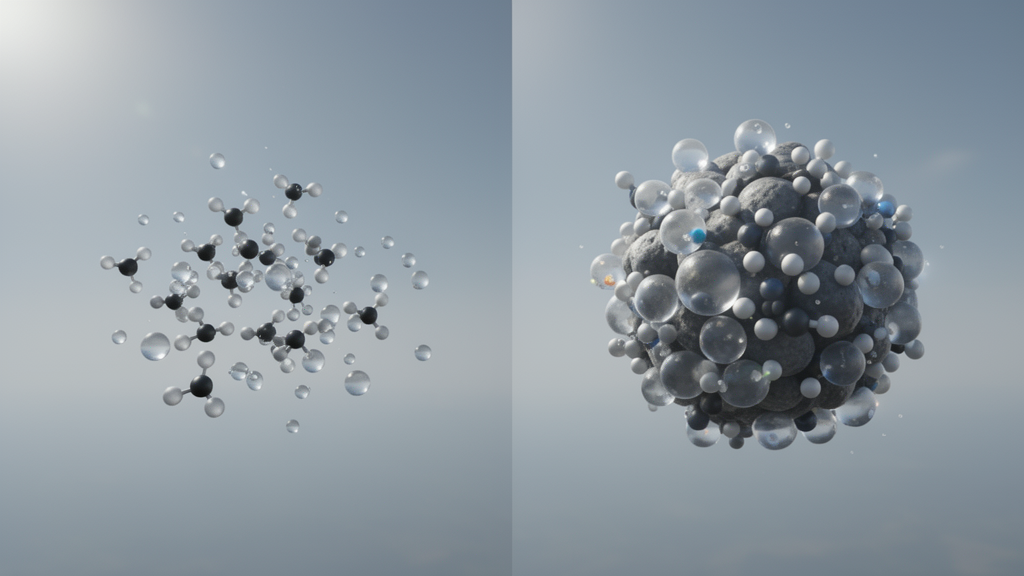
Quantum-chemical calculations of molecular clusters containing up to 20 molecules suggest that sulfuric acid, rather than methanesulfonic acid or a combination of the two acids, controls the earliest stage of atmospheric new particle formation in the ammonia- and amine-containing systems examined. Sulfuric acid consistently produced more stable acid–base clusters than methanesulfonic acid, while the advantage of incorporating methanesulfonic acid generally increased as clusters grew. The result separates two roles for atmospheric acids: sulfuric acid establishes the initial cluster scaffold, whereas methanesulfonic acid may act more prominently as a secondary participant in subsequent growth, particularly with ammonia or methylamine and under cold, methanesulfonic-acid-rich conditions. These are thermodynamic model results rather than direct atmospheric observations or measured particle-formation rates, and the study examined neutral clusters without water or ions.
The investigation, reported in Aerosol Research, combined extensive configuration sampling, density functional theory and a machine-learning model to examine clusters containing sulfuric acid, methanesulfonic acid and one of three bases: ammonia, methylamine or dimethylamine. The mixed-acid calculations followed a systematic substitution pathway in which one sulfuric acid molecule was replaced by methanesulfonic acid in a cluster containing equal numbers of acids and bases; that pathway was used for the investigated mixed-acid clusters, while separate pure-methanesulfonic-acid and sulfuric-acid–base systems provided comparisons. The clusters contained up to 10 acid–base pairs, or 20 molecules in total. Initial structures were generated with ABCluster and further explored with CREST metadynamics, then optimized and treated with the B97-3c density functional method. For the larger clusters, a PaiNN neural network trained to reproduce B97-3c energies and forces accelerated part of the optimization workflow.
Under standard thermodynamic conditions of 298.15 kelvin and 1 atmosphere, clusters containing sulfuric acid were more stable than the corresponding clusters made only with methanesulfonic acid for all three bases. The gap was particularly large for dimethylamine: at 20 molecules, the pure sulfuric acid–dimethylamine cluster had a binding free energy of roughly minus 264 kilocalories per mole, compared with about minus 183 kilocalories per mole for the pure methanesulfonic acid–dimethylamine analogue. The resulting advantage for sulfuric acid was approximately 81 kilocalories per mole. For ammonia and methylamine, methanesulfonic-acid-only clusters at the largest size were about 55 to 62 kilocalories per mole less stable than their sulfuric-acid counterparts. This contrasts with previously reported mixed-base synergy, in which adding ammonia to sulfuric acid–dimethylamine clusters could stabilize larger structures. Replacing sulfuric acid with methanesulfonic acid did not produce an equivalent cooperative gain.
The calculated structures nevertheless revealed a size-dependent change. As clusters grew, both sulfuric-acid and mixed-acid systems shifted from compact molecular complexes toward more extended, three-dimensional networks of hydrogen bonds. One methanesulfonic acid molecule did not fundamentally alter that transition, but its methyl group slightly disturbed the bonding arrangement and could reduce coordination efficiency. The energetic penalty associated with this substitution became smaller as size increased, especially for ammonia and methylamine. A plausible explanation is that a larger network can distribute the molecular perturbation more effectively than a compact initial complex can. In dimethylamine systems, however, the strong sulfuric acid–dimethylamine interaction dominated the energetics, leaving little room for methanesulfonic acid to make a substantial stabilizing contribution. The authors therefore distinguish the behavior of mixed acids from the previously observed synergy between sulfuric acid and mixed bases.
The researchers also recalculated binding free energies at prescribed gas concentrations and temperatures. The tested atmospheres included 278.15 and 298.15 kelvin, with sulfuric acid and methanesulfonic acid concentrations of either 106 or 108 molecules per cubic centimetre; base concentrations were fixed at 10 parts per billion for ammonia and 5 parts per trillion for methylamine and dimethylamine. These conditions were chosen to represent selected chamber and atmospheric regimes and to assess how relative acid abundance influences the stability and composition of the earliest clusters. A further sensitivity case at 258.15 kelvin used 109 methanesulfonic acid molecules per cubic centimetre and 106 sulfuric acid molecules per cubic centimetre, an intentionally extreme ratio designed to locate the regime in which methanesulfonic acid becomes thermodynamically important rather than to represent typical atmospheric abundance.
At 298.15 kelvin under low acid concentrations, sulfuric-acid-rich clusters had the lowest free energies. The distinction was most pronounced with dimethylamine, for which incorporating methanesulfonic acid offered essentially no energetic advantage. Ammonia and methylamine systems were somewhat more sensitive to acid composition, but pure or sulfuric-acid-rich clusters still tended to be most stable at the smallest sizes. Raising methanesulfonic acid to 100 times the sulfuric acid concentration made mixed-acid clusters more competitive in the ammonia and methylamine series, with one methanesulfonic acid molecule producing the most stable composition across much of the size range in the sulfuric acid–methanesulfonic acid–ammonia system. The dimethylamine result remained unchanged because the stronger sulfuric acid–dimethylamine pairing governed the cluster. Under these warm and dilute conditions, the authors judged the overall free-energy landscape uphill, making new particle formation unlikely.
Cooler and more concentrated conditions made particle-like growth more thermodynamically favorable overall, but did not reverse the acids’ relative roles. At 278.15 kelvin, free-energy surfaces for larger ammonia- and methylamine-containing clusters became more favorable, while the smallest clusters still presented an initial barrier. In the dimethylamine system, sulfuric acid again dominated, and the pure methanesulfonic acid clusters remained much less favorable. Under the sensitivity case at 258.15 kelvin, methanesulfonic acid became substantially more competitive at larger sizes, especially with dimethylamine, and its stabilizing contribution increased markedly. Even there, however, mixed clusters containing sulfuric acid remained among the most stable structures at the smallest sizes. The calculations therefore do not support methanesulfonic acid replacing sulfuric acid as the principal nucleating acid in the systems studied. They instead show that its contribution increases as the cluster grows and as the relative abundance of methanesulfonic acid rises.
The findings identify a systematic divide between initial nucleation and later growth. Sulfuric acid dominates the earliest cluster formation steps, most decisively in the presence of dimethylamine, where the interaction between the two compounds can yield nearly barrierless growth under favorable conditions. Ammonia and methylamine systems have larger initial barriers, but those barriers shrink at lower temperatures and higher methanesulfonic acid concentrations. The incorporation of one methanesulfonic acid molecule becomes increasingly favorable as clusters grow, especially in the sulfuric acid–methanesulfonic acid–ammonia and –methylamine systems. This pattern supports the interpretation of methanesulfonic acid as a secondary, growth-modifying species in the neutral, unhydrated clusters examined, rather than as a primary nucleating acid under all atmospheric conditions. The result applies specifically to the cluster compositions and conditions modeled; it does not establish a universal ordering for every atmospheric nucleation pathway.
Important limits prevent the calculations from being converted directly into atmospheric formation rates or particle-growth kinetics. The model is thermodynamic and does not simulate reaction pathways, cluster collisions, evaporation rates or atmospheric transport. It also omits water and ions, both of which can stabilize clusters. That omission is particularly important because recent experiments cited by the authors found rapid particle growth driven by methanesulfonic acid at high relative humidity but negligible contribution under low humidity. The comparatively weak role assigned to methanesulfonic acid by the dry calculations therefore may not apply to hydrated atmospheric clusters. Future work identified by the study should include water, ions, ammonia, clusters with multiple methanesulfonic acid molecules and explicit cluster-dynamics simulations. The calculations also use a controlled set of neutral acid–base systems, so their conclusions should not be extended to every mixture that may occur in the atmosphere.
For atmospheric science, the main implication is that two acids frequently associated with nucleation should not be treated as interchangeable. Within the selected neutral systems, sulfuric acid provides most of the thermodynamic foundation for the first molecular clusters, while methanesulfonic acid becomes more consequential as size, coldness and the methanesulfonic-acid-to-sulfuric-acid ratio increase. The results suggest that marine or other cold environments could favor a larger role for methanesulfonic acid in stabilizing growing clusters, but they do not establish when a methanesulfonic-acid pathway becomes kinetically competitive with sulfuric-acid-driven nucleation. The safest conclusion is a division of labor: sulfuric acid starts the cluster, and methanesulfonic acid can join or alter the structure as it grows, with the magnitude of that contribution controlled by cluster size, the choice of base and atmospheric conditions.
Subject of Research: Computational study of sulfuric acid–methanesulfonic acid–base clusters in atmospheric new particle formation
Article Title: Stability and composition of large sulfuric acid–methanesulfonic acid–base molecular clusters
Article References: Hasan, G., Knattrup, Y., Wu, H., & Elm, J. (2026). Stability and composition of large sulfuric acid–methanesulfonic acid–base molecular clusters. Aerosol Research, 4(2), 501-515. https://doi.org/10.5194/ar-4-501-2026
Image Credits: AI Generated
Keywords: atmospheric new particle formation, sulfuric acid, methanesulfonic acid, molecular clusters, ammonia, methylamine, dimethylamine, quantum chemistry, machine learning, aerosol nucleation, Stability, composition
Cite Scienmag News
Russell Cooper. (October 22, 2026). Sulfuric acid leads early particle formation, methanesulfonic acid favors later growth. Scienmag. https://scienmag.com/sulfuric-acid-leads-early-particle-formation-methanesulfonic-acid-favors-later-growth/
Russell Cooper. "Sulfuric acid leads early particle formation, methanesulfonic acid favors later growth." Scienmag, 22 October 2026, https://scienmag.com/sulfuric-acid-leads-early-particle-formation-methanesulfonic-acid-favors-later-growth/. Accessed 22 October 2026.
Russell Cooper. "Sulfuric acid leads early particle formation, methanesulfonic acid favors later growth." Scienmag. October 22, 2026. https://scienmag.com/sulfuric-acid-leads-early-particle-formation-methanesulfonic-acid-favors-later-growth/


