


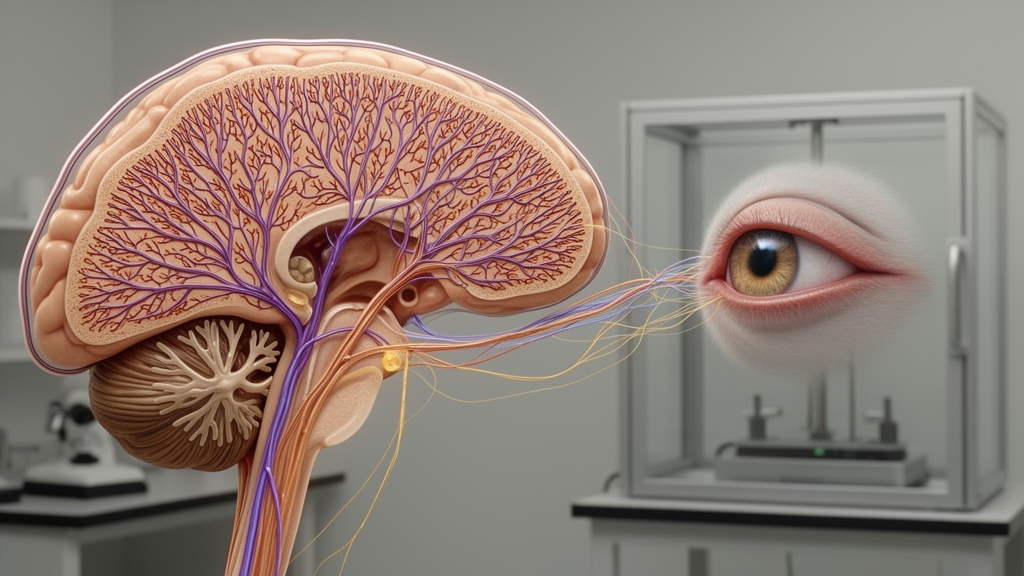
A systematic review of 74 animal studies found that Purkinje cells are central to eyeblink conditioning, but the evidence does not support a single cellular explanation for how the cerebellum acquires and expresses the learned response. Most studies either manipulated Purkinje-cell-related mechanisms and measured behavior, or recorded Purkinje-cell activity without directly testing causality. Only three studies combined both approaches, leaving the relationship among molecular processes, cellular dynamics and conditioned behavior only partly resolved.
Eyeblink conditioning is an experimental model of associative motor learning in which a neutral conditioned stimulus, such as an auditory cue or mild skin stimulation, is repeatedly paired with an unconditioned stimulus, commonly a corneal air puff or periocular electrical stimulation that naturally elicits a blink. After repeated pairings, animals begin to produce an anticipatory conditioned response that occurs before the unconditioned stimulus and is timed near its expected onset. The ability to control the stimuli, their temporal relationship and the resulting movement allows learning processes to be related to identifiable neural circuits.
Purkinje cells occupy a central position in the relevant circuit. They receive input from parallel fibers carrying conditioned-stimulus-related information and climbing fibers carrying unconditioned-stimulus-related information, while providing the sole output of the cerebellar cortex through inhibitory projections to cerebellar nuclei. This arrangement made them prominent candidates in theories of cerebellar learning.
The historically influential long-term depression model proposed that conjunctive activation of parallel and climbing fiber inputs weakens parallel-fiber synapses onto Purkinje cells. Reduced Purkinje-cell inhibition would then permit greater activity in cerebellar nuclei and could facilitate the conditioned response. The review, published in Frontiers in Synaptic Neuroscience, indicates that this LTD-centered account has not been discarded but is no longer treated as a complete explanation on its own.
Among 61 of the 74 studies that proposed or tested an explicit mechanistic hypothesis, more recent publications increasingly described processes that include bidirectional synaptic plasticity, intrinsic excitability, learned pauses in simple-spike firing, inhibitory microcircuits, cerebellar nuclear plasticity and nucleo-olivary feedback. This publication pattern suggests that the field has moved from a predominantly single-mechanism account toward a multilevel model in which synaptic, cellular and circuit processes may jointly shape learning. The review separated the literature into two complementary evidence branches.
Forty-five studies, or 61%, belonged to the intervention branch, meaning that researchers manipulated Purkinje-cell function, survival or associated molecular or circuit mechanisms. The outcomes extracted from these studies were behavioral effects on acquisition, retention, extinction, timing, strength or expression. Thirty-two studies, or 43%, directly measured Purkinje-cell-related physiological or structural properties during or after conditioning.
The branch totals exceed the number of unique studies because three studies included both an intervention and a direct measurement, underscoring how rarely causal manipulation and cellular observation have been combined in the same experimental framework. That separation constrains what can be inferred from either body of evidence. An intervention can show that a molecular pathway, cellular process or Purkinje-cell-related circuit component contributes to normal conditioning, but without simultaneous recordings it does not establish how the manipulation changes Purkinje-cell activity during learning.
Conversely, a measurement can document a pause, firing change or structural modification associated with conditioning, but usually cannot determine whether that change is necessary for learning, compensatory or merely correlated with the conditioned response. The review identifies experiments that combine cell-specific perturbation with direct physiological measurement as a major way to close this gap. The animal models used in the two branches also differed markedly.
Of the 45 intervention studies, 33, or 74%, used genetic manipulations, 10 used pharmacological interventions, one combined genetic and pharmacological approaches and one used a surgical intervention. All genetic studies were conducted in mice, and mice appeared more broadly in 35 intervention studies, compared with six rat studies and two each involving ferrets and rabbits. Direct Purkinje-cell measurements, by contrast, drew most heavily on ferrets, followed by mice, rabbits, rats and guinea pigs.
The comparison creates a species-method gap: mouse genetics offers molecular and cell-type-specific inference, while the larger-animal physiology literature has historically supplied many stable recordings of Purkinje-cell activity during conditioning. Most direct measurement studies relied on electrophysiology. Twenty-eight of the 32 studies, or 88%, used electrophysiological approaches, making simple-spike frequency the most frequently extracted readout, followed by electrical properties, complex-spike frequency and pause responses.
The observed conditioned-stimulus responses were heterogeneous: simple-spike firing could be inhibited, excited, non-responsive or biphasic. Thus, the measurement literature is concentrated on Purkinje-cell firing dynamics and is not a comprehensive survey of all possible forms of plasticity. The review also notes that several studies recorded multiple cells from the same animal without clearly distinguishing cell-level from animal-level sampling, an issue that can affect the interpretation of statistical evidence.
Sex reporting and experimental transparency varied as well. Thirteen of the 45 intervention studies, or 29%, did not report the sex of the animals used. Among the 32 measurement studies, 25, or 78%, used exclusively males, six used both males and females and one did not report sex.
They also cautioned that evidence in this field often comes from specialized laboratories and species-specific preparations, so apparent support for a mechanism may partly reflect concentration within particular groups, protocols and analytical traditions. Conditioning protocols were generally compatible with acquisition of a conditioned response, although essential details were missing from some reports. Sixty-six studies used delay conditioning only, five used both delay and trace conditioning, and three used trace conditioning alone.
The small number of trace-conditioning studies did not support meaningful comparisons between the paradigms. Ten studies, or 13.5% of the 74 included papers, failed to report at least one key parameter such as interstimulus interval, intertrial interval or total number of trials. Only two articles included conditions with interstimulus intervals below 100 milliseconds, a range in which acquisition is generally considered unreliable, and both also tested intervals at or above 100 milliseconds.
Despite broadly suitable designs, incomplete reporting limits reproducibility and more detailed analysis of how timing and training structure affect learning. Publication patterns also revealed a methodological imbalance. Intervention studies remained relatively numerous across periods, whereas direct Purkinje-cell measurement studies were concentrated in the 2000s and 2010s, with the highest number appearing between 2007 and 2016 and fewer published later.
The authors suggest that the requirements of these experiments—including stable surgical preparations, precise behavioral control, electrophysiological expertise and analysis of temporally structured neural activity—may help explain the pattern. They identify calcium or voltage imaging, optogenetic perturbation combined with recording, cell-type-specific molecular readouts and computational models linking cellular changes to behavior as approaches that could complement electrophysiology. Cross-species validation and direct replication would also help test whether proposed mechanisms generalize beyond the species, laboratories and preparations in which they were studied.
The overall conclusion is that Purkinje-cell involvement in eyeblink conditioning is well supported, but neither fully localized to one cell function nor reducible to LTD alone. Synaptic plasticity may contribute alongside intrinsic excitability, learned pauses, interneuron dynamics, climbing-fiber signaling, cerebellar nuclear plasticity and feedback circuits. The field’s principal obstacle is no longer a shortage of plausible mechanisms; it is the fragmentation of evidence across species, preparations and methods.
Experiments that combine molecularly specific interventions, real-time Purkinje-cell recordings and clearly defined behavioral endpoints will be needed to determine whether Purkinje cells store the learned association, implement its timing, regulate its expression or coordinate those functions within a distributed cerebellar learning system. The review itself is limited to eyeblink and nictating-membrane conditioning, uses only the PubMed database and does not claim exhaustive coverage of the wider cerebellar literature.
Subject of Research: Methodological evidence for Purkinje-cell contributions to eyeblink conditioning in animal studies
Article Title: Purkinje cells in eyeblink conditioning: a systematic review of methodological approaches in animal studies
Article References: Gornov, A., Moulin, T. C., Rasmussen, A., & Johansson, F. (2026). Purkinje cells in eyeblink conditioning: a systematic review of methodological approaches in animal studies. Frontiers in Synaptic Neuroscience, 18, Article 1957105. https://doi.org/10.3389/fnsyn.2026.1957105
Image Credits: AI Generated
DOI: 10.3389/fnsyn.2026.1957105
Keywords: Purkinje cells, Eyeblink conditioning, Cerebellar learning, Systematic review, Animal studies, Synaptic plasticity, Long-term depression, Electrophysiology, Cerebellar circuits, Cellular mechanisms, Purkinje, cells
Cite Scienmag News
Ophelia Keating. (October 22, 2026). Systematic review maps fragmented Purkinje cell evidence in eyeblink conditioning. Scienmag. https://scienmag.com/systematic-review-maps-fragmented-purkinje-cell-evidence-in-eyeblink-conditioning/
Ophelia Keating. "Systematic review maps fragmented Purkinje cell evidence in eyeblink conditioning." Scienmag, 22 October 2026, https://scienmag.com/systematic-review-maps-fragmented-purkinje-cell-evidence-in-eyeblink-conditioning/. Accessed 22 October 2026.
Ophelia Keating. "Systematic review maps fragmented Purkinje cell evidence in eyeblink conditioning." Scienmag. October 22, 2026. https://scienmag.com/systematic-review-maps-fragmented-purkinje-cell-evidence-in-eyeblink-conditioning/


