


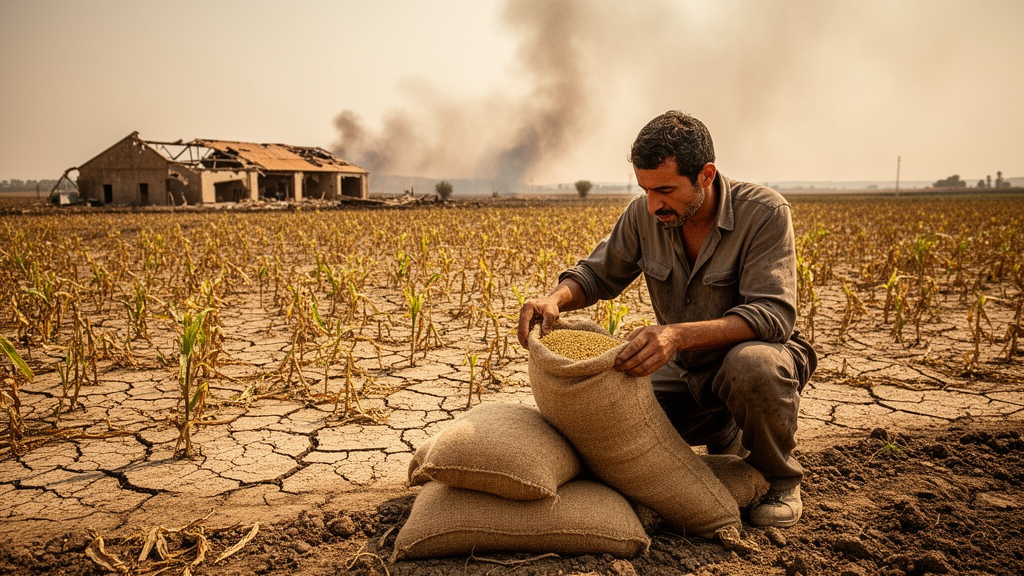
Systemic changes across the agri-food supply chain are needed to address food shortages intensified by conflict and climate change, argues Elizabeth Robinson of the London School of Economics in a commentary published in The BMJ. Robinson notes that the world continues to produce more calories per person year on year, yet localized food shortages persist as conflict disrupts agriculture, trade, market access and households’ ability to afford food. Her commentary examines how armed conflict and climate-related hazards interact with food insecurity, rather than testing the effectiveness of a particular agricultural intervention.
Conflict can affect every stage of food security, according to the commentary. It can leave farmland abandoned or make it difficult to cultivate, displace communities, restrict access to markets and reduce food affordability, potentially producing long-term health consequences. Robinson cites the Food and Agriculture Organization and World Food Programme’s 2026 Global Report on Food Crises, which identifies 13 hotspots where acute food insecurity is expected to increase.
Twelve of these hotspots are affected by armed conflict and violence, and the report identifies risks of famine in Sudan, South Sudan, the Gaza Strip and Somalia. The scale of the global burden is substantial. Robinson reports that around 60% to 70% of the world’s most undernourished people live in areas affected by conflict, while 85% of people facing hunger are reported to live in conflict-affected countries.
She also cites an estimate that 123.7 million additional people faced moderate or severe food insecurity in 2023 because heat-wave days and drought months were more frequent than during the 1981–2010 period. Rising temperatures and extreme weather can contribute to food insecurity through crop losses, disruption of supply chains and volatility in food prices. Food insecurity can also contribute to violence and instability, according to Robinson, creating a cycle in which conflict worsens food access and deteriorating food security can worsen conflict.
Major conflicts, including Russia’s invasion of Ukraine and the US–Iran war, have implications beyond their immediate locations, especially for countries dependent on food and agricultural imports from affected countries or on shipping routes that may be disrupted. Robinson identifies several potential responses: reducing global greenhouse-gas emissions, including emissions from the agri-food sector; shifting toward more plant-based diets; reducing food loss and waste; diversifying supply chains; increasing cooperation; and targeting support to farmers and vulnerable households. Short-term anticipatory action, such as protecting local agriculture or providing cash and food relief to affected households, can reduce food insecurity associated with conflict and climate change.
Longer-term resilience, however, requires systemic changes throughout the supply chain, from what is grown and how through to what is eaten. Because the article is a commentary rather than an original experiment or systematic review, it synthesizes reported evidence and policy options without comparing their effectiveness or demonstrating that any single measure will eliminate food shortages.
Subject of Research: Conflict, climate change and global food insecurity
Article Title: Sweeping changes to agri-food supply chain needed to tackle global food shortages
Article References: Sweeping changes to agri-food supply chain needed to tackle global food shortages. Original publication (Bibliographic details unavailable.)
Image Credits: AI Generated
DOI: Not provided
Keywords: food insecurity, agri-food systems, armed conflict, climate change, crop losses, food prices, supply chains, famine risk, food waste, food security, Sweeping, changes
Cite Scienmag News
Sloane Callahan. (October 22, 2026). BMJ commentary links conflict and climate change to food shortages. Scienmag. https://scienmag.com/bmj-commentary-links-conflict-and-climate-change-to-food-shortages/
Sloane Callahan. "BMJ commentary links conflict and climate change to food shortages." Scienmag, 22 October 2026, https://scienmag.com/bmj-commentary-links-conflict-and-climate-change-to-food-shortages/. Accessed 22 October 2026.
Sloane Callahan. "BMJ commentary links conflict and climate change to food shortages." Scienmag. October 22, 2026. https://scienmag.com/bmj-commentary-links-conflict-and-climate-change-to-food-shortages/


