


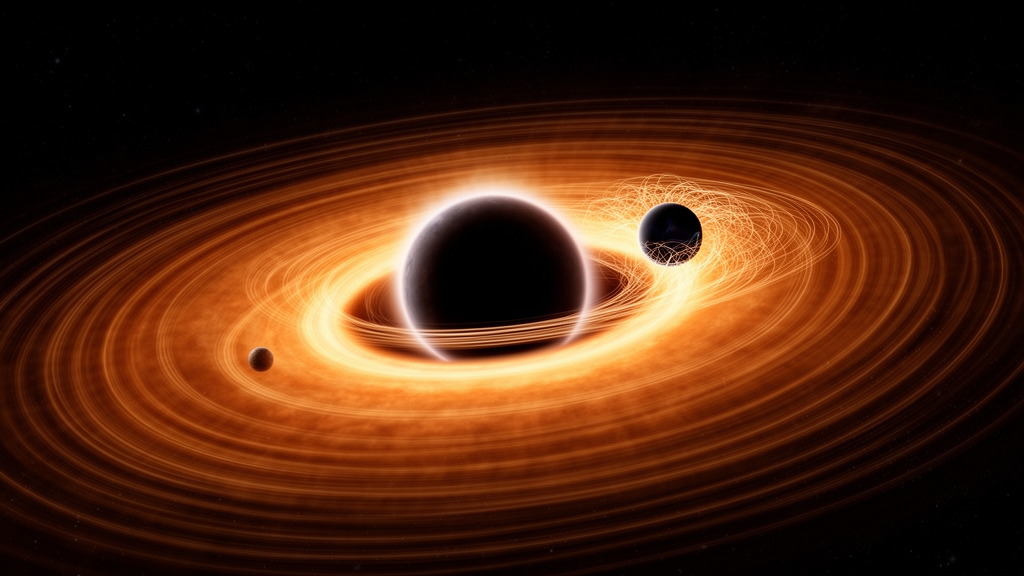
A theoretical study finds that the intrinsic magnetic field of a magnetized Ernst black hole can reshape the gravitational waves produced when a stellar-mass compact object follows a periodic, eccentric orbit around a supermassive black hole. The researchers modeled trajectories in the magnetized spacetime and found that increasing the magnetic-field parameter changes the waves’ amplitude and phase while shifting their frequency spectrum. Their calculations place much of the predicted signal in the millihertz range targeted by proposed space-based observatories such as LISA, Taiji and Tianqin, although a dedicated signal-to-noise and parameter-estimation analysis will be needed to establish whether the effect can be uniquely attributed to a magnetic field.
The work, published in The European Physical Journal C as a theoretical-physics article, focuses on extreme mass-ratio inspirals, or EMRIs: systems in which a much lighter compact object orbits a supermassive black hole and can take years to spiral inward. The authors represent the small object as a test particle in a magnetized Ernst spacetime, with a supermassive black hole of mass 10^6 solar masses and a compact object of mass 10 solar masses. They placed the source at a luminosity distance of 200 megaparsecs and fixed the inclination and longitude of pericentre at π/4.
The study is a theoretical model rather than an observational detection, and it examines one specific magnetized geometry rather than the full range of possible black-hole environments. The magnetized Ernst metric used in the analysis is axially symmetric but not spherically symmetric, and it is not asymptotically flat. Its event horizon remains at the Schwarzschild radius, r_h = 2M, while the magnetic field introduces a parameter B that changes the geometry away from the horizon.
The authors also note a subtle inconsistency in parts of the theoretical description: although the discussion of the effective potential treats the configuration as asymptotically flat, the stated magnetized metric does not have that property, so the threshold energy E = 1 is used as a normalization inherited from the timelike geodesic equation rather than as a consequence of the geometry. This distinction matters when interpreting the orbital calculations and the limits of the modeled bound-orbit parameter space. To organize the bound trajectories, the team used the zoom–whirl–vertex representation, which labels each periodic orbit with three integers, (z, w, v).
The zoom number counts the larger radial excursions, the whirl number counts loops close to the black hole, and the vertex number records the direction in which the particle traverses the orbit’s vertices. This scheme is based on the rational ratio between the azimuthal and radial frequencies: because a rational number can approximate an irrational one, periodic trajectories can serve as a systematic representation of more general bound motion. As the magnetic parameter B increased, the numerical results showed that the energy required for selected configurations rose monotonically, while the corresponding angular momentum decreased.
Waveforms were generated with a numerical “kludge” framework that combines exact geodesic motion in the magnetized background with the quadrupole approximation for gravitational radiation. The compact object’s trajectory was integrated numerically, transformed into Cartesian coordinates, and inserted into the second time derivative of its mass quadrupole moment. No circular-orbit approximation was imposed: the calculation included both radial motion between turning points and rapid azimuthal motion during the whirl phases.
This is an approximation suited to EMRIs, where the inspiral timescale is much longer than the orbital period and radiation back-reaction can be neglected over the modeled interval, but it does not model the slow secular evolution of the orbit. The resulting plus and cross polarizations displayed a repeating alternation that directly reflected the orbital geometry. Relatively weak radiation occurred during the highly eccentric zoom phases, when the object traveled farther from the black hole, and these quieter stretches were followed by short, stronger bursts during nearly circular whirl phases close in.
Different zoom–whirl labels produced correspondingly different waveform structures. For example, the model compared the combinations (1, 2, 0), (2, 1, 1) and (3, 2, 2), showing that more complex spatial trajectories yielded more intricate substructure in the gravitational signal. The magnetic field altered the underlying orbit and therefore changed the timing and strength of these distinct phases.
Comparisons among magnetic-field settings showed significant changes in waveform amplitude and a noticeable phase shift as B increased. The Fourier spectra also developed shifted peaks and stronger high-frequency components, indicating that the field altered both the orbital dynamics and the resulting radiation. A phase difference becomes especially relevant for observations when it accumulates beyond roughly one radian, while differences as small as 0.1 radian might sometimes be measurable in matched filtering at high signal-to-noise ratio.
The authors estimated that an order-one-radian drift developing after about 100 cycles would correspond to an observing time of approximately one day, though that estimate is not the result of a complete observing-scenario analysis. Most of the modeled gravitational-wave frequencies lay in the millihertz band, where space-based detectors are intended to observe EMRIs. The authors converted the time-domain signals into characteristic-strain curves and compared them with projected sensitivity curves for LISA, Taiji and Tianqin.
Portions of the calculated spectra exceeded those curves for several combinations of zoom–whirl parameters and magnetic-field values, indicating that the characteristic frequencies and amplitudes fall within regions relevant to the proposed observatories. The study’s detectability claim is therefore limited: it shows overlap with projected detector sensitivity ranges, not a guaranteed measurement of a magnetic field or a confirmed additional source of signal. A major remaining challenge is degeneracy.
The magnetic-field parameter may be confused with black-hole mass, spin, orbital energy, angular momentum, eccentricity or inclination, depending on the waveform model and observing setup. An observed departure from a vacuum waveform would therefore not automatically identify a magnetized spacetime. Its result is a theoretical chain connecting magnetic-field strength to orbit geometry, phase, amplitude and spectral structure, providing a target for waveform and parameter-estimation studies.
The authors present gravitational-wave astronomy as a possible avenue for probing magnetized black-hole spacetimes, but the current results are a model-based prediction rather than an observed magnetic-field signature.
Subject of Research: Gravitational-wave signatures of magnetic fields in extreme-mass-ratio inspirals around magnetized Ernst black holes
Article Title: Gravitational wave signatures of magnetized Ernst black hole
Article References: Ahmed, F., Shaymatov, S., Yuan, C., & Nasri, S. (2026). Gravitational wave signatures of magnetized Ernst black hole. The European Physical Journal C, 86(10), Article 1201. https://doi.org/10.1140/epjc/s10052-026-16454-w
Image Credits: AI Generated
DOI: 10.1140/epjc/s10052-026-16454-w
Keywords: gravitational waves, magnetized black holes, extreme mass-ratio inspirals, periodic orbits, Ernst spacetime, waveform modeling, space-based detectors, supermassive black holes, strong-field gravity, Gravitational, wave, signatures
Cite Scienmag News
Grant Pearson. (October 22, 2026). Magnetic fields could imprint distinctive extreme-mass-ratio gravitational waves. Scienmag. https://scienmag.com/magnetic-fields-could-imprint-distinctive-extreme-mass-ratio-gravitational-waves/
Grant Pearson. "Magnetic fields could imprint distinctive extreme-mass-ratio gravitational waves." Scienmag, 22 October 2026, https://scienmag.com/magnetic-fields-could-imprint-distinctive-extreme-mass-ratio-gravitational-waves/. Accessed 22 October 2026.
Grant Pearson. "Magnetic fields could imprint distinctive extreme-mass-ratio gravitational waves." Scienmag. October 22, 2026. https://scienmag.com/magnetic-fields-could-imprint-distinctive-extreme-mass-ratio-gravitational-waves/


