


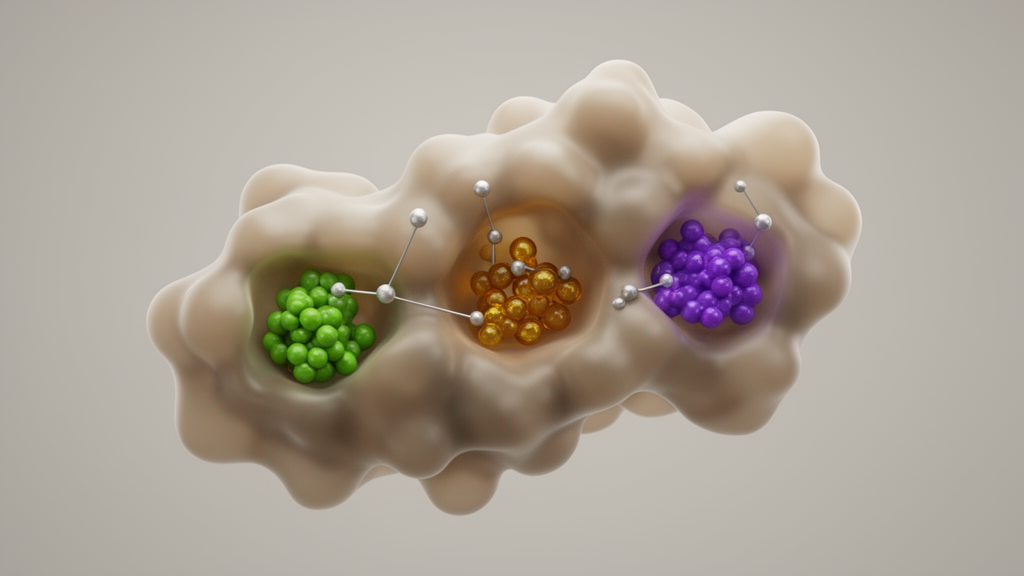
A laboratory profiling and computational study of the Ayurvedic polyherbal formulation Guduchyadi Yoga identified 368 putative compounds and found that 55 passed preliminary filters for predicted blood–brain barrier permeability and drug-like properties. From this set, researchers constructed target and pathway networks associated with mild cognitive impairment, then used molecular docking, density functional theory, 500-nanosecond molecular dynamics simulations and post-simulation analyses to examine three selected protein–ligand complexes. Across the simulated trajectories, isoferulic acid, arctigenin and 3,6,2′-trimethoxyflavone remained associated with AKT1, PPARG and TNF, respectively. The study was computational and did not test the formulation in people or establish therapeutic effects.
The formulation came from a GMP-certified supplier in Uttarakhand, India, and was extracted at the All India Institute of Ayurveda in New Delhi with a 70:30 ethanol–water mixture. Investigators macerated a 25-gram sample for eight hours with stirring at 300 rpm and then for 16 additional hours without stirring. Following filtration through Whatman No. 42 paper and a 0.22-micrometer PTFE membrane, the extract was concentrated by rotary evaporation at 40 °C under reduced pressure and stored at −20 °C in amber vials. For chemical analysis, the extract was separated on a C18 UHPLC column during a 30-minute gradient run at 0.3 milliliters per minute. High-resolution mass spectra were acquired in positive and negative electrospray ionization modes, with data-dependent top-five MS2 fragmentation. Peak detection, centroiding and chromatogram alignment were followed by mass-error screening at no more than 5 ppm, retention-time alignment within 0.2–0.3 minutes and quality-control checks. The analysis tentatively identified 109 compounds in negative mode and 259 in positive mode. Some assignments met Level 2 MSI criteria, based on spectral and retention-time matches, while confirmation with reference standards enabled Level 1 identification.
The detected compounds entered an in silico screening pipeline intended to prioritize constituents that might plausibly reach the brain. SwissADME and Molsoft were used to examine absorption, distribution, metabolism, excretion, toxicity, Lipinski’s Rule of Five and blood–brain barrier status. Canonical chemical structures obtained from PubChem were submitted to SwissTargetPrediction, with predicted targets retained when their probability was at least 0.10. Separately, the team collected mild-cognitive-impairment genes from NCBI Gene and GeneCards, applying a relevance threshold of at least 10 to GeneCards entries. After duplicate entries were removed, the analysis contained 1,204 predicted compound targets and 16,035 disease-associated genes. Their intersection produced 942 shared genes, which were carried into protein-interaction and functional analyses. These filters and intersections were computational prioritization steps, not measurements of blood concentrations, brain exposure or target modulation.
Cytoscape, STRING and CytoHubba analyses ranked AKT1, TP53, TNF, SRC, IL6, EGFR, CTNNB1, STAT3, ESR1, HSP90AA1, CASP3, JUN, BCL2, HIF1A and PPARG among the leading network genes. Gene Ontology enrichment linked the network with protein and enzyme binding, transcriptional regulation, apoptosis, inflammatory responses, oxidative-stress signaling and synaptic transmission. KEGG results included Alzheimer’s disease, PI3K–AKT, MAPK, TNF, apoptosis, HIF-1, estrogen and Wnt/β-catenin signaling, along with IL-17, NOD-like receptor and C-type lectin receptor signaling. The network consequently associated the formulation with several mechanisms relevant to MCI, including inflammation, cell survival, metabolism and programmed cell death. It also showed overlap with pathways marked in the paper for Alzheimer’s, Huntington’s and amyotrophic lateral sclerosis, but the analysis does not demonstrate that any of these genes changes in an individual with MCI.
Molecular docking prioritized AKT1 with isoferulic acid, PPARG with arctigenin and TNF with 3,6,2′-trimethoxyflavone. Their respective predicted scores were −8.010, −7.647 and −7.891 kilocalories per mole. Hydrogen bonds, hydrophobic contacts and π–π interactions supported the selected poses. Isoferulic acid was predicted to interact with AKT1 residues including GLN61, TYR151, TYR59, TYR119, SER60 and LEU57. Arctigenin formed hydrogen bonds with HIE449, TYR473 and SER289 in PPARG, while the TNF–trimethoxyflavone model showed polar and hydrophobic contacts involving residues such as GLN61, TYR151 and TYR59. Donepezil and lecanemab were docked under the same reported conditions, receiving scores of −5.635 and −6.121 kilocalories per mole, respectively. The numerical comparison favored the three selected plant compounds, but the authors cautioned that docking scores alone do not predict biological efficacy or clinical performance. Exact receptor-grid coordinates and dimensions were not retained in the available records, and no retrospective redocking or ligand-pose RMSD validation was performed.
Density functional theory calculations examined the electronic properties of isoferulic acid, arctigenin and 3,6,2′-trimethoxyflavone using Gaussian 16. Their structures were optimized with the B3LYP hybrid functional and 6-31G(d,p) basis set, with solvent effects treated using the IEFPCM model; frequency analyses indicated that the optimized structures had no imaginary frequencies. Isoferulic acid had an ionization potential of 5.68 electron volts, an energy gap of 4.13 electron volts and an electrophilicity index of 3.16 electron volts. The trimethoxyflavone had a similar 4.27-electron-volt gap and the highest reported electrophilicity value, 3.27 electron volts. Arctigenin differed sharply, with an 8.45-electron-volt ionization potential, a 12.01-electron-volt gap and an electrophilicity index of 0.50 electron volts. These calculations characterize predicted electronic reactivity and chemical stability; they do not measure binding, metabolism or biological activity in cells or animals. The documented protocol did not specify a nondefault self-consistent-field setting or apply a separate empirical dispersion correction.
Each selected complex was then examined in one 500-nanosecond molecular dynamics trajectory in Schrödinger Maestro. The systems were solvated with TIP3P water, surrounded by a 10-ångström buffer and neutralized with sodium ions; the simulations used a constant-particle-number, constant-pressure and constant-temperature ensemble at 300 K. No independent replicate simulations were performed. The TNF complex showed backbone root-mean-square deviations of approximately 1.2 to 3.2 ångströms, while PPARG remained between about 1.0 and 3.0 ångströms. AKT1 was more flexible, reaching approximately 4.0 ångströms, which the authors interpreted as conformational variation rather than outright destabilization. Ligand motions followed the corresponding protein motions in all three systems, supporting continued retention near the predicted binding regions. Residues associated with the predicted binding interfaces showed lower fluctuations than peripheral loops and terminal regions. Hydrogen bonds, hydrophobic contacts and water bridges persisted over substantial portions of the trajectories, while radius of gyration and solvent-accessible surface area remained comparatively stable.
Post-simulation analysis used backbone alignment, principal component analysis and molecular mechanics with generalized Born surface area calculations. The AKT1 and PPARG systems formed relatively compact principal-component trajectories, while TNF showed a more elongated distribution that nevertheless retained endpoint clustering. Free-energy landscapes differed among the complexes: PPARG had the widest and deepest reported low-energy basin, whereas AKT1 and TNF explored more elevated conformations. MM-GBSA estimated mean binding free energies of −74.87 ± 4.94 kilocalories per mole for AKT1 with isoferulic acid, −74.81 ± 5.24 for PPARG with arctigenin and −74.87 ± 5.01 for TNF with trimethoxyflavone. The van der Waals and lipophilic terms contributed strongly to these modeled values, while hydrogen-bond terms were comparatively small. Because the study used a single trajectory per complex without independent replicates, these results are computational estimates under the specified conditions rather than experimentally observed binding energies or measurements of biological activity.
The study’s central result is a prioritization result: three phytochemicals from Guduchyadi Yoga formed computationally persistent complexes with proteins embedded in pathways associated with mild cognitive impairment and broader neurodegeneration. The work combines chemical profiling with network pharmacology, electronic-structure calculations, docking and long-duration molecular dynamics, creating mechanistic hypotheses for further testing. Important gaps remain. The researchers did not perform retrospective redocking or ligand-pose RMSD validation, and the exact receptor-grid settings could not be verified from the available records. The formulation was not tested in people with MCI, and the study did not show changes in symptoms, cognition or disease progression, nor did it demonstrate that any compound modulated its proposed target in a biological system. The findings therefore identify compounds and protein interactions for biochemical, animal and appropriately designed clinical evaluation, rather than establish a treatment effect or support clinical recommendations.
Subject of Research: Computational profiling of Guduchyadi Yoga phytochemicals and their modeled interactions with MCI-related proteins
Article Title: Chemical characterization and computational validation of Guduchyadi Yoga in mild cognitive impairment: UHPLC-HRMS, network pharmacology, docking, DFT, dynamics, and post dynamics analysis.
Article References: Yadav, P., Badal, R., Jayaraman, A., Venkatachalapathy, R., Ghildiyal, S., Rai, S., Kumar, R. C. S., Bhide, B., Sherkhane, R., & Nesari, T. (2026). Chemical characterization and computational validation of Guduchyadi Yoga in mild cognitive impairment: UHPLC-HRMS, network pharmacology, docking, DFT, dynamics, and post dynamics analysis.. Results in Chemistry, 31, Article 103983. https://doi.org/10.1016/j.rechem.2026.103983
Image Credits: AI Generated
DOI: 10.1016/j.rechem.2026.103983
Keywords: Guduchyadi Yoga, mild cognitive impairment, UHPLC-HRMS, network pharmacology, molecular docking, molecular dynamics, AKT1, PPARG, TNF, Ayurvedic formulation, Chemical, characterization
Cite Scienmag News
Louis Brooks. (October 21, 2026). Three Guduchyadi phytochemicals remain bound in MCI-related protein simulations. Scienmag. https://scienmag.com/three-guduchyadi-phytochemicals-remain-bound-in-mci-related-protein-simulations/
Louis Brooks. "Three Guduchyadi phytochemicals remain bound in MCI-related protein simulations." Scienmag, 21 October 2026, https://scienmag.com/three-guduchyadi-phytochemicals-remain-bound-in-mci-related-protein-simulations/. Accessed 21 October 2026.
Louis Brooks. "Three Guduchyadi phytochemicals remain bound in MCI-related protein simulations." Scienmag. October 21, 2026. https://scienmag.com/three-guduchyadi-phytochemicals-remain-bound-in-mci-related-protein-simulations/


