


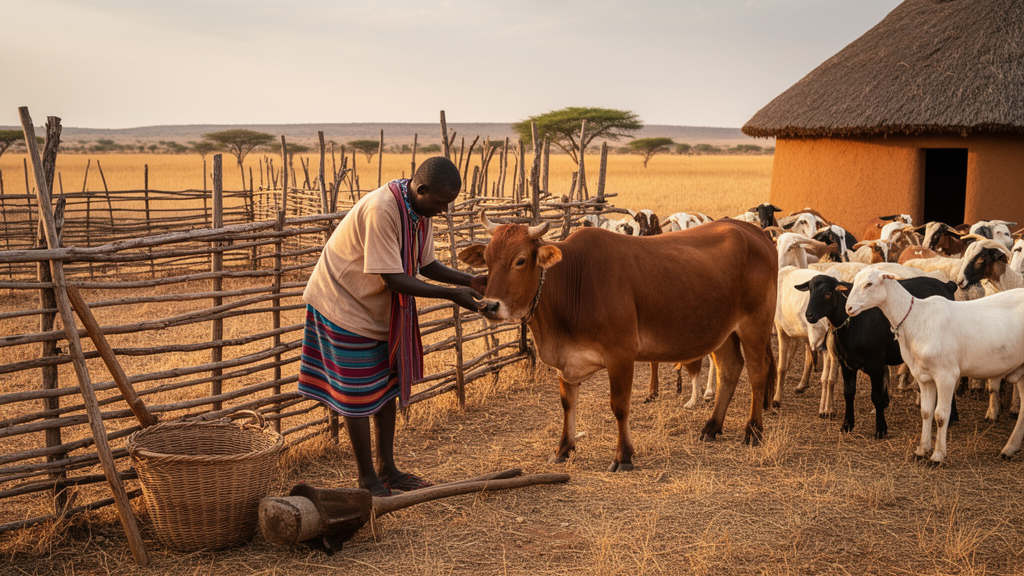
A structured narrative review finds that indigenous knowledge systems in Southern Africa are associated with the persistence of several indigenous livestock breeds and some conservation-relevant genetic patterns, but the evidence does not yet show that community practices directly cause greater genetic diversity. The authors synthesized 62 peer-reviewed and grey-literature sources published from 1995 through 2026, covering cattle, goats, sheep, chickens, pigs and donkeys across the Southern African Development Community region. Most of the underlying studies were cross-sectional, observational or ethnographic, limiting causal conclusions and revealing a need for longitudinal genetic studies.
Southern Africa contains more than 70% of the continent’s locally adapted cattle, goat and sheep breeds, according to the review. Smallholder and communal production systems maintain much of this diversity, including Sanga-type cattle such as Nguni, Tuli, Barotse, Tswana, Tonga and Mashona, along with zebu breeds including Malawi Zebu and Angoni. These animals have been shaped by generations of environmental pressures and human management, and many display tolerance to heat, drought, trypanosomiasis or low-input conditions. The review reports that 23% of indigenous breeds in the region are classified as at risk of extinction, while the Hottentot, White Woolled Tswana and Namaqua Afrikaner sheep have disappeared.
Indigenous knowledge systems encompass oral and practical knowledge developed through sustained interaction with livestock and the environment. They include criteria for choosing breeding animals, methods of controlling reproduction, ethnoveterinary treatments, seasonal movement of herds, management of grazing areas and water, and customary institutions that regulate ownership, inheritance, sale and ceremonial use. In this sense, knowledge transmission can function as a decentralized selection system operating alongside formal breeding programmes. The review nevertheless separates three outcomes that are often conflated: maintaining recognizable breed characteristics, preserving genome-wide genetic diversity, and retaining variants associated with adaptive traits such as disease resistance or heat tolerance. A practice that preserves a visible trait does not automatically protect diversity elsewhere in the genome.
Coat colour is among the most frequently documented selection preferences. Certain spotted or multicoloured Nguni cattle, known as ibona, have ritual and marriage-related significance in South Africa and Eswatini, while herders in other communities associate particular colours and body characteristics with temperament, fertility, heat tolerance or drought resilience. Tswana herders reportedly describe a preferred breeding bull as one that “walks well and eats little,” while Nguni women evaluate breeding females through udder shape, milk let-down and calf development. These observations show that herders use detailed phenotypic judgments, but the review says genomic evidence has not established whether such preferences preserve adaptive variants, narrow genetic variation, or do both.
Community institutions may also influence how breeding animals move among households. In the mafisa livestock-loaning system of Botswana and Zimbabwe, a better-resourced patron places cattle with a poorer household, which receives milk, draught power and manure while the patron retains breeding rights over offspring. The arrangement is described as dispersing breeding animals across different homesteads, potentially buffering localized disease or drought losses and spreading genetic material. Bull rotation and reciprocal bull borrowing in Zimbabwe, Namibia, Botswana and northern Namibia may limit the reproductive dominance of a single sire. Customary restrictions on selling proven breeding females, matrilineal inheritance and the designation of certain animals for ceremonial obligations may also keep breeding stock within community groups. However, most of these proposed conservation effects are supported by ethnographic or indirect population evidence rather than pedigrees, genotyping or long-term measurements of inbreeding.
Animal-health knowledge provides another possible pathway. Where veterinary services are distant or expensive, herders use plant-based treatments for ticks, intestinal parasites, wounds and reproductive conditions. The literature reviewed includes Aloe species, Nicotiana tabacum, Cissus quadrangularis, Sclerocarya birrea and Kigelia africana. Laboratory studies have reported anti-inflammatory, antibacterial or wound-healing activity for some preparations, including Aloe marlothii and Kigelia africana. Yet each step from documented remedy to lower mortality, herd survival and genetic conservation has weaker support than the preceding one. The review does not claim that ethnoveterinary medicine has been shown to preserve genetic diversity. It instead identifies herd survival as a plausible, incompletely tested benefit and notes that deforestation and urban expansion are reducing access to medicinal plants.
Formal conservation programmes produced a mixed contrast in the evidence. Zimbabwe’s community-based breeding programmes were designed around existing collective selection, seasonal mating management and community assessment of breeding females, while external support focused on veterinary assistance and records. Genetic monitoring in Matabeleland South found higher heterozygosity in Nguni and Mashona herds in programme villages than in unorganised communal herds, and participating households reported better calf survival and body condition at weaning. This was among the review’s few cases pairing a genetic outcome with an institutional account, but it remained observational. By contrast, Botswana’s veterinary cordon fence, introduced without Tswana pastoralist participation, disrupted historical movement and bull-rotation practices. Genetic studies reported greater population subdivision, smaller effective population sizes and higher homozygosity in extensively fenced areas, patterns consistent with reduced gene flow but insufficient to establish a direct causal chain.
Molecular surveys also revealed notable differences between village-managed and commercial populations. A study of Nguni ecotypes reported heterozygosity of 69–72%, an average of 6.0–6.9 alleles per locus and an inbreeding coefficient of 0.01. Village chickens managed under traditional free-range systems in Malawi, Zimbabwe and South Africa showed lower linkage disequilibrium and more distinct regional genetic patterns than flocks in ex situ programmes. In South African pigs, an analysis of genetic variance partitioned approximately 35.5% within populations and 62.4% among groups in the village-managed sample, compared with 76.4% within populations and 5.4% among groups in the commercial sample. These are population-structure measures rather than direct percentages of genetic diversity, and the review emphasizes that they remain associations with community management rather than proof of its effect.
Three gaps stand out. First, genomic studies have concentrated more on phylogenies and population structure than on the functional targets recognized by herders. The authors call for participatory genome-wide association studies using community-defined phenotypes and for longitudinal genotyping of IKS-managed and commercially managed herds. Second, women’s knowledge of small ruminants and indigenous poultry is systematically under-documented, even though women often manage these species, make breeding decisions and maintain matrilineally inherited lineages. Third, almost no study follows herds over time while recording both changing knowledge practices and genetic outcomes. The proposed solution is a network of community genomics sentinel sites, with baseline genotyping, repeated sampling about five years apart and concurrent mapping of customary practices. Such designs could test whether bull rotation, livestock loaning or other practices change heterozygosity, allelic richness and inbreeding over time.
The review recommends documenting community-defined traits as complementary data in national inventories, creating stronger research consent and benefit-sharing arrangements, and revising regional livestock policy to include indigenous knowledge where evidence supports it. It also cautions that indigenous systems are not uniformly beneficial: selection for ceremonial traits can narrow diversity, inheritance rules can restrict gene flow, and externally imposed conservation policies can disrupt effective community institutions. The central conclusion is therefore measured rather than promotional. Indigenous knowledge appears to be a widespread and potentially consequential component of in situ conservation in Southern Africa, but genomic validation, long-term herd monitoring and fuller recognition of women’s management knowledge are needed before its conservation effects can be distinguished from those of other features of communal farming systems.
Subject of Research: Review of indigenous knowledge systems and animal genetic resource conservation in Southern Africa
Article Title: The role of indigenous knowledge systems in conserving animal genetic resource biodiversity in Southern Africa: a review
Article References: Nhara, R. B., Karuma, P. G., Gobvu, V., Mvududu, S. M., Charambira, T., Hodzi, P., Chigede, N., & Baloyi, J. J. (2026). The role of indigenous knowledge systems in conserving animal genetic resource biodiversity in Southern Africa: a review. Frontiers in Conservation Science, 7, Article 1946724. https://doi.org/10.3389/fcosc.2026.1946724
Image Credits: AI Generated
DOI: 10.3389/fcosc.2026.1946724
Keywords: indigenous knowledge, animal genetic resources, livestock conservation, genetic diversity, Southern Africa, community breeding, ethnoveterinary medicine, in situ conservation, food security, climate adaptation, role, indigenous
Cite Scienmag News
William Thompson. (October 21, 2026). Review links Southern African knowledge systems with livestock genetic diversity. Scienmag. https://scienmag.com/review-links-southern-african-knowledge-systems-with-livestock-genetic-diversity/
William Thompson. "Review links Southern African knowledge systems with livestock genetic diversity." Scienmag, 21 October 2026, https://scienmag.com/review-links-southern-african-knowledge-systems-with-livestock-genetic-diversity/. Accessed 21 October 2026.
William Thompson. "Review links Southern African knowledge systems with livestock genetic diversity." Scienmag. October 21, 2026. https://scienmag.com/review-links-southern-african-knowledge-systems-with-livestock-genetic-diversity/


