


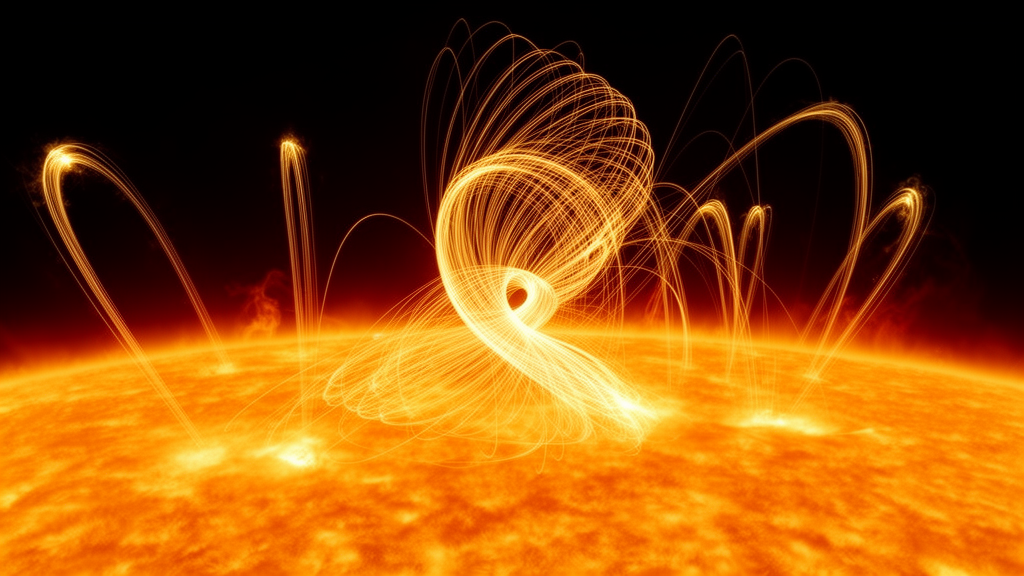
An analytical study of solar magnetic null points finds that sufficiently twisted configurations can become unstable to the m=1 kink mode, growing at Alfvénic rates and strongly deforming the magnetic geometry. The authors report that the deformation can create current sheets where subsequent magnetic reconnection may substantially change the field’s topology. The results appear in Solar Physics as Volume 301, article 160.
The study focuses on three-dimensional magnetic reconnection at null points in the solar corona, a process associated in the research with flares, jets and rapid restructuring of coronal magnetic fields. Two idealized magnetic-field geometries are examined: the torsional spine and the torsional fan. In both models, the central result is the same. Once the azimuthal magnetic-field amplitude is sufficiently large, the total twist exceeds the Kruskal–Shafranov threshold of 2π, and the configuration becomes kink-unstable.
To derive the behavior of these configurations, the researchers use the ideal magnetohydrodynamic energy principle. Their analysis treats line-tied cylindrical flux tubes and takes the static limit of the equilibrium flows. Within this framework, the linear growth rates show that both the torsional spine and torsional fan are susceptible to the m=1 kink mode. The instability develops with Alfvénic growth rates, indicating a rapid evolution in the model rather than a slow static deformation.
The modeled instability sharply distorts the original null-point geometry and produces current sheets. Those sheets provide sites where magnetic reconnection can subsequently occur, potentially causing substantial changes in magnetic topology. The authors therefore interpret the results as a possible natural route by which twisted null-point configurations in the solar corona evolve into kink-unstable states. They propose that this mechanism may help trigger impulsive energy release and topological restructuring associated with solar flares, jets and coronal-heating events.
Because this is an analytical study based on idealized magnetic-field models, the findings establish behavior within the model’s assumptions rather than directly demonstrating the evolution of a particular solar event. The authors’ connection to flares, jets and coronal heating is a model-based implication. The analysis also depends on its treatment of line-tied cylindrical flux tubes, the ideal magnetohydrodynamic framework and the static limit of equilibrium flows, which define the scope of the reported instability and growth rates.
Subject of Research: Analytical modeling of ideal kink instability in twisted solar magnetic null points
Article Title: Kink Instability of Torsional Spine and Fan Magnetic Null Points
Article References: Hosseinpour, M. (2026). Kink Instability of Torsional Spine and Fan Magnetic Null Points. Solar Physics, 301(10), Article 160. https://doi.org/10.1007/s11207-026-02757-4
Image Credits: AI Generated
DOI: 10.1007/s11207-026-02757-4
Keywords: solar corona, magnetic null points, kink instability, magnetic reconnection, torsional spine, torsional fan, magnetohydrodynamics, current sheets, solar flares, coronal jets, Kink, Instability
Cite Scienmag News
Grant Pearson. (October 21, 2026). Twisted Solar Null Points Can Become Kink-Unstable, Analytical Study Finds. Scienmag. https://scienmag.com/twisted-solar-null-points-can-become-kink-unstable-analytical-study-finds/
Grant Pearson. "Twisted Solar Null Points Can Become Kink-Unstable, Analytical Study Finds." Scienmag, 21 October 2026, https://scienmag.com/twisted-solar-null-points-can-become-kink-unstable-analytical-study-finds/. Accessed 21 October 2026.
Grant Pearson. "Twisted Solar Null Points Can Become Kink-Unstable, Analytical Study Finds." Scienmag. October 21, 2026. https://scienmag.com/twisted-solar-null-points-can-become-kink-unstable-analytical-study-finds/


