


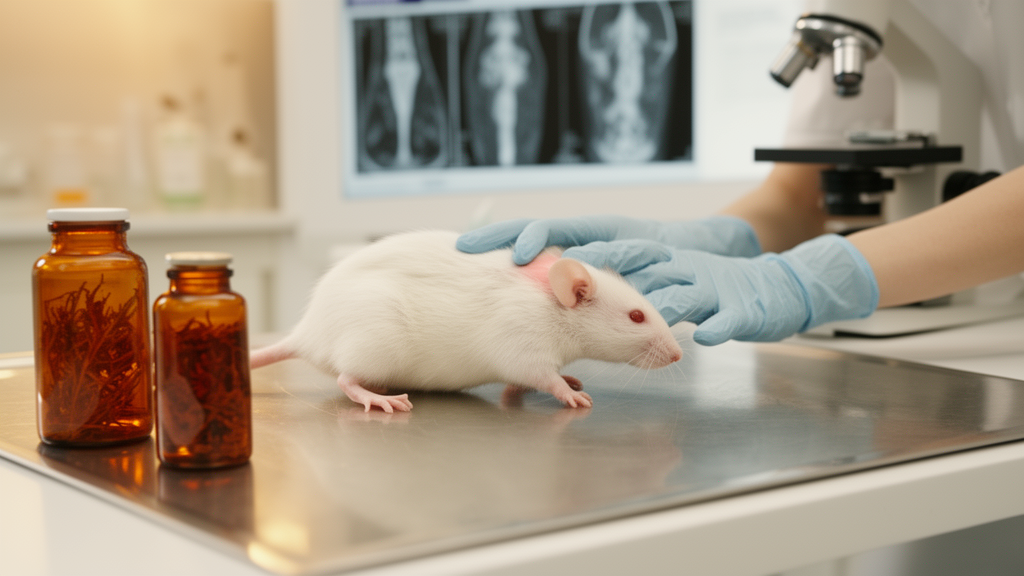
Tanshinone IIA treatment was associated with improved femoral-head microarchitecture, reduced fatty infiltration and fewer osteoclasts in a randomized experiment involving 24 rats with a steroid-induced osteonecrosis of the femoral head model. The animal study was reported in Frontiers in Endocrinology.
Researchers assigned eight rats each to a control group, a disease model group and a Tanshinone IIA group. The model and treatment groups received intramuscular methylprednisolone at 30 mg/kg/day during the first three consecutive days of each week for three weeks. Tanshinone IIA was then administered by oral gavage at 8 mg/kg/day for six weeks.
Micro-computed tomography showed that the model group had lower bone volume and bone volume fraction, higher tissue volume, and disorganized, partly cystic trabeculae. Compared with the model group, the Tanshinone IIA group had recovered bone volume, a significantly increased bone volume fraction and trabeculae tending toward an orderly arrangement. Imaging and pathology assessments were conducted on three randomly selected rats per group.
Hematoxylin and eosin staining showed denser trabeculae and reduced adipocyte infiltration in the Tanshinone IIA group than in the model group. Tartrate-resistant acid phosphatase staining showed fewer osteoclasts and weaker staining in the treated group. These findings concern changes in the experimental model and do not establish clinical efficacy in people with osteonecrosis.
Untargeted fecal metabolomics, performed with six rats per group, identified 18 differentially abundant metabolites between control and model animals and 19 between model and Tanshinone IIA animals. Xanthine, hypoxanthine, 2-oxopentanedioic acid and succinic semialdehyde were elevated in the model group and declined after Tanshinone IIA intervention.
Pathway enrichment included purine metabolism in the model comparison and 2-oxocarboxylic acid, butanoate, amino acid and related metabolic pathways in the treatment comparison. The metabolomic patterns suggested partial rather than complete normalization, with global differences between control and Tanshinone IIA animals remaining modest, based on a Q² value of 0.04. Pyruvate and glutamic acid were lower in the Tanshinone IIA group than in the model group; the authors interpreted this as potentially consistent with greater metabolic utilization, not direct proof of enhanced mitochondrial activity.
Data-independent acquisition proteomics, based on five rats per group, identified 116 differentially expressed proteins between control and model animals and 12 between model and Tanshinone IIA animals. Model-related proteins were enriched in Hippo, TGF-β and Wnt signaling pathways, while the treated comparison was primarily associated with aminoacyl-tRNA biosynthesis and lipid-related pathways.
Matched metabolomic and proteomic data identified Bmp6, Smoc2, Ihh and Enpp2 as proteins significantly correlated with differential metabolites after false-discovery-rate correction. These multi-omics findings are correlative and hypothesis-generating rather than evidence that the proteins caused the observed changes.
The study had small analytical samples, no positive drug control and no network-centrality analysis. Fecal metabolomics reflects systemic host–microbiota metabolism and may not represent local femoral-head conditions. Candidate proteins were selected through correlation analysis and prior literature rather than causal experiments, while oral administration of poorly water-soluble Tanshinone IIA may have limited exposure. Overall, the rat experiment provides preliminary evidence associating Tanshinone IIA with changes across bone structure, metabolism and protein networks, and its clinical relevance cannot be determined from the animal data alone.
Subject of Research: Multi-omics assessment of Tanshinone IIA in a rat model of steroid-induced femoral-head osteonecrosis
Article Title: Insights into potential multi-target protective effects of Tanshinone IIA in steroid-induced osteonecrosis of the femoral head: evidence from integrated metabolomics and proteomics
Article References: Li, W., Xu, N., Chai, J.-L., Zhang, B.-C., Liang, Y.-C., Li, G., & Liang, X.-Z. (2026). Insights into potential multi-target protective effects of Tanshinone IIA in steroid-induced osteonecrosis of the femoral head: evidence from integrated metabolomics and proteomics. Frontiers in Endocrinology, 17, Article 1991120. https://doi.org/10.3389/fendo.2026.1991120
Image Credits: AI Generated
DOI: 10.3389/fendo.2026.1991120
Keywords: Tanshinone IIA, osteonecrosis, femoral head, rat model, metabolomics, proteomics, bone microarchitecture, multi-omics, osteoclasts, Insights, potential, multi-target
Cite Scienmag News
Alexandra Wallace. (October 21, 2026). Tanshinone IIA linked to bone, metabolic and protein changes in rat osteonecrosis study. Scienmag. https://scienmag.com/tanshinone-iia-linked-to-bone-metabolic-and-protein-changes-in-rat-osteonecrosis-study/
Alexandra Wallace. "Tanshinone IIA linked to bone, metabolic and protein changes in rat osteonecrosis study." Scienmag, 21 October 2026, https://scienmag.com/tanshinone-iia-linked-to-bone-metabolic-and-protein-changes-in-rat-osteonecrosis-study/. Accessed 21 October 2026.
Alexandra Wallace. "Tanshinone IIA linked to bone, metabolic and protein changes in rat osteonecrosis study." Scienmag. October 21, 2026. https://scienmag.com/tanshinone-iia-linked-to-bone-metabolic-and-protein-changes-in-rat-osteonecrosis-study/


