

Wednesday, October 21, 2026
Science
No Result
View All Result
  • Login
  • HOME
  • SCIENCE NEWS
  • CONTACT US
  • HOME
  • SCIENCE NEWS
  • CONTACT US
No Result
View All Result
Scienmag
No Result
View All Result
Home Science News Biology

Taxonomic review describes two new Episyron species and three new records for China

October 21, 2026
in Biology, Science News
Drew Townsend
By Drew Townsend Scienmag Editorial Profile - Cell Biology
Reading Time: 3 mins read
0
Two new spider wasps lift China’s Episyron count to eight species

Two new spider wasps lift China's Episyron count to eight species

65
SHARES
587
VIEWS
Share on FacebookShare on Twitter
ADVERTISEMENT

A specimen-based taxonomic review of Chinese spider wasps described two new species in the genus Episyron and documented three species as new records for China. The additions bring the country’s known inventory from three species and one subspecies to eight species and one subspecies. The new species are Episyron fulvimaculatus Song & Li and E. immaculatus Song & Ma.

E. fulvimaculatus was described from examined material collected in Yunnan, including Menghai County, Dehong State, Baoshan, Wenshan State and Yuxi. Females measured 9.2–13.5 mm in body length and 8.1–11.8 mm in fore-wing length; males measured 7.3–9.5 mm and 7.6–8.3 mm, respectively. E. fulvimaculatus has numerous fulvous markings, a largely fulvous mesosoma and tergites 4–6 that are almost entirely fulvous.

Its female first flagellomere measured 5.63–6.02 times its maximum width, while the male first flagellomere measured 1.42–1.64 times its maximum width. E. immaculatus was described from specimens collected at Helan Mountain in Inner Mongolia. Females measured 10.5–12.5 mm in body length and 8.1–9.8 mm in fore-wing length.

The name refers to the black metasoma, which lacks spots or bands. The authors distinguished it from E. rufipes using first-flagellomere proportions, postocellar and ocellocular distances, leg coloration, pterostigma shape and the absence of metasomal markings. The review also documented E. albonotatum, E. rufipes and E. rufotibius as new records for China.

Examined E. albonotatum and E. rufipes material came from Inner Mongolia, whereas examined E. rufotibius material came from Yunnan and Guangdong. The authors supplied descriptions, images and distribution information for these taxa. An illustrated key was provided for identifying Chinese Episyron species, with separate female and male pathways where males were known.

Diagnostic characters included body coloration and patterning, pterostigma form, fore-tarsal spines, antennal proportions, ocellar distances, wing structure and genital features. E. fulvimaculatus was compared with E. vagabundus hopponis using female first-flagellomere proportions, postocellar and ocellocular distances, pterostigma shape and the fore-metatarsal comb spine. This was a morphological examination of museum specimens rather than a field experiment.

Researchers used an Olympus SZ-series stereomicroscope with an ocular micrometer, photographed specimens using a Keyence VHX-5000 digital microscope system and edited the images in Adobe Photoshop 8.0. Wing-vein and cell terminology followed Day’s 1988 system. The occurrence records were based on examined material and cited reports, while broader geographic ranges were drawn from the literature.

The authors associated the expanded Chinese inventory with the country’s Palearctic and Oriental representation, extensive collection efforts, vegetation diversity, complex terrain and varied climatic conditions. These factors were presented as possible influences rather than experimentally tested causes of diversity. The revised Chinese total represented about 9% of the stated global inventory of 87 Episyron species and 13 subspecies.

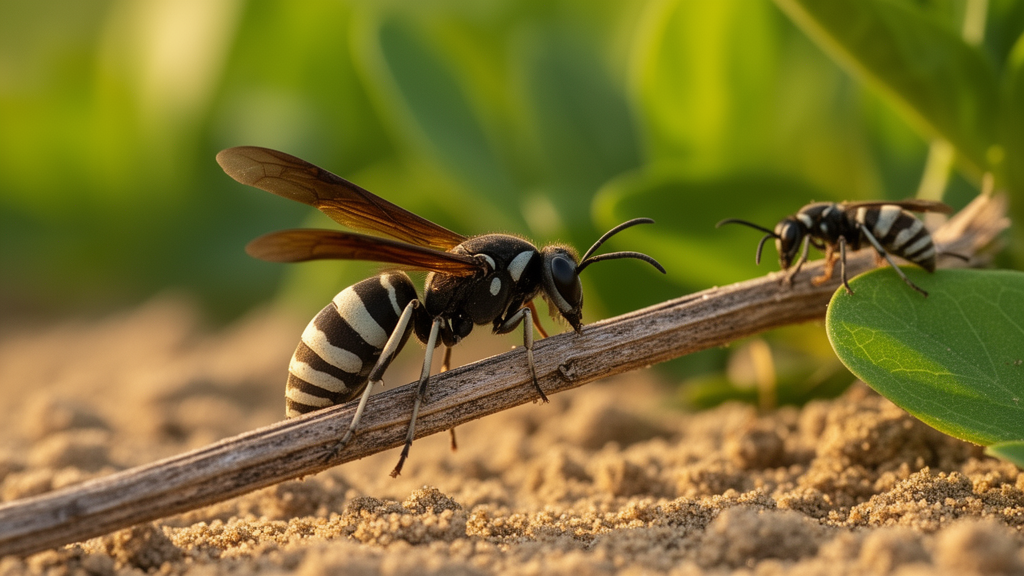
Episyron species are small- to medium-sized predatory and parasitic wasps that prey on orb-weaver spiders. Previously cited biological research reported that females paralyze prey and move it to soil nests, while adults may visit flowers; these behaviors were not tested in the present morphological review.

Subject of Research: Taxonomic review of Chinese Episyron spider wasps

Article Title: Review and key of the Chinese species of the genus Episyron Schiødte ( Hymenoptera , Pompilidae ), including descriptions of two new species

Article References: Song, Z., Dong, L., Ma, L., & Li, Q. (2025). Review and key of the Chinese species of the genus Episyron Schiødte (Hymenoptera, Pompilidae), including descriptions of two new species. Deutsche Entomologische Zeitschrift, 72(2), 133-154. https://doi.org/10.3897/dez.72.138061

Image Credits: AI Generated

DOI: 10.3897/dez.72.138061

Keywords: Episyron, taxonomy, new species, China, spider wasps, Hymenoptera, Pompilidae, morphology, species identification, Review, Chinese, species

Cite Scienmag News

Drew Townsend. (October 21, 2026). Taxonomic review describes two new Episyron species and three new records for China. Scienmag. https://scienmag.com/taxonomic-review-describes-two-new-episyron-species-and-three-new-records-for-china/


Drew Townsend. "Taxonomic review describes two new Episyron species and three new records for China." Scienmag, 21 October 2026, https://scienmag.com/taxonomic-review-describes-two-new-episyron-species-and-three-new-records-for-china/. Accessed 21 October 2026.

Drew Townsend. "Taxonomic review describes two new Episyron species and three new records for China." Scienmag. October 21, 2026. https://scienmag.com/taxonomic-review-describes-two-new-episyron-species-and-three-new-records-for-china/

Tags: ChinaChineseChinese wasp biodiversitydistribution of Episyron in ChinaEpisyronEpisyron fulvimaculatusEpisyron immaculatusevolutionary relationships within Episyron genusHymenopteraidentification key for Chinese EpisyronInner Mongolia spider waspsmorphological characteristics of Episyron speciesmorphologynew Episyron speciesnew records for Chinanew speciesPompilidaereviewspeciesspecies identificationspider wasp wing and body measurementsspider waspsTaxonomic review of Chinese spider waspstaxonomyYunnan spider wasps
Share26Tweet16
Previous Post

Morphological study identifies probable first Miocene Selaginella macrofossil in Dominican amber

Next Post

John S. Dugdale’s six decades of fieldwork reshaped New Zealand entomology

Related Posts

John S. Dugdale, the Entomologist Who Mapped New Zealand’s Moths, Dies at 86
Science News

John S. Dugdale’s six decades of fieldwork reshaped New Zealand entomology

October 21, 2026
Ancient Spike Moss Trapped in Dominican Amber Fills 20-Million-Year Gap
Science News

Morphological study identifies probable first Miocene Selaginella macrofossil in Dominican amber

October 21, 2026
400°C cotton-stalk wood vinegar most strongly enhanced pig-manure compost humification
Science News

400°C cotton-stalk wood vinegar most strongly enhanced pig-manure compost humification

October 21, 2026
Case Report Confirms Gastric Leiomyosarcoma in a 4-Year-Old Horse
Science News

Case Report Confirms Gastric Leiomyosarcoma in a 4-Year-Old Horse

October 21, 2026
Research report: Radiative forcing variability and its moderation during a cyclonic event: a case study
Earth Science

Research report: Radiative forcing variability and its moderation during a cyclonic event: a case study

October 21, 2026
Spinal Hsp90 Blockade Boosts Morphine Pain Relief via DUSP15 in CGRP Neurons
Medicine

Mouse study links spinal Hsp90 inhibition to enhanced morphine pain relief through DUSP15 in CGRP neurons

October 21, 2026
Next Post
John S. Dugdale, the Entomologist Who Mapped New Zealand’s Moths, Dies at 86

John S. Dugdale’s six decades of fieldwork reshaped New Zealand entomology

  • Mothers who receive childcare support from maternal grandparents show more optimized

    Mothers who receive childcare support from maternal grandparents show more parental warmth, finds NTU Singapore study

    27656 shares
    Share 11059 Tweet 6912
  • University of Seville Breaks 120-Year-Old Mystery, Revises a Key Einstein Concept

    1061 shares
    Share 424 Tweet 265
  • Bee body mass, pathogens and local climate influence heat tolerance

    682 shares
    Share 273 Tweet 171
  • Researchers record first-ever images and data of a shark experiencing a boat strike

    546 shares
    Share 218 Tweet 137
  • Groundbreaking Clinical Trial Reveals Lubiprostone Enhances Kidney Function

    531 shares
    Share 212 Tweet 133
Science

Embark on a thrilling journey of discovery with Scienmag.com—your ultimate source for cutting-edge breakthroughs. Immerse yourself in a world where curiosity knows no limits and tomorrow’s possibilities become today’s reality!

RECENT NEWS

  • John S. Dugdale’s six decades of fieldwork reshaped New Zealand entomology
  • Taxonomic review describes two new Episyron species and three new records for China
  • Morphological study identifies probable first Miocene Selaginella macrofossil in Dominican amber
  • 400°C cotton-stalk wood vinegar most strongly enhanced pig-manure compost humification

Categories

  • Agriculture
  • Anthropology
  • Archaeology
  • Athmospheric
  • Biology
  • Biotechnology
  • Blog
  • Bussines
  • Cancer
  • Chemistry
  • Climate
  • Earth Science
  • Editorial Policy
  • Marine
  • Mathematics
  • Medicine
  • Pediatry
  • Policy
  • Psychology & Psychiatry
  • Science Education
  • Science News
  • Social Science
  • Space
  • Technology and Engineering

Subscribe to Blog via Email

Enter your email address to subscribe to this blog and receive notifications of new posts by email.

Join 5,150 other subscribers

© 2025 Scienmag - Science Magazine

Welcome Back!

Login to your account below

Forgotten Password?

Retrieve your password

Please enter your username or email address to reset your password.

Log In
No Result
View All Result
  • HOME
  • SCIENCE NEWS
  • CONTACT US

© 2025 Scienmag - Science Magazine

Discover more from Science

Subscribe now to keep reading and get access to the full archive.

Continue reading