


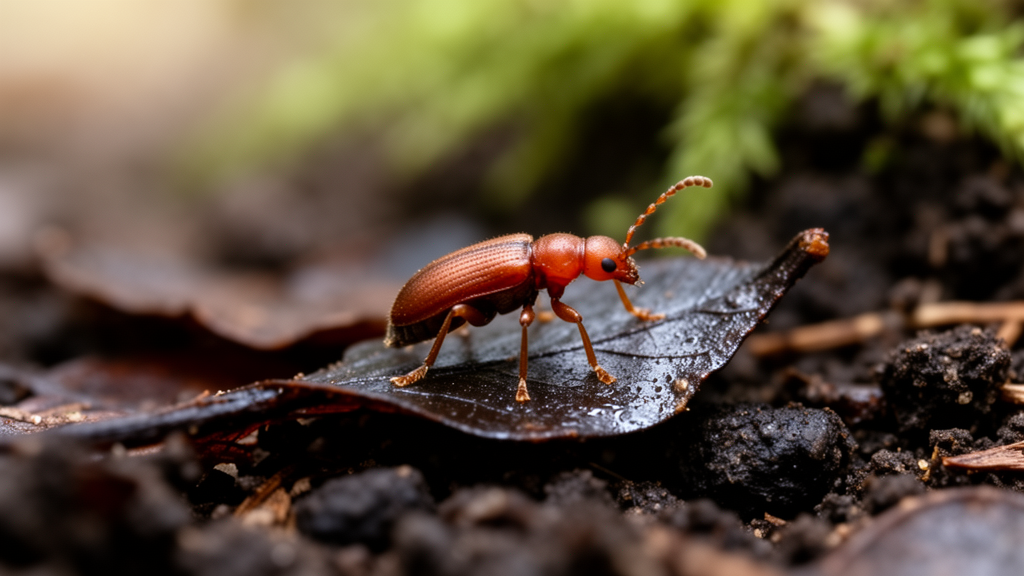
A taxonomic study has described Disarthricerus dulcissimus, a new species of ant-like litter beetle collected in mixed broad-leaved forest in Yunnan, southwest China. The description is based on two adult males recovered by flight-intercept traps, one designated as the holotype and the other as a paratype. Their discovery extends the documented range of Disarthricerus northward by more than 2,100 kilometers.
The new beetle belongs to the rove beetle family Staphylinidae and the subfamily Pselaphinae. The genus is an unusual myrmecophilous group distinguished from many related clavigerites by the absence of trichomes, specialized glandular hair tufts, on the elytra and abdomen. Its antennae are also highly reduced, with rounded apices that lack the setose cavities typical of related groups. Disarthricerus was established by Raffray in 1895 for D. integer, described from a female specimen obtained by sifting leaf litter in Singapore.
The genus has remained scarce in collections. D. moultoni was described in 1915 from Mount Matang in Sarawak, northern Borneo, where one specimen was found in a nest of the ant then named Prenolepis butteli and now known as Paraparatrechina butteli. This remains the only putative host association reported for Disarthricerus. A third species, D. bruneicus, was described in 2018 from a specimen collected by light trap in Brunei. Before the Yunnan discovery, the three named species were known from Singapore and Pahang in Malaysia, Sarawak and Sabah in Malaysian Borneo, and Brunei.
The new material came from a field survey in the Xishuangbanna region of Yunnan. Eight flight-intercept traps were deployed at different sites in mixed evergreen tropical forests surrounding the Xishuangbanna Tropical Botanic Garden. Careful stereomicroscopic examination of material collected over several weeks yielded only the two male specimens. The holotype was collected at Mangang Mountain in Mengla County at an elevation of 640 meters, while the paratype came from the nearby Namiao River at 710 meters. Both were collected in May 2025 by Lü and are deposited in the Insect Collection of Shanghai Normal University.
Disarthricerus dulcissimus has a stout, reddish-brown body measuring 1.08–1.12 millimeters in length, with paler tarsi and mouthparts. Its antennae are 0.32 millimeters long and show two observable antennomeres, although faint basal sutures suggest that apical antennomeres are fused. The terminal antennomere is nearly straight, with a dorsally exposed section approximately 3.6 times as long as wide. The compound eyes are relatively small and broadly separated, with approximately 32 ommatidia in each. The pentagonal pronotum is wider than long, while the elytra have well-marked reticulate sculpture at the center of the disc.
The male aedeagus is 0.13 millimeters long and elongate, with dorsoventral symmetry. Its median lobe has a basally rounded capsule, a transversely oval foramen and a large oval diaphragm. The apical quarter narrows into an apex bent ventrally, and the endophallus armature contains numerous membranous, spine-like structures concentrated centrally. The parameres are dorsally fused with the median lobe and are elongate and slender, with rounded, asetose apices. The female of the new species remains unknown.
The diagnosis separates D. dulcissimus from its three named congeners through a combination of antennal, leg, eye and genital characters. It has nearly straight terminal antennomeres and unmodified male legs, unlike D. bruneicus, whose terminal antennomeres curve basolaterally and whose mesofemora bear large ventral spines. From D. moultoni, it differs in having antennae longer relative to the head and simple mesofemora rather than femora with one long and one short ventral spine. Compared with D. integer, the new species has proportionately shorter and more robust terminal antennomeres and the smallest male eyes among the known congeners.
The Yunnan locality produces a substantial biogeographical disjunction from the previously documented distribution in Singapore, Pahang, Sarawak, Sabah and Brunei. The authors note that comparable extensions have been documented in other rare, myrmecophilous clavigerites, including Archiclaviger, which was considered a Javan endemic before a species was discovered in eastern China. They also report having examined undescribed Disarthricerus material from southern Thailand, central Laos and northern Sarawak. The intermediate Thai and Laotian localities suggest that the apparent gap may reflect incomplete sampling rather than the genus’ historical distribution, and the authors consider a continuous but sparsely populated range across the Indochinese Peninsula plausible.
Ecological knowledge of Disarthricerus remains limited. A low recovery rate from eight flight-intercept traps may indicate very low population density or high microhabitat specificity, possibly involving an unidentified symbiotic host, but the trapping method did not establish such an association. Passive traps can capture dispersing adults but provide little information about the beetles’ bionomics. The authors therefore state that understanding the genus’ life history will require targeted collecting, including sifting leaf litter and investigating ant nests, particularly those of formicine ants related to Paraparatrechina.
Subject of Research: Taxonomic description of a new Yunnan species of Disarthricerus and its biogeographical implications
Article Title: Disarthricerus dulcissimus sp. nov. ( Coleoptera , Staphylinidae , Pselaphinae ): a precious dwarf from the north
Article References: Yin, Z.-W., Nomura, S., Hlaváč, P., & Lü, L. (2025). Disarthricerus dulcissimus sp. nov. (Coleoptera, Staphylinidae, Pselaphinae): a precious dwarf from the north. Deutsche Entomologische Zeitschrift, 72(2), 517-524. https://doi.org/10.3897/dez.72.170957
Image Credits: AI Generated
Keywords: Disarthricerus dulcissimus, taxonomy, rove beetles, Pselaphinae, Yunnan, Xishuangbanna, flight-intercept trapping, biogeography, insect morphology, Disarthricerus, dulcissimus, Coleoptera
Cite Scienmag News
Drew Townsend. (October 20, 2026). Taxonomic study describes Yunnan beetle extending Disarthricerus range northward by more than 2,100 km. Scienmag. https://scienmag.com/taxonomic-study-describes-yunnan-beetle-extending-disarthricerus-range-northward-by-more-than-2100-km/
Drew Townsend. "Taxonomic study describes Yunnan beetle extending Disarthricerus range northward by more than 2,100 km." Scienmag, 20 October 2026, https://scienmag.com/taxonomic-study-describes-yunnan-beetle-extending-disarthricerus-range-northward-by-more-than-2100-km/. Accessed 20 October 2026.
Drew Townsend. "Taxonomic study describes Yunnan beetle extending Disarthricerus range northward by more than 2,100 km." Scienmag. October 20, 2026. https://scienmag.com/taxonomic-study-describes-yunnan-beetle-extending-disarthricerus-range-northward-by-more-than-2100-km/


