


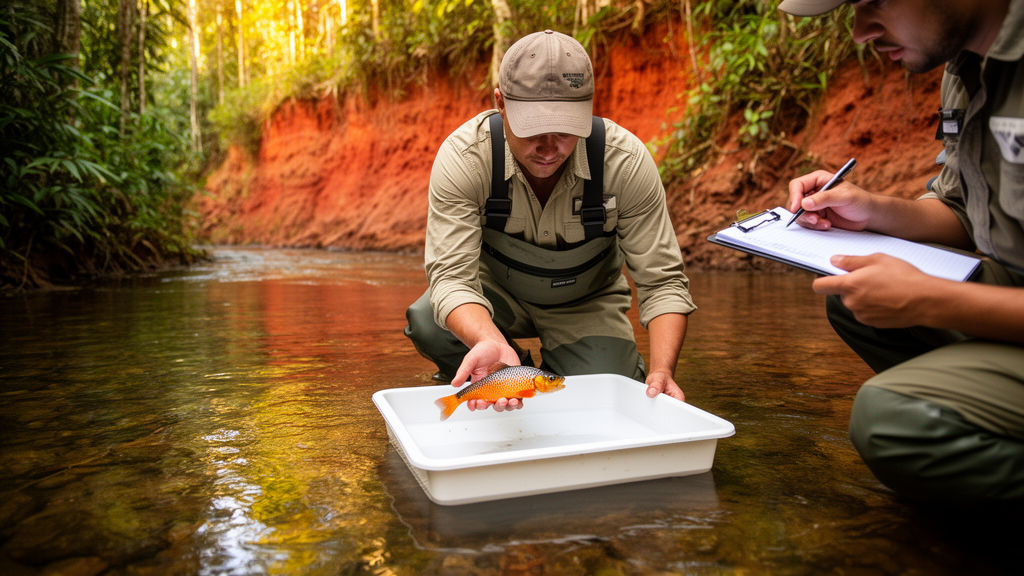
An observational analysis of 16,014 fish records from the Colombian Western Amazon found that species composition was strongly associated with the geomorphology of eight aquatic ecosystem types. The records represented 905 native species across 420,000 square kilometres, and complementary analyses identified significant differences among ecosystem assemblages, spatial clustering and four modular fish communities.
The study used an updated database of Colombian Amazonian fish occurrences compiled from museum collections and recently published records. Locality information was validated and used to assign each record to one of eight physical ecosystem categories: Andean rivers, Andean streams, foothill alluviums, major lowland rivers, floodplains, rapids, small lowland rivers and streams, and shield streams. The analysis used presence-absence data rather than abundance estimates or replicated sampling of individual geological units.
Researchers applied Jaccard dissimilarity and additive partitioning to distinguish species turnover from nestedness, then used hierarchical clustering on principal components analysis and PERMANOVA to assess compositional differences among ecosystems. They also partitioned variation among ecosystem type, spatialized ecosystems and space alone. A weighted bipartite network analysis tested whether the fish communities were more modular than expected under two randomized null models, each run 1,000 times.
Lowland major rivers and floodplains each contained 680 recorded species, the highest totals in the dataset, and lowland major rivers contained 136 unique species. Small lowland rivers and streams supported 396 species, including 84 unique species. Andean streams had the fewest total species, with 47, while shield streams had 16 and no species unique to that category in the database.
Neighbouring ecosystems had significantly less species turnover than nonadjacent ecosystems, a relationship accounting for 57% of the variation in the regression, with a p-value of 0.01. Adjacent systems also had significantly greater nestedness, for which the model reported an R-squared of 0.16 and a p-value of 0.02. A positive relationship between turnover and the number of intervening network nodes was not significant because the network provided few comparisons.
The multivariate analyses also showed substantial ecosystem-level differences. The first principal dimension in the hierarchical clustering represented 33% of the variation and principally separated Andean from lowland ecosystems, while a second dimension accounted for 17% and distinguished communities within the lowlands. PERMANOVA corroborated these differences, with a pseudo-F value of 7.99, an R value of 0.86 and a p-value below 0.01. The broad ecosystem pattern was retained when the analysis was restricted separately to Characiformes and Siluriformes, the two most diverse orders in the region.
Variation partitioning attributed 14.2% of community variation to geomorphologically defined ecosystems, 56.9% to spatialized ecosystems and 28.9% to space alone. The network was significantly modular, with a Q score of 0.31 that exceeded the 97.5% confidence limits of both null models. This analysis identified four modules: 463 species associated with major lowland rivers and floodplains; 323 associated with small lowland rivers, streams and shield streams; 71 associated with Andean rivers, Andean streams and foothill alluviums; and 48 primarily associated with rapids.
The authors interpret the results as evidence that local fish assemblages are not randomly drawn from the regional species pool. Instead, species sorting associated with geomorphology appears to act as an environmental filter, although physical and chemical conditions such as conductivity, hardness and pH may also contribute. Some species occurred across several ecosystem types, including Moenkhausia oligolepis, Astyanax maximus and Hypostomus plecostomoides. The observed structure was also consistent with the metacommunity concept, in which species from a regional pool colonize and sort among habitats.
The findings do not establish the causal mechanism behind these associations, and the analysis was not designed to estimate habitat suitability or abundance-based distribution models. The records came from varied sources rather than a standardized sampling programme, individual geological subunits were not sampled equally, and additional records or finer spatial resolution could refine the results. Shield streams were also sparsely represented, while many Amazonian areas remain unexplored and some species remain undescribed. Even with these limitations, the study identifies geomorphologically defined ecosystems as potential units for conservation and fisheries planning in a region threatened by habitat loss, overfishing, hydroelectric dams and climate change.
Subject of Research: Geomorphological structuring of fish species composition in the Colombian Western Amazon
Article Title: Fish species composition reflects geomorphology in the Western Amazon, the Earth's vertebrate biodiversity hotspot
Article References: Bogotá-Gregory, J. D., DoNascimiento, C., Lima, F. C. T., Correa, S. B., Ohyama, L., Acosta-Santos, A., Agudelo Córdoba, E., Jenkins, D. G., & Albert, J. S. (2026). Fish species composition reflects geomorphology in the Western Amazon, the Earth's vertebrate biodiversity hotspot. Frontiers of Biogeography, 19, Article e173249. https://doi.org/10.21425/fob.19.173249
Image Credits: AI Generated
Keywords: Western Amazon, freshwater fish, geomorphology, species composition, beta diversity, network modularity, Colombian Amazon, community assembly, environmental filtering, Fish, species, composition
Cite Scienmag News
Cole Johnston. (October 20, 2026). Database study links Western Amazon fish assemblages to aquatic geomorphology. Scienmag. https://scienmag.com/database-study-links-western-amazon-fish-assemblages-to-aquatic-geomorphology/
Cole Johnston. "Database study links Western Amazon fish assemblages to aquatic geomorphology." Scienmag, 20 October 2026, https://scienmag.com/database-study-links-western-amazon-fish-assemblages-to-aquatic-geomorphology/. Accessed 20 October 2026.
Cole Johnston. "Database study links Western Amazon fish assemblages to aquatic geomorphology." Scienmag. October 20, 2026. https://scienmag.com/database-study-links-western-amazon-fish-assemblages-to-aquatic-geomorphology/


