


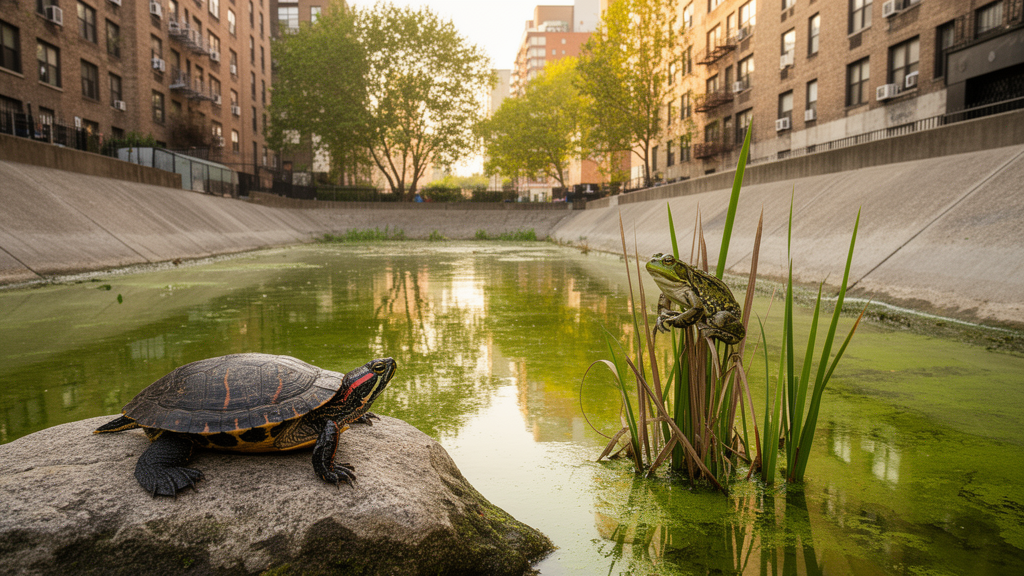
A field survey and risk-screening study in Central Europe’s Pannonian Biogeographical Region compiled 5,134 georeferenced observations of non-native amphibians and aquatic reptiles from 1990 to 2024. The research found the greatest diversity and densities in artificial habitats, particularly urban ponds, lakes and thermally influenced waters, and identified several pet-traded species as high or very-high invasion risks under present and projected climate conditions. The study combined records from conservation-organization databases, interviews with 24 Hungarian experts, citizen-science questionnaires, literature published from 2004 to 2024, researchers’ field observations and a long-term monitoring program around Budapest.
The region comprises Hungary and peripheral areas of the Czech Republic, Romania, Slovakia, Serbia and Ukraine. It supports 18 native amphibian and 16 native reptile species, including three aquatic reptiles, and contains numerous artificial and thermal-water habitats. The authors said the research did not directly quantify ecological impacts on native herpetofauna.
The assembled database contained five non-native amphibian species and 16 aquatic reptile taxa, with the red-eared, yellow-bellied and Cumberland sliders treated separately as subspecies. The three sliders accounted for 4,426 observed individuals, representing 86.21% of the observed non-native individuals in the region rather than 86.21% of observation records. The red-eared slider was detected in every country in the region, including 2,599 individuals in artificial habitats and 687 in river arms, streams, lakes and protected wetlands.
Budapest monitoring ran from March 2015 through November 2024 and surveyed 33 water bodies at 37 sites across approximately 8,200 km² with more than 3.3 million inhabitants. Visual observations, baited traps, nets and electrofishing were used three times annually. The program produced 1,138 observations, equal to 22.16% of the regional dataset, although the monitored area covered only 2.66% of the region.
For amphibians, 58.38% of observations came from the monitored area, but the authors cautioned that focused monitoring was expected to increase detection probability relative to the region-wide compilation. Urban monitoring yielded the region’s first records for four non-native amphibians—the oriental fire-bellied newt, western dwarf clawed frog, Iberian ribbed newt and African clawed frog—and four aquatic reptiles—the eastern painted turtle, Chinese stripe-necked turtle, peninsula cooter and common musk turtle. The researchers documented nesting, hatching and juveniles of the red-eared and yellow-bellied sliders in public ponds, Danube side arms and bays, along with the first juvenile common snapping turtles in the Budapest area.
These observations establish occurrence and, for some taxa, reproduction, but not that every recorded species has become invasive. Thermal and industrial warm-water sites contained African clawed frogs, western dwarf clawed frogs and Iberian ribbed newts. Juvenile false map turtles with recent umbilical scars were collected from three Budapest sites, while juvenile common musk turtles were found in two small thermal ponds.
The authors identified warmth, release pathways associated with urban pet keeping and the concentration of the pet trade as plausible facilitators of establishment, although the observational design did not isolate their individual causal effects. For risk assessment, the team used version 2.4 of the Aquatic Species Invasiveness Screening Kit, a 55-question decision-support tool comprising 49 Basic Risk Assessment questions and six Climate Change Assessment questions. The researchers screened 16 amphibian and 28 aquatic reptile species or subspecies selected from occurrence records and the pet trade.
Calibrated thresholds ranked taxa as medium or high risk, with an additional ad hoc category for very high risk. Area-under-the-curve values were 0.9847, with a 95% confidence interval of 0.8363–1.0000, for amphibians and 0.8525, with a 95% confidence interval of 0.6983–1.0000, for aquatic reptiles. Under the Basic Risk Assessment, four of 16 amphibians were ranked high risk; including climate change raised that number to six.
The African clawed frog ranked very high under both assessments, while the western dwarf clawed frog, American bullfrog and cane toad were very high only when climate change was included. The three slider subspecies ranked very high under both assessments; the common snapping turtle, Chinese soft-shelled turtle, eastern river cooter and false map turtle joined that category when climate change was considered. Field evidence and screening distinguished demonstrated establishment from modeled risk.
The red-eared and yellow-bellied sliders had documented overwintering and successful reproduction in artificial and (quasi)natural habitats, and the authors considered them established across most of the region. The common snapping turtle had overwintered and bred in outdoor enclosures, while several other species had reproduced in captivity but lacked confirmed natural breeding in the region. The authors recommended continued high-intensity monitoring of urban environments, immediate removal of non-native animals from artificial habitats and public awareness about releasing exotic pets.
They also proposed using the combined field-data and screening framework to assess invasions in other European biogeographical regions.
Subject of Research: Occurrence and invasion risk of non-native amphibians and aquatic reptiles in the Pannonian Biogeographical Region
Article Title: Distribution and invasion risk of non-native amphibians and aquatic reptiles in the Pannonian Biogeographical Region of Central Europe
Article References: Pintér-Szajbert, B., Weiperth, A., Márk Bányai, Z., & Herczeg, G. (2026). Distribution and invasion risk of non-native amphibians and aquatic reptiles in the Pannonian Biogeographical Region of Central Europe. NeoBiota, 107, 175-206. https://doi.org/10.3897/neobiota.107.175797
Image Credits: AI Generated
DOI: 10.3897/neobiota.107.175797
Keywords: non-native species, amphibians, aquatic reptiles, biological invasions, Pannonian region, urban habitats, risk screening, climate change, pond sliders, pet trade, Distribution, invasion
Cite Scienmag News
Patricia Pace. (October 20, 2026). Urban records and climate screening reveal invasion risks for non-native amphibians and aquatic reptiles in the Pannonian region. Scienmag. https://scienmag.com/urban-records-and-climate-screening-reveal-invasion-risks-for-non-native-amphibians-and-aquatic-reptiles-in-the-pannonian-region/
Patricia Pace. "Urban records and climate screening reveal invasion risks for non-native amphibians and aquatic reptiles in the Pannonian region." Scienmag, 20 October 2026, https://scienmag.com/urban-records-and-climate-screening-reveal-invasion-risks-for-non-native-amphibians-and-aquatic-reptiles-in-the-pannonian-region/. Accessed 20 October 2026.
Patricia Pace. "Urban records and climate screening reveal invasion risks for non-native amphibians and aquatic reptiles in the Pannonian region." Scienmag. October 20, 2026. https://scienmag.com/urban-records-and-climate-screening-reveal-invasion-risks-for-non-native-amphibians-and-aquatic-reptiles-in-the-pannonian-region/


