


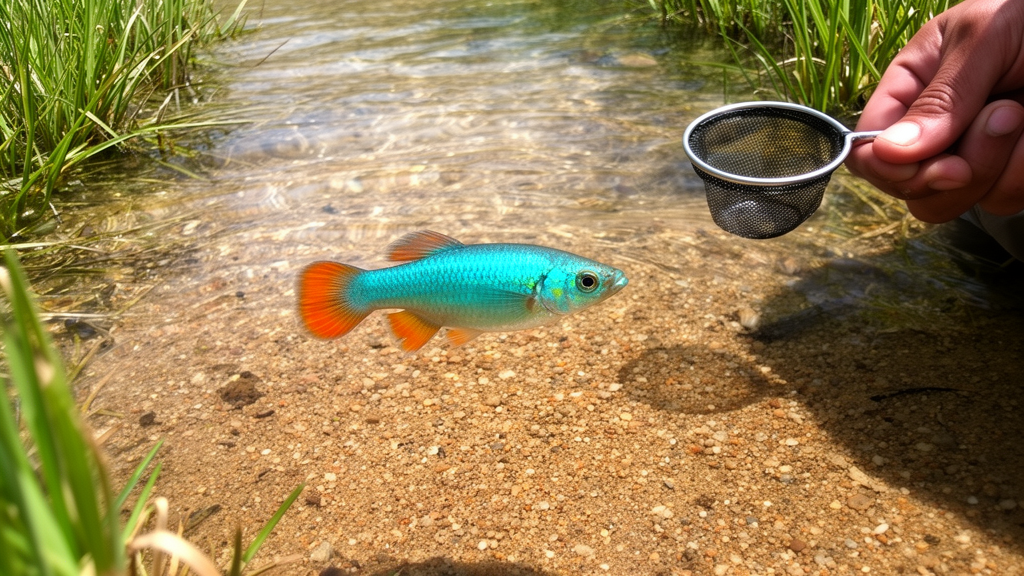
A cytogenetic study of the African killifish Epiplatys spilargyreius from southwestern Ethiopia found a diploid chromosome number of 34, comprising 18 metacentric or submetacentric chromosomes and 16 subtelocentric or acrocentric chromosomes. The reported fundamental number was 52. The study provides the first detailed karyotype description for this species from Ethiopia, adding chromosome-arm information beyond the chromosome counts previously published for populations in Nigeria and the Democratic Republic of the Congo.
Researchers collected four fish, two females and two males measuring 21–28 mm in standard length, from an oxbow pond on the right bank of the Baro River at Baziel Kebele. The Baro is a tributary of the Sobat River in the White Nile system. The fish were collected by the Joint Ethio-Russian Biological Expedition, and species identification was based on morphological characters. Three individuals, two females and one male, were successfully karyotyped.
After intraperitoneal treatment with 0.1% colchicine at 0.01 ml per gram of body weight for three to five hours, the fish were euthanized with an overdose of tricaine methanesulfonate and preserved in 70% ethanol. Chromosome preparations were obtained from kidney tissue. Conventional staining used a 4% Giemsa solution in phosphate buffer at pH 6.8 for eight minutes, and slides were examined using an Axioplan 2 imaging microscope equipped with a CV-M4+CL camera and Ikaros software.
Chromosome pairs were arranged according to size within categories based on centromere position. For the reported fundamental number, metacentric and submetacentric chromosomes were treated as biarmed, while subtelocentric and acrocentric chromosomes were counted as one-armed. The analysis included 30 complete metaphases from the three successfully karyotyped fish. The resulting karyotypic formula was 18 metacentric/submetacentric chromosomes and 16 subtelocentric/acrocentric chromosomes.
No distinguishable sex chromosomes were observed in the female or male complements. This result was consistent with earlier cytogenetic studies of representatives of Epiplatys. The three populations for which chromosome numbers are available—Nigeria, the Democratic Republic of the Congo and Ethiopia—have the same diploid number of 34. A detailed comparison among these populations was not possible because the earlier studies from Nigeria and the Democratic Republic of the Congo reported only 2n values, without karyotypic formulas or fundamental numbers.
Across the genus, reported diploid chromosome numbers range from 34 to 50, while fundamental numbers range from 48 to 82. Cytogenetic and phylogenetic analyses cited in the study place the putative ancestral state at 2n = 48 and FN = 48. The authors interpret karyotype differentiation as occurring mainly through chromosomal fusions and pericentric inversions and, less frequently, chromosomal fissions. The Ethiopian E. spilargyreius population has the lowest diploid number reported for the genus, shared with E. barmoiensis, but its FN of 52 exceeds the putative ancestral value.
Phylogenetic analyses divide Epiplatys into western-and-savanna and eastern-and-coastal groups. In the western-and-savanna group, which includes E. spilargyreius, diploid chromosome numbers range from 34 to 48, whereas fundamental numbers vary only from 48 to 52. The study’s authors interpret this pattern as supporting a substantial role for centric fusion in karyotype differentiation. Relative to the putative ancestral karyotype, they estimate that E. bifasciatus, E. fasciolatus and E. spilargyreius differ by four, four to six and seven centric chromosome fusions, respectively.
The authors’ broader interpretation of chromosome evolution in Epiplatys includes four components: a putative ancestral karyotype with 2n = 48 and FN = 48; independent structural rearrangements involving centric fusion; increases in chromosome-arm number associated with pericentric inversions or other forms of centromere repositioning; and at least one chromosome-fission event. These mechanisms are inferences drawn from comparisons among cytogenetic and phylogenetic data rather than direct observations of rearrangements in the Ethiopian fish.
The research was a small animal cytogenetic study based on three successfully karyotyped individuals from one Ethiopian locality. Its population-level comparison is constrained by the absence of detailed karyotype data for the Nigerian and Congolese populations, while its evolutionary conclusions extend beyond the sampled population through comparison with previously published karyotypes. Within those bounds, the study supplies previously unavailable chromosome-arm information for E. spilargyreius and places its 2n = 34 complement within the comparative framework used to assess chromosome evolution in Epiplatys.
Subject of Research: Chromosome number and structure in an Ethiopian population of the African killifish Epiplatys spilargyreius
Article Title: First karyotype description of Epiplatys spilargyreius (Duméril, 1861) with comments on chromosome evolution in the genus Epiplatys Gill, 1862 ( Nothobranchiidae )
Article References: Simanovsky, S. A., Skuratovskaya, A. Y., Simonian, M. G., Medvedev, D. A., Tefera, F., & Golubtsov, A. S. (2025). First karyotype description of Epiplatys spilargyreius (Duméril, 1861) with comments on chromosome evolution in the genus Epiplatys Gill, 1862 (Nothobranchiidae). Comparative Cytogenetics, 19, 109-115. https://doi.org/10.3897/compcytogen.19.151345
Image Credits: AI Generated
DOI: 10.3897/compcytogen.19.151345
Keywords: Epiplatys spilargyreius, killifish, karyotype, cytogenetics, chromosome evolution, Ethiopia, White Nile Basin, Nothobranchiidae, centric fusion, First, description, Epiplatys
Cite Scienmag News
Drew Townsend. (October 20, 2026). Ethiopian killifish population adds detailed karyotype data for Epiplatys spilargyreius. Scienmag. https://scienmag.com/ethiopian-killifish-population-adds-detailed-karyotype-data-for-epiplatys-spilargyreius/
Drew Townsend. "Ethiopian killifish population adds detailed karyotype data for Epiplatys spilargyreius." Scienmag, 20 October 2026, https://scienmag.com/ethiopian-killifish-population-adds-detailed-karyotype-data-for-epiplatys-spilargyreius/. Accessed 20 October 2026.
Drew Townsend. "Ethiopian killifish population adds detailed karyotype data for Epiplatys spilargyreius." Scienmag. October 20, 2026. https://scienmag.com/ethiopian-killifish-population-adds-detailed-karyotype-data-for-epiplatys-spilargyreius/


