


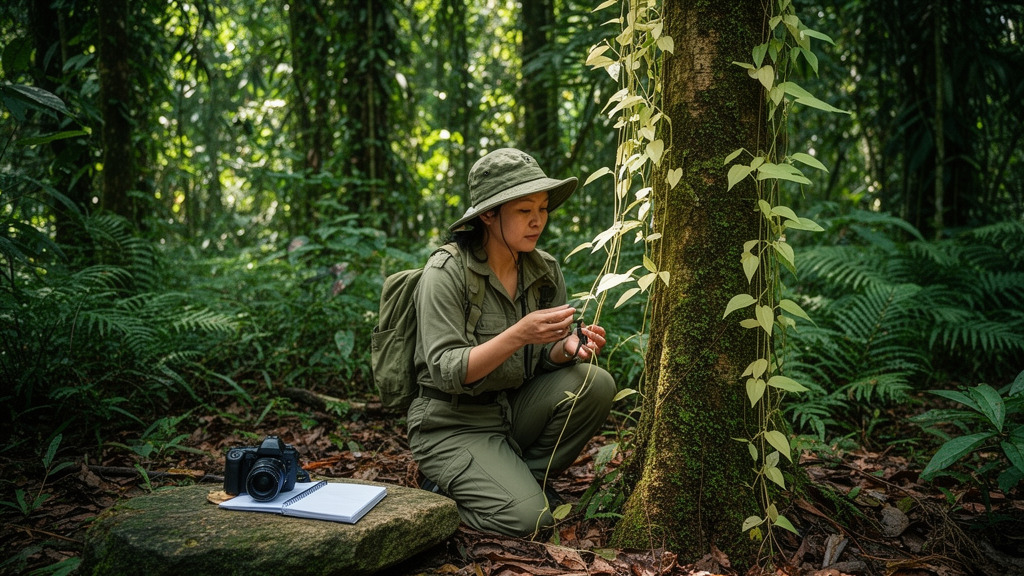
Botanists have described Vincetoxicum phucanhense, a new climbing species known only from Phu Canh Nature Reserve in Phu Tho Province, northern Vietnam. The taxonomic study, based on living and dried specimens, identifies the plant by a combination of floral, vegetative and fruit characters and raises the number of recognized Vincetoxicum species in Vietnam from 13 to 14.
The new species belongs to Apocynaceae and the subfamily Asclepiadoideae. Its authors, T.T.H. Nguyen and T.H. Bui, named it after the type locality. The holotype was collected at 20°54′7.33″N, 105°04′32.03″E, at an elevation of 900 m on 18 March 2026. The holotype and three isotypes are deposited at HN, with one isotype also held at VNM.
All morphological characters of the new species were observed from living and dried specimens, with preserved material at HN and VNM. Comparative specimens of other Vietnamese Vincetoxicum species were examined at the herbaria HN, P, TI and VNM. The authors assessed conservation status using International Union for Conservation of Nature guidelines.
Vincetoxicum phucanhense is a climber approximately 2 m long. Its stems bear pubescence in one or two rows and are about 1.4 mm in diameter, with internodes 25–57 mm long. The leaves are entire and glabrous on both surfaces. Petioles measure 3–8 mm, while the ovate-triangular blades measure 9–42 by 4–18 mm and have an acuminate tip and a rounded, obtuse or truncate base.
The extra-axillary inflorescences are simple to few-branched and umbelliform, with four to 11 flowers that open successively. Pedicels are 4.0–7.6 mm long, and the corolla measures 7.2–9.6 mm in diameter. It is pink to red outside and densely pubescent inside, with yellow-green toward the edges and pinkish red toward the center. The yellow pollinia are broadly elliptic and measure 0.18 by 0.11 mm.
The species also has elongated fruit and seed dimensions. Its glabrous, linear follicles measure 109–123 by 6–8 mm and diverge at angles of 20–30 degrees. The smooth brown seeds are ovate-lanceolate and measure 9.2–9.5 by 2.8–3.0 mm, with a white coma approximately 20.4–20.5 mm long.
The authors compared the specimens with three morphologically similar species: V. flexuosum, V. harmandii and V. tengii. Compared with V. flexuosum, the new species has shorter pedicels, 4.0–7.6 mm versus 14.0–16.0 mm; a larger corolla, 7.2–9.6 mm in diameter versus 4.0–6.0 mm; broadly elliptic rather than globose pollinia; longer fruits, 109–123 mm versus 40–80 mm; and longer seeds, 9.2–9.5 mm versus 6.0–8.0 mm.
Relative to V. harmandii, V. phucanhense has shorter petioles, 3–8 mm versus 10–20 mm; smaller leaves, 9–42 by 4–18 mm versus 45–75 by 25–45 mm; glabrous rather than hairy upper leaf surfaces; and a larger corolla, 7.2–9.6 mm in diameter versus 4–5 mm. From V. tengii, it differs in its larger corolla, 7.2–9.6 mm versus 5–7 mm; yellow, pink or red corolla rather than greenish; and broadly elliptic rather than globose pollinia.
The species is presently known only from Phu Canh Nature Reserve, where it grows in tropical forest on limestone. Many individuals were observed climbing through surrounding vegetation in dense forest on rugged, rocky montane terrain at approximately 900–950 m. Flowering and fruiting specimens were collected near the end of the dry season. The reserve receives more than 90% of its nearly 2,000 mm annual rainfall between April and October, with a dry season from November to March.
Because the species is known from only its type locality, occupies rugged terrain and has no immediate threats observed by the authors, its conservation status was assessed as Data Deficient under IUCN criteria. The study also presents an identification key for the 14 Vincetoxicum species recorded in Vietnam. The authors further note that a 2016 phylogenetic study included almost no representatives of the genera formerly recognized in Vietnam, apart from a few widely distributed Ischnostemma and Tylophora species, and state that further phylogenetic research using Vietnamese representatives is needed.
Subject of Research: Taxonomic description of a new Vincetoxicum species from Phu Canh Nature Reserve in Vietnam
Article Title: Vincetoxicum phucanhense ( Apocynaceae , Asclepiadoideae ), a new species from Vietnam
Article References: Nguyen, T. T. H., Le, N. H., Tran, D. B., Tran, T. B., & Bui, T. H. (2026). Vincetoxicum phucanhense (Apocynaceae, Asclepiadoideae), a new species from Vietnam. PhytoKeys, 279, 27-34. https://doi.org/10.3897/phytokeys.279.203612
Image Credits: AI Generated
DOI: 10.3897/phytokeys.279.203612
Keywords: Vincetoxicum phucanhense, new species, plant taxonomy, Apocynaceae, Asclepiadoideae, Vietnam, Phu Canh Nature Reserve, Phu Tho Province, limestone forest, conservation status, Vincetoxicum, phucanhense
Cite Scienmag News
Margaret Porter. (October 20, 2026). Botanists describe Vincetoxicum phucanhense, a new climbing species from Vietnam. Scienmag. https://scienmag.com/botanists-describe-vincetoxicum-phucanhense-a-new-climbing-species-from-vietnam/
Margaret Porter. "Botanists describe Vincetoxicum phucanhense, a new climbing species from Vietnam." Scienmag, 20 October 2026, https://scienmag.com/botanists-describe-vincetoxicum-phucanhense-a-new-climbing-species-from-vietnam/. Accessed 20 October 2026.
Margaret Porter. "Botanists describe Vincetoxicum phucanhense, a new climbing species from Vietnam." Scienmag. October 20, 2026. https://scienmag.com/botanists-describe-vincetoxicum-phucanhense-a-new-climbing-species-from-vietnam/


