


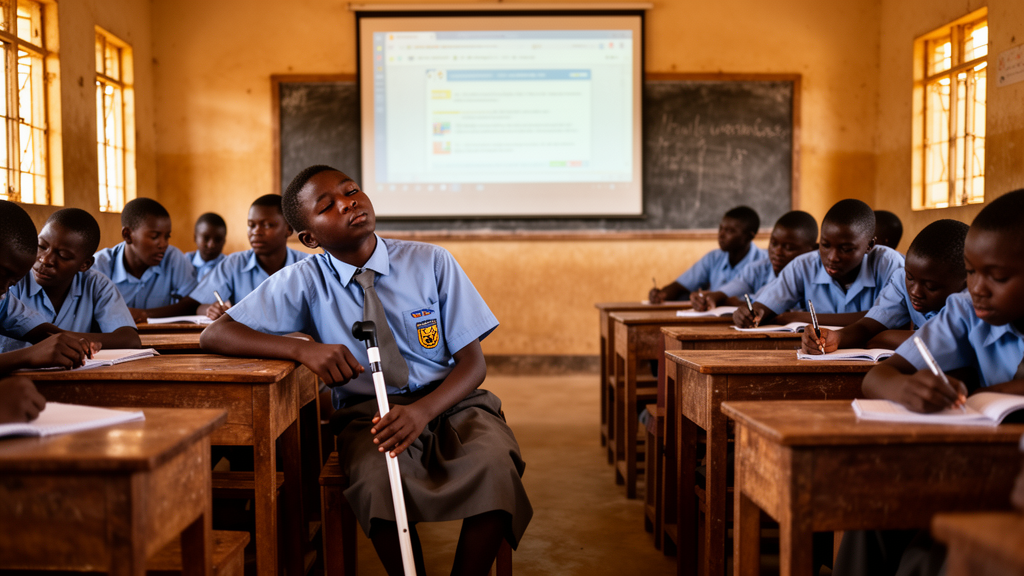
A qualitative single-case study at the Open University of Tanzania found that barriers to e-learning among undergraduate students and academic staff with visual impairments were interconnected and extended across teaching practices, institutional support, assessment rules, social attitudes and the timing of access to learning resources. The study was published in Discover Education on 14 September 2026.
Researchers interviewed 12 undergraduate students and four academic staff members with visual impairments about their experiences using the university’s Moodle learning management system, Zoom and other digital services. Students and lecturers described activities including downloading course materials, attending online classes, completing assignments and quizzes, accessing digital library resources and communicating with instructors. The university was purposively selected because of its extensive use of e-learning and enrolment of students with visual impairments.
The study used a qualitative descriptive design and semi-structured interviews lasting approximately 45 to 60 minutes. With participants’ permission, interviews were audio-recorded and transcribed verbatim. Researchers analysed the transcripts using Braun and Clarke’s six-phase thematic approach, supported by MAXQDA software. Coding proceeded through open, axial and selective stages before the findings were interpreted through Bronfenbrenner’s ecological systems theory.
Credibility was addressed through member checking and comparison of accounts across participant groups. Transcripts were returned to participants for validation, and a summary of emerging themes was shared with a subset for confirmation. The researchers also compared perspectives from students and lecturers and used structured software-assisted coding and constant comparison across transcripts.
At the microsystem level, participants described inaccessible course materials and teaching practices as sources of exclusion. Students reported difficulty obtaining materials from the university portal, poor formatting and limited alternatives such as audio or screen-reader-compatible text. Some relied on print copies obtained from previous students. Synchronous Zoom classes also created difficulty when lecturers relied heavily on visual slides without verbal explanation or post-lecture notes. Students sometimes reconstructed lessons by replaying audio recorded by peers, shifting the work of making content accessible from the institution to individual learners.
The mesosystem findings concerned limited coordination among lecturers, special-needs units, libraries and information and communication technology services. Lecturers reported little interaction with support units and uncertainty about institutional responsibilities. One lecturer with a visual impairment said they had not attended university-organised diversity or inclusion training during ten years of employment, despite teaching students with visual impairments. Another said the Special Needs Unit could not help with subject content involving projected drawings. The study associated these fragmented links with inconsistent support across courses and faculties.
At the exosystem level, institutional assessment policies and decisions shaped participation. Lecturers reported applying uniform assignments, assessment modes, examination times and deadlines regardless of disability status. The researchers argued that identical deadlines under inaccessible conditions may assess students’ capacity to overcome institutional barriers as well as their academic mastery. Assessment regulations, procurement decisions and fixed timelines influenced participation even though they were outside students’ and lecturers’ immediate control. At the macrosystem level, participants reported low formal disclosure of disability, while students linked this reluctance to stigmatisation within families and communities. The study interpreted non-disclosure as a response to an environment in which seeking support could carry personal or social costs.
The chronosystem analysis showed how delayed access accumulated over time. Participants described long-standing reliance on print-based systems and limited availability of audiobooks and Braille resources. Late submission of reading lists left disability units and libraries with insufficient time to convert materials into audio, Braille or screen-reader-compatible text. Across courses and semesters, these delays were associated with staggered access, academic fatigue and reduced academic momentum. The authors therefore treated accessibility as an ongoing institutional responsibility requiring early planning, including alignment with academic calendars, course design and procurement cycles.
The study recommends coordinated reforms based on its findings: mainstreaming Universal Design for Learning in course design, strengthening collaboration and accountability across institutional units, embedding accessibility in digital infrastructure and assessment policies, and addressing stigma within institutional culture. These are recommendations derived from one institution’s qualitative evidence, not demonstrations that the proposed measures have already improved participation or academic outcomes. The findings are also bounded by the small purposive sample, reliance on retrospective interview accounts and the absence of direct platform-usability testing or outcome measurement. The article contains inconsistencies about the number of participating faculties and the number of lecturers contacted, so its scope and generalisation should be interpreted cautiously. The research provides detailed evidence about the reported experiences at one university but does not establish the prevalence of the barriers across Tanzanian universities or determine their causal effects.
Subject of Research: Accessibility of e-learning for university students and staff with visual impairments in Tanzania
Article Title: Accessibility of e-learning platforms for lecturers and students with visual impairments in Tanzania’s university systems
Article References: Ngalomba, S. P. (2026). Accessibility of e-learning platforms for lecturers and students with visual impairments in Tanzania’s university systems. Discover Education, 5(1), Article 914. https://doi.org/10.1007/s44217-026-02144-y
Image Credits: AI Generated
DOI: 10.1007/s44217-026-02144-y
Keywords: e-learning accessibility, visual impairment, Tanzania, higher education, Moodle, assistive technology, inclusive education, qualitative study, student support, Accessibility, e-learning, platforms
Cite Scienmag News
Courtney Benton. (October 20, 2026). Qualitative study identifies interconnected barriers to accessible e-learning in Tanzanian university. Scienmag. https://scienmag.com/qualitative-study-identifies-interconnected-barriers-to-accessible-e-learning-in-tanzanian-university/
Courtney Benton. "Qualitative study identifies interconnected barriers to accessible e-learning in Tanzanian university." Scienmag, 20 October 2026, https://scienmag.com/qualitative-study-identifies-interconnected-barriers-to-accessible-e-learning-in-tanzanian-university/. Accessed 20 October 2026.
Courtney Benton. "Qualitative study identifies interconnected barriers to accessible e-learning in Tanzanian university." Scienmag. October 20, 2026. https://scienmag.com/qualitative-study-identifies-interconnected-barriers-to-accessible-e-learning-in-tanzanian-university/


