


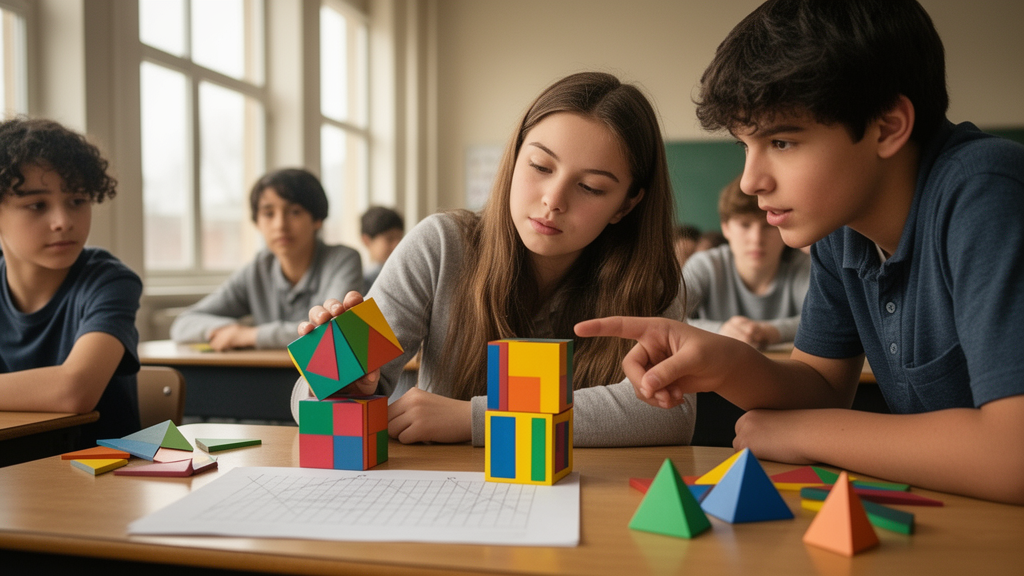
A 2026 correlational study of 95 junior high school students found that mathematics beliefs and metacognitive awareness were each positively associated with spatial reasoning performance and, together, accounted for about 31.4% of the variation in test scores. The study was conducted at one public school in Padang City, West Sumatra, Indonesia, so the findings cannot establish causation or be assumed to apply broadly to other schools or countries.
Researchers administered a spatial reasoning test to students aged 12 to 14. The test assessed spatial visualisation, spatial orientation and mental rotation, with each answer scored from 0 to 3. Students achieved a mean score of 7.34, with a standard deviation of 1.76. Based on the study’s classification criteria, 74.74% of students were in the medium spatial reasoning category, 9.47% were in the high category and 15.79% were in the low category.
Beliefs and metacognitive awareness were measured separately through questionnaires. The belief instrument was based on three domains: beliefs about mathematics, beliefs about oneself as a mathematics learner, and beliefs about the social context of mathematics learning. The metacognitive questionnaire addressed knowledge and regulation, including planning, information management, monitoring, debugging and evaluation. Responses were converted to scores from 1 to 4 and averaged for each student.
Two mathematics-education experts assessed the instruments’ content validity. Item-level Pearson correlations ranged from 0.785 to 0.892 for the spatial reasoning test and from 0.375 to 0.937 for the belief and metacognitive questionnaires. Cronbach’s alpha values were 0.882 for the spatial test, 0.949 for the belief questionnaire and 0.843 for the metacognition questionnaire. A pilot study involving 30 students from comparable schools preceded data collection.
Questionnaire results showed high reported confidence in mathematics learning: 52.63% of students were classified as very confident and 46.32% as confident, while 1.05% were not very confident and none were classified as not confident. For metacognition, 74.74% of students were classified as reflective, 24.21% as strategic, 1.05% as conscious and none as tacit. These self-reported categories indicate that students generally perceived themselves as confident and able to monitor their thinking, although questionnaire responses may be affected by social desirability bias.
Multiple linear regression showed that the combined model was statistically significant, with F = 21.13 and p < 0.001. Beliefs were positively associated with spatial reasoning after accounting for metacognition (β = 0.103, p = 0.023), as was metacognitive awareness (β = 0.167, p = 0.006). The larger metacognition coefficient indicates stronger statistical predictive power in this sample, but neither result demonstrates that changing beliefs or metacognition would directly cause an improvement in spatial reasoning.
The reported explained variance differs slightly across sections of the article. The abstract gives R² = 0.315, or 31.5%, while the results and conclusion give R² = 0.314, or 31.4%. The results also report R = 0.561; this is the multiple correlation for the model, not a correlation coefficient between any single pair of variables. On the results-and-conclusion value, the model accounted for 31.4% of the observed variation in spatial reasoning, leaving 68.6% associated with factors not included in the analysis.
The study was framed within Education 5.0, an approach that places human cognitive, social and emotional development at the centre while using technology to support learning. The authors discuss visual and digital resources such as Augmented Reality, three-dimensional simulations and interactive geometry software. They also describe belief-strengthening activities, metacognitive reflection, self-assessment, peer evaluation and opportunities to revise work after feedback as possible elements of learning design. These are proposed applications of the findings, not interventions tested in this study.
Important limitations include the purposive sample of 95 students from a single public school, the correlational design and the modest amount of variance accounted for by the model. Potential influences omitted from the regression include working-memory capacity, spatial experiences outside school, teacher instruction and previous geometry achievement. The direction of the relationships may also be reciprocal: stronger spatial reasoning could support more positive beliefs and metacognitive reports rather than the reverse. The authors recommend replication with larger and more geographically diverse samples, experimental or quasi-experimental intervention studies, longitudinal research and mixed-methods investigations of the processes behind the statistical associations.
Subject of Research: Correlational analysis of mathematics beliefs, metacognitive awareness and spatial reasoning among Indonesian junior high school students
Article Title: How beliefs and metacognitive awareness influence junior high students’ spatial reasoning ability for education 5.0
Article References: Hafizatunnisa, Fauzan, A., Candra, O., & Harisman, Y. (2026). How beliefs and metacognitive awareness influence junior high students’ spatial reasoning ability for education 5.0. Discover Education, 5(1), Article 926. https://doi.org/10.1007/s44217-026-02008-5
Image Credits: AI Generated
DOI: 10.1007/s44217-026-02008-5
Keywords: spatial reasoning, metacognition, mathematics beliefs, junior high students, Indonesia, multiple regression, mathematics education, Education 5.0, beliefs, metacognitive, awareness, influence
Cite Scienmag News
Reid Dalton. (October 20, 2026). Correlational study links mathematics beliefs and metacognition with spatial reasoning in 95 Indonesian junior high students. Scienmag. https://scienmag.com/correlational-study-links-mathematics-beliefs-and-metacognition-with-spatial-reasoning-in-95-indonesian-junior-high-students/
Reid Dalton. "Correlational study links mathematics beliefs and metacognition with spatial reasoning in 95 Indonesian junior high students." Scienmag, 20 October 2026, https://scienmag.com/correlational-study-links-mathematics-beliefs-and-metacognition-with-spatial-reasoning-in-95-indonesian-junior-high-students/. Accessed 20 October 2026.
Reid Dalton. "Correlational study links mathematics beliefs and metacognition with spatial reasoning in 95 Indonesian junior high students." Scienmag. October 20, 2026. https://scienmag.com/correlational-study-links-mathematics-beliefs-and-metacognition-with-spatial-reasoning-in-95-indonesian-junior-high-students/


